. 2019 Nov 25;374(1786):20190086.
doi: 10.1098/rstb.2019.0086. Epub 2019 Oct 7.

Targeted metagenomic recovery of four divergent viruses reveals shared and distinctive characteristics of giant viruses of marine eukaryotes

Affiliations

Targeted metagenomic recovery of four divergent viruses reveals shared and distinctive characteristics of giant viruses of marine eukaryotes

David M Needham et al. Philos Trans R Soc Lond B Biol Sci. .

Abstract

Giant viruses have remarkable genomic repertoires-blurring the line with cellular life-and act as top-down controls of eukaryotic plankton. However, to date only six cultured giant virus genomes are available from the pelagic ocean. We used at-sea flow cytometry with staining and sorting designed to target wild predatory eukaryotes, followed by DNA sequencing and assembly, to recover novel giant viruses from the Pacific Ocean. We retrieved four 'PacV' partial genomes that range from 421 to 1605 Kb, with 13 contigs on average, including the largest marine viral genomic assembly reported to date. Phylogenetic analyses indicate that three of the new viruses span a clade with deep-branching members of giant Mimiviridae, incorporating the Cafeteria roenbergensis virus, the uncultivated terrestrial Faunusvirus, one PacV from a choanoflagellate and two PacV with unclear hosts. The fourth virus, oPacV-421, is phylogenetically related to viruses that infect haptophyte algae. About half the predicted proteins in each PacV have no matches in NCBI nr (e-value < 10-5), totalling 1735 previously unknown proteins; the closest affiliations of the other proteins were evenly distributed across eukaryotes, prokaryotes and viruses of eukaryotes. The PacVs encode many translational proteins and two encode eukaryotic-like proteins from the Rh family of the ammonium transporter superfamily, likely influencing the uptake of nitrogen during infection. cPacV-1605 encodes a microbial viral rhodopsin (VirR) and the biosynthesis pathway for the required chromophore, the second finding of a choanoflagellate-associated virus that encodes these genes. In co-collected metatranscriptomes, 85% of cPacV-1605 genes were expressed, with capsids, heat shock proteins and proteases among the most highly expressed. Based on orthologue presence-absence patterns across the PacVs and other eukaryotic viruses, we posit the observed viral groupings are connected to host lifestyles as heterotrophs or phototrophs. This article is part of a discussion meeting issue 'Single cell ecology'.

Keywords: Mimiviridae; uncultivated giant viruses; virus–host mutualism.


Conflict of interest statement

We declare we have no competing interests.

Figures
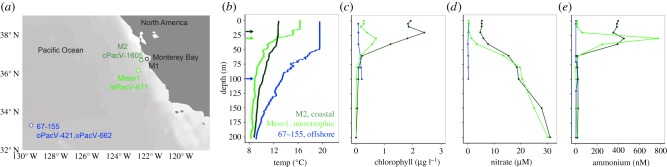
Figure 1.
Figure 1.
Sites of sorting in distinct ecological zones of the eastern North Pacific Ocean. (a) Location of cell sorting experiments, as well as one station where a sample for metatranscriptomics was collected (M1). Depth profiles of (b) temperature, (c) chlorophyll concentration, (d) nitrate concentration and (e) ammonium concentration at Stations 67-155 (oligotrophic, blue), Meso1 (mesotrophic, light green) and M2 (coastal, dark green). The arrows indicate the depth from which water was collected for flow cytometric sorting, specifically, the deep chlorophyll maximum for 67-155 (100 m, see electronic supplementary material, figure S1a for in vivo fluorescence profile) and at the sub-surface maxima for Meso1 (30 m) and M2 (20 m). Note, 67-155 data in (b), (c) and (d) are from a CTD cast executed 8 h prior to the cast on which sorting was performed. Additionally, ammonium concentrations at 67-155 (e) were measured from a CTD cast collected 25.5 h prior to sorting. Electronic supplementary material, figure S1e,f provides additional data on temperature and salinity for the cast on which cell sorting was performed, which exhibited highly similar conditions to casts depicted in the above panels.
Figure 2.
Figure 2.
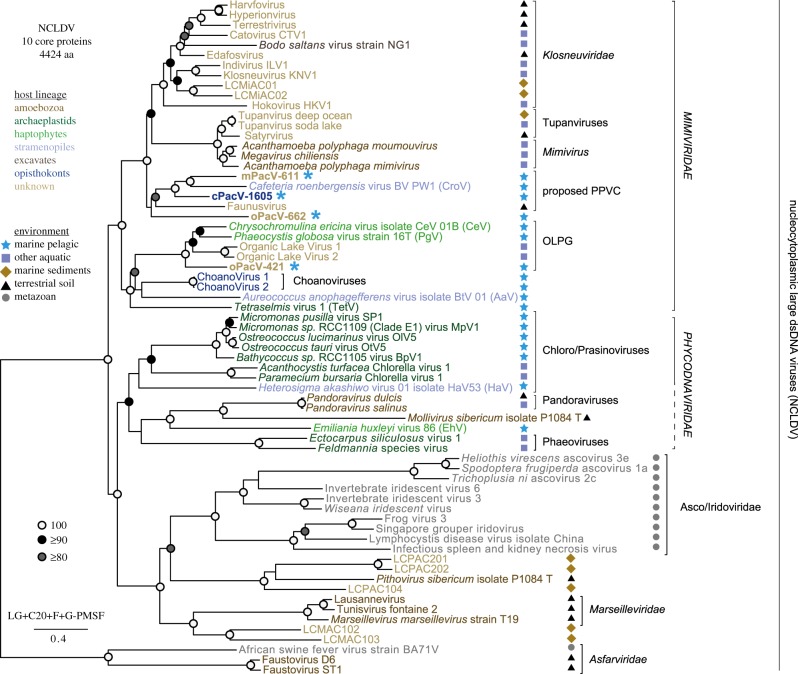
Maximum-likelihood phylogenomic reconstruction of NCLDV based on 10 putatively vertically inherited proteins. Support is indicated when greater than 80% (500 bootstrap replicates). The scale bar and the number beneath it indicate the estimated number of substitutions per site and the model for tree reconstruction is provided. Abbreviated names used in the manuscript for cultured marine pelagic viruses are shown in parentheses: Cafeteria roenbergensis virus BV PW1 (CroV), Heterosigma akashiwo virus 01 isolate HaV53 (HaV), Phaeocystis globosa virus strain 16T (PgV), Chrysochromulina ericina virus isolate CeV 01B (CeV), Aureococcus anophagefferens virus isolate BtV 01 (AaV) and Emiliania huxleyi virus 86 (EhV). Note that viral naming conventions are currently an active area of research and discussion, for example one recent proposed taxonomy suggested that the shared ancestry and common traits of the nucleocytoplasmic large DNA virus (NCLDV) group justified renaming these viruses as a formal order called ‘Megavirales’ [1]. Additionally, there was a proposal that the Mimiviridae groups be reclassified into proposed subfamilies, Megamimivirinae and Mesomimivirinae (the latter mostly being giant algal viruses and CroV) [105]. Note that the proposed Mesomimivirinae was split by our 10-gene phylogeny. Because these groups have not yet been approved by the International Committee on the Taxonomy of Viruses (ICTV) they have not been used herein. We simply refer to the previously unrecognized clade that brings together CroV, Faunusvirus, mPacV-611 and cPacV-1605, as being the predatory protist viral clade (PPVC), until viral classification conventions can be resolved. OLPG, Organic Lake Phycodnaviridae group.
Figure 3.
Figure 3.
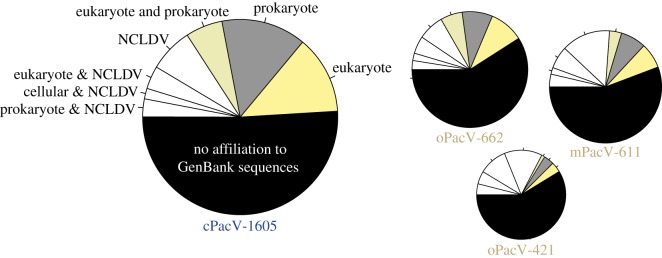
Summarized taxonomic affiliation of predicted proteins in the four novel giant NCLDV. Taxonomic affiliations to prokaryotes (combining archaea and bacteria), eukaryotes or NCLDV were determined based on the top ten DIAMOND blastp hits (e-value < e−5). If among these top ten there were hits to more than one lineage, it was categorized accordingly. Pie chart area is proportional to recovered genome size.
Figure 4.
Figure 4.
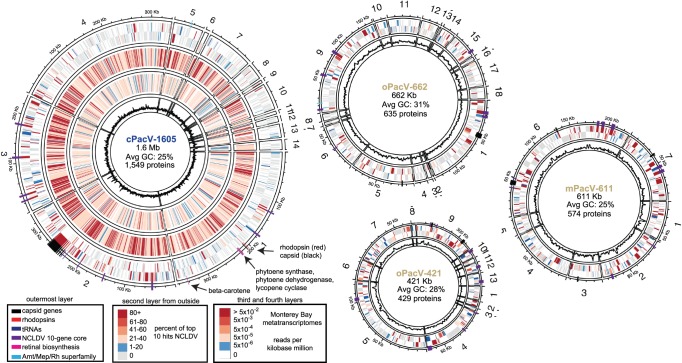
Genomic visualization of the novel giant NCLDV viruses. The outermost coloured layer (intersecting with contig map) shows the location of the notable genes indicated in the legend. The second layer shows the predicted proteins of each virus according to the coding strand; the colour represents the percent of the top 10 NCBI nr matches that were best hits to other NCLDV viruses. For virus cPacV-1605, the third and fourth layers show the reads per Kb million of each predicted gene that were recovered from metatranscriptomes collected at the time of sampling and one month prior at an ocean location approximately 30 km away (M1, figure 1a). The innermost layer in each figure shows a 1 Kb moving average of GC-content, where the scale is set from 0% to 60% GC-content. Contigs that are less than 5 Kb in length (three and four for oPacV-421 and oPacV-662) are marked with a dash.
Figure 5.
Figure 5.
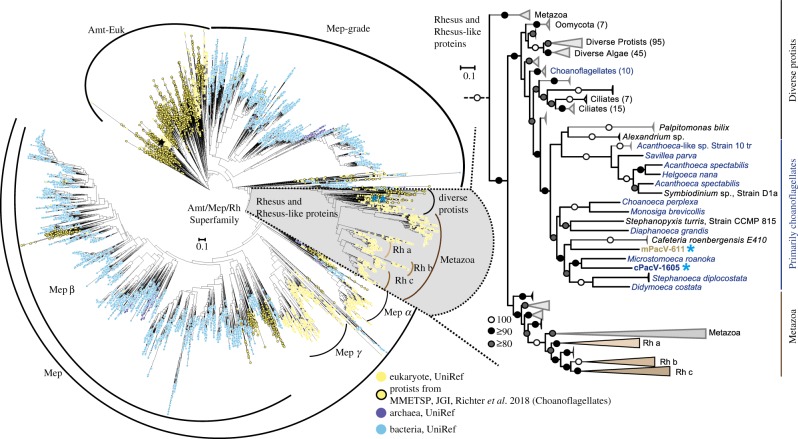
Phylogenetic analysis of the Amt/MEP/Rh superfamily. (a) Phylogenetic reconstruction of 17 339 proteins predicted to have a domain matching PF00909, Amt/Mep/superfamily. As described in §2, the taxon selection is the same as that from [83], supplemented with proteins from 19 choanoflagellates [65]. The total number of amino acid positions analysed was 374. (b) Amt/MEP/Rh superfamily reconstruction restricted to the Rh protein family, which includes mostly proteins from animals and diverse protists. The phylogeny includes 1,532 sequences and 362 positions.
Figure 6.
Figure 6.
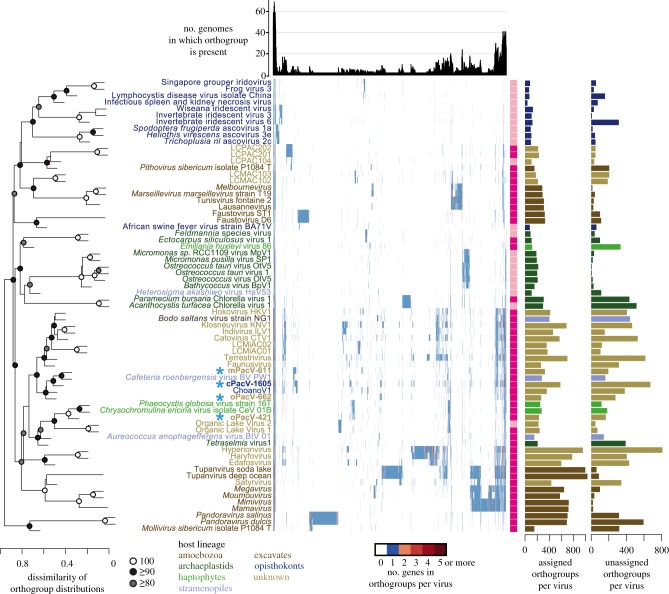
Orthogroup patterns for proteins of PacVs and a broad array of representative NCLDV having sequenced genomes. Hierarchical clustering is based on the presence or absence of all orthogroups by pvclust with 500 bootstraps from the ‘approximately unbiased’ method [69]. The histogram above the heatmap shows the number of genomes in which an orthogroup was found. The light pink and dark pink bars indicate whether or not a particular virus is categorized as a ‘giant’ virus (i.e. genome size greater than 300 Kb). The bar charts at the right indicate the sum of orthogroup proteins found for a given virus and the number of proteins that were not shared with any of the viruses analysed.
Figure 7.
Figure 7.
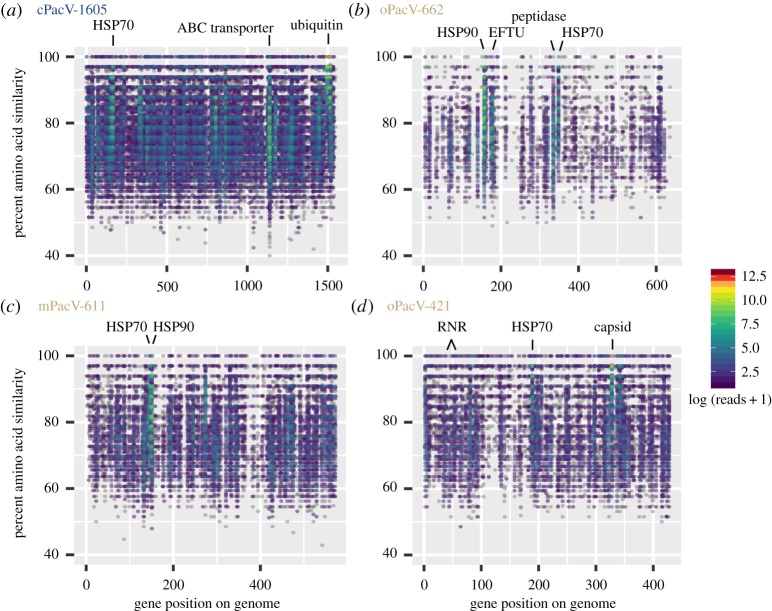
Detection of viral gene expression in metatranscriptomes from other regions. (ad) Read recruitment by blastx of Tara Oceans metatranscriptome reads to PacV predicted proteins. Only reads that were a best-hit (and bit-score greater than 50) to a given viral genome compared with a representative set of NCLDV (electronic supplementary material, table S3 and figure S11) and all of NCBI nr are shown. Reads are plotted on a gene-by-gene basis, and reads to each gene were summed across 84 Tara metatranscriptomes. Gene order is the same as shown in figure 4. Abbreviations: EFTU, elongation factor thermo unstable; RNR, ribonucleotide reductase; HSP, heat shock protein.

References

    1. Colson P, et al. 2013. ‘Megavirales’, a proposed new order for eukaryotic nucleocytoplasmic large DNA viruses. Arch. Virol. 158, 2517–2521. ( 10.1007/s00705-013-1768-6) - DOI - PMC - PubMed
    1. Claverie J-M, Abergel C. 2016. Giant viruses: the difficult breaking of multiple epistemological barriers. Stud. Hist. Philos. Sci. Part C Stud. Hist. Philos. Biol. Biomed. Sci. 59, 89–99. ( 10.1016/j.shpsc.2016.02.015) - DOI - PubMed
    1. Abergel C, Legendre M, Claverie J-M. 2015. The rapidly expanding universe of giant viruses: Mimivirus, Pandoravirus, Pithovirus and Mollivirus. FEMS Microbiol. Rev. 39, 779–796. ( 10.1093/femsre/fuv037) - DOI - PubMed
    1. Forterre P, Prangishvili D. 2009. The great billion-year war between ribosome- and capsid-encoding organisms (cells and viruses) as the major source of evolutionary novelties. Ann. N. Y. Acad. Sci. 1178, 65–77. ( 10.1111/j.1749-6632.2009.04993.x) - DOI - PubMed
    1. Schulz F, et al. 2017. Giant viruses with an expanded complement of translation system components. Science 356, 82–85. ( 10.1126/science.aal4657) - DOI - PubMed

Publication types