The Use of Alcohol, Tobacco, Illegal Drugs and Medicines: An Estimate of Consumption and Substance-Related Disorders in Germany
- PMID: 31587705
- PMCID: PMC6804269
- DOI: 10.3238/arztebl.2019.0577
The Use of Alcohol, Tobacco, Illegal Drugs and Medicines: An Estimate of Consumption and Substance-Related Disorders in Germany
Abstract
Background: Prevalence estimates of the use of tobacco, alcohol, illegal drugs, and psychoactive medications and of substance-related disorders enable an assessment of the effects of substance use on health and society.
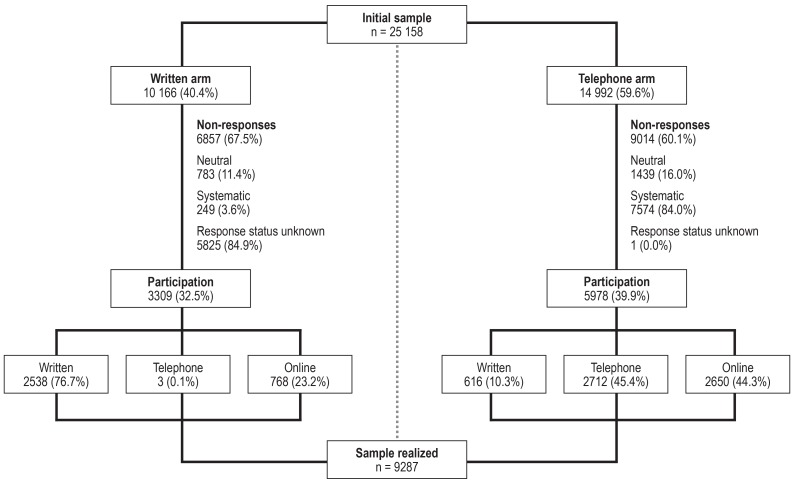
Methods: The data used for this study were derived from the 2018 Epidemiological Survey of Substance Abuse (Epidemiologischer Suchtsurvey, ESA). The sample of the German adult population comprised 9267 persons aged 18 to 64 (response rate, 42%). Population estimates were obtained by extrapolation to a total resident population of 51 544 494 people.
Results: In the 30 days prior to the survey, 71.6% of the respondents (correspond- ing to 36.9 million persons in the population) had consumed alcohol, and 28.0% (14.4 million) had consumed tobacco. 4.0% reported having used e-cigarettes, and 0.8% reported having used heat-not-burn products. Among illegal drugs, cannabis was the most commonly used, with a 12-month prevalence of 7.1% (3.7 million), followed by amphetamines (1.2%; 619 000). The prevalence of the use of anal- gesics without a prescription (31.4%) was markedly higher than that of the use of prescribed analgesics (17.5%, 26.0 million); however, analgesics were taken daily less commonly than other types of medication. 13.5% of the sample (7.0 million) had at least one dependence diagnosis (12-month prevalence).
Conclusion: Substance use and the consumption of psychoactive medications are widespread in the German population. Substance-related disorders are a major burden to society, with legal substances causing greater burden than illegal substances.
Figures
References
-
- GBD 2017 Risk Factors Collaborators. Global, regional, and national comparative risk assessment of 84 behavioural, environmental and occupational, and metabolic risks or clusters of risks for 195 countries and territories, 1990-2017: a systematic analysis for the Global Burden of Disease Study 2017. Lancet. 2018;392:1923–1994. - PMC - PubMed
-
- GBD 2015 Risk Factors Collaborators. Global, regional, and national comparative risk assessment of 79 behavioural, environmental and occupational, and metabolic risks or clusters of risks, 1990-2015: a systematic analysis for the global burden of disease study 2015. Lancet. 2016;388:1659–1724. - PMC - PubMed
-
- Peacock A, Leung J, Larney S, et al. Global statistics on alcohol, tobacco and illicit drug use: 2017 status report. Addiction. 2018;113:1905–1926. - PubMed
-
- World Health Organization. WHO Press. Geneva: 1998. Guidelines for controlling and monitoring the tobacco epidemic.
-
- Burger M, Bronstrup A, Pietrzik K. Derivation of tolerable upper alcohol intake levels in Germany: a systematic review of risks and benefits of moderate alcohol consumption. Prev Med. 2004;39:111–127. - PubMed