. 2019 Sep 30;14(9):933-945.
doi: 10.1093/scan/nsz072.

A resting-state network comparison of combat-related PTSD with combat-exposed and civilian controls

Affiliations

A resting-state network comparison of combat-related PTSD with combat-exposed and civilian controls

Thomas J Vanasse et al. Soc Cogn Affect Neurosci. .

Abstract

Resting-state functional connectivity (rsFC) is an emerging means of understanding the neurobiology of combat-related post-traumatic stress disorder (PTSD). However, most rsFC studies to date have limited focus to cognitively related intrinsic connectivity networks (ICNs), have not applied data-driven methodologies or have disregarded the effect of combat exposure. In this study, we predicted that group independent component analysis (GICA) would reveal group-wise differences in rsFC across 50 active duty service members with PTSD, 28 combat-exposed controls (CEC), and 25 civilian controls without trauma exposure (CC). Intranetwork connectivity differences were identified across 11 ICNs, yet combat-exposed groups were indistinguishable in PTSD vs CEC contrasts. Both PTSD and CEC demonstrated anatomically diffuse differences in the Auditory Vigilance and Sensorimotor networks compared to CC. However, intranetwork connectivity in a subset of three regions was associated with PTSD symptom severity among executive (left insula; ventral anterior cingulate) and right Fronto-Parietal (perigenual cingulate) networks. Furthermore, we found that increased temporal synchronization among visuospatial and sensorimotor networks was associated with worse avoidance symptoms in PTSD. Longitudinal neuroimaging studies in combat-exposed cohorts can further parse PTSD-related, combat stress-related or adaptive rsFC changes ensuing from combat.

Keywords: PTSD; combat; military; resting-state; stress.


Figures

Fig. 1
Fig. 1
Group ICA components. Thirteen group-level, non-artifactual intrinsic connectivity networks (ICNs). Group independent component analysis (GICA) (d = 20) was applied to all 103 subjects. Each group ICN is thresholded at z > 3 and is shown with its network name. ICNs are ordered left to right and top to bottom in order of explained variance.
Fig. 2
Fig. 2
SDR patterns. (A) Ten (of 41) selected significant discriminatory regions (SDRs; red) extracted from voxel-wise, 2-sample t-tests of intrinsic connectivity network (ICN) spatial maps across groups (PTSD vs CC, PTSD vs CEC and CEC vs CC). SDR M-N (e.g. SDR 1–2) corresponds to the Mth ICN (ordered by explained variance) and the Nth SDR (arbitrarily ordered) within the Mth ICN. Violin & boxplots show the mean SDR z-score distribution per group, which represents connectivity within that ICN. The green overlay is the positive t-stat images for each ICN, masked at Bonferroni-corrected P = 0.05. CC indicates civilian controls; CEC, combat-exposed controls; PTSD, posttraumatic stress disorder. (B) Conjunction image of all 41 SDR masks.
Fig. 3
Fig. 3
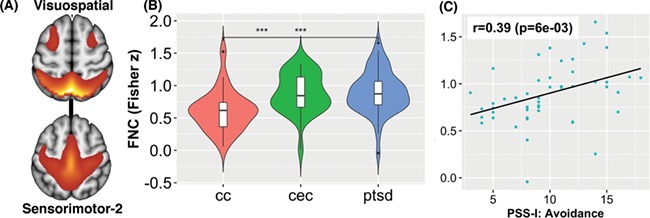
Functional network connectivity (FNC). A significant FNC network pair that included (A) the Sensorimotor-2/Visuospatial networks: (B) F2,100 = 7.57 (P = 0.049, corrected). Post hoc t tests found significant group differences in PTSD vs CC and CEC vs CC, but not PTSD vs CEC. (C) FNC within the PTSD group showed significant correlation with avoidance symptoms.
Fig. 4
Fig. 4
Connectivity correlations with inventories. (A–C) Spearman rho correlations (P < 0.01) of mean z-scores within a significant discriminatory region (SDR) with PTSD checklist (PCL) scores among combined combat-exposed controls (CECs) and posttraumatic stress disorder (PTSD) cohorts. Green dots correspond to CEC; teal dots correspond to PTSD; large blue dots correspond to the mean z-score of CC. (D) Pearson correlation (P < 0.01) of the PTSD Symptom Scale—Interview (PSS-I) symptom cluster score (avoidance, arousal, or reexperiencing) and mean z-score within the PTSD cohort only. BA indicates Brodmann area. *SDR 1–1 correlation exceeded the tested significance threshold (P > 0.01) after adjustment for age, gender and IQ (P = 0.029).
Fig. 5
Fig. 5
Intranetwork connectivity patterns. Spider plot displaying the number of significant discriminatory regions (SDRs) identified for each intrinsic connectivity network (ICN) derived from 2-sample t-tests of ICN spatial maps across three pairs of groups (posttraumatic stress disorder (PTSD) vs combat-exposed controls (CECs), posttraumatic stress disorder vs civilian controls (CC) and combat-exposed controls vs civilian controls); 41 SDRs were identified in total. Lines show all SDRs; dots show only SDRs that survive correction for multiple comparisons across 13 components. Group differences according to the SDR pattern within each SDR are color-coded. Numerical labels 2–8 indicate the number of SDRs identified per ICN. Of note, no significant (corrected or uncorrected) PTSD vs CEC patterns were identified (green dot). PCL—cluster-level P value.

References

    1. R Core Team , 2016. R: A Language and Environment for Statistical Computing.
    1. American Psychiatric Association (2013). Diagnostic and Statistical Manual of Mental Disorders (DSM-5®), American Psychiatric Publishing.
    1. American Psychiatric Association, Staff, A.P.A (2010). Diagnostic and Statistical Manual of Mental Disorders, Fourth Edition, Text Revision (DSM-IV-TR®), American Psychiatric Association Publishing.
    1. Ashley C Chen A.E. (2013). Hippocampal network connectivity and activation differentiates post-traumatic stress disorder from generalized anxiety disorder. Neuropsychopharmacology, 38, 1889–98. doi: 10.1038/npp.2013.122. - DOI - PMC - PubMed
    1. Aupperle R.L., Melrose A.J., Stein M.B., Paulus M.P. (2012). Executive function and PTSD: disengaging from trauma. Neuropharmacology, 62, 686–94. doi: 10.1016/j.neuropharm.2011.02.008. - DOI - PMC - PubMed

Publication types