


Reversible lesion in the splenium of the corpus callosum
- PMID: 31588684
- PMCID: PMC6851813
- DOI: 10.1002/brb3.1440
Reversible lesion in the splenium of the corpus callosum
Abstract
Aim of review: The presence of isolated, reversible lesions in the splenium of the corpus callosum (SCC) is essential to confirm the diagnosis of mild encephalitis/encephalopathy. The lesions usually heal within a month after the onset of neurological symptoms. Magnetic resonance imaging (MRI) has increasingly been used as a diagnostic tool, which has led to the publication of an increasing number of case reports. These have highlighted some inconsistencies about encephalitis/encephalopathy. First, the condition is not always mild and may be severe. Second, reversible lesions in the SCC have been identified in various diseases and conditions other than viral encephalitis/encephalopathy. Third, lesions in SCC are not always completely reversible. On this note, this review describes the specific clinical and radiological features of encephalitis/encephalopathy.
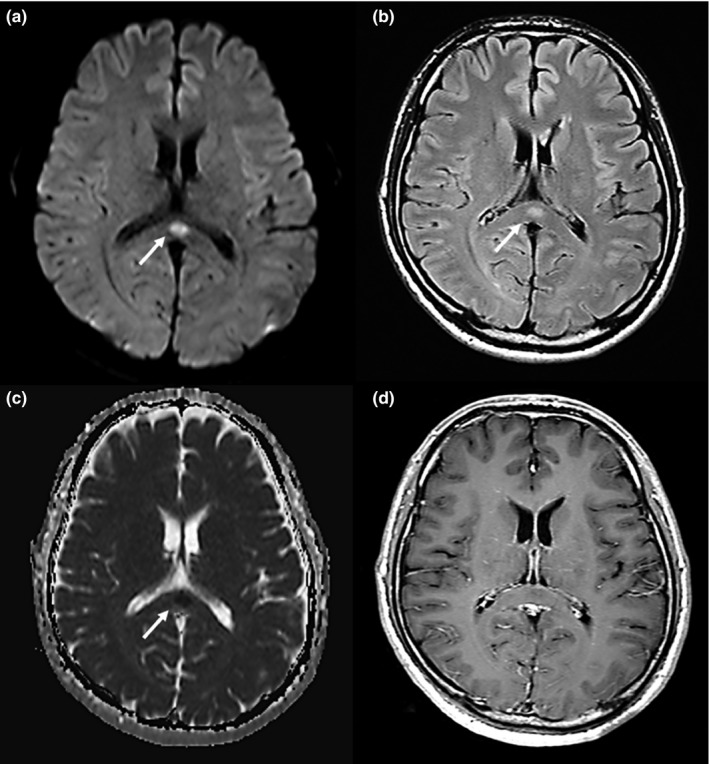
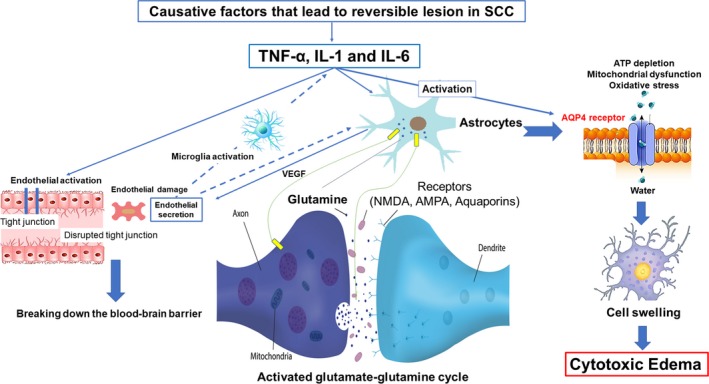
Findings: The reversible lesion in SCC is an MRI finding observable in a wide variety of diseases and conditions. Thus, it should be considered as a secondary change rather than a peculiar feature associated with mild encephalitis/encephalopathy. If reversible lesions are present in the SCC, the symptoms and prognosis are not necessarily favorable, with manifestations of encephalitis/encephalopathy varying from absent to severe. Neuroradiological features that appear as isolated high-intensity signals on diffusion-weighted images and a decreased apparent diffusion coefficient of the lesion might indicate a diagnosis of cytotoxic edema. Findings of previous studies suggest that cytokine-mediated cytotoxic edema of the SCC may be an important pathophysiological manifestation of this condition.
Conclusion: The reversible lesions in the SCC found on MRI are not exclusive to encephalitis/encephalopathy but may be secondary to other disorders.
Keywords: apparent diffusion coefficient; cytokine; cytotoxic edema; reversible; splenium of the corpus callosum.
© 2019 The Authors. Brain and Behavior published by Wiley Periodicals, Inc.
Conflict of interest statement
The author declares no conflict of interest.
Figures
References
-
- Avcu, G. , Kilinc, M. A. , Eraslan, C. , Karapinar, B. , & Vardar, F. (2017). Mild encephalitis/encephalopathy with reversible splenial lesion (MERS) associated with Streptococcus pneumoniae bacteraemia. Journal of Infection and Public Health, 10(4), 479–482. 10.1016/j.jiph.2016.08.019 - DOI - PMC - PubMed
Publication types
MeSH terms
Substances
LinkOut - more resources
Full Text Sources
Medical
Research Materials
