


Use of a Web-Based Dietary Assessment Tool (RiksmatenFlex) in Swedish Adolescents: Comparison and Validation Study
- PMID: 31588902
- PMCID: PMC6914230
- DOI: 10.2196/12572
Use of a Web-Based Dietary Assessment Tool (RiksmatenFlex) in Swedish Adolescents: Comparison and Validation Study
Abstract
Background: A Web-based dietary assessment tool-RiksmatenFlex-was developed for the national dietary survey of adolescents in Sweden.
Objective: This study aimed to describe the Web-based method RiksmatenFlex and to test the validity of the reported dietary intake by comparing dietary intake with 24-hour dietary recalls (recall interviews), estimated energy expenditure, and biomarkers.
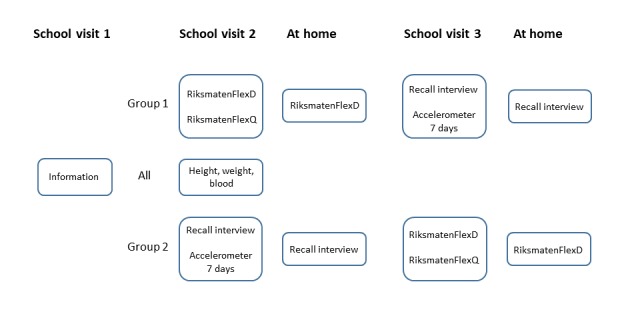
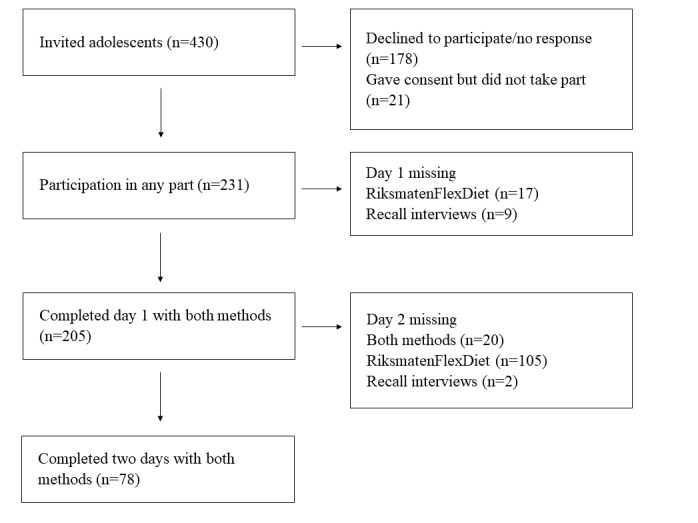
Methods: Adolescents aged 11-12, 14-15, and 17-18 years were recruited through schools. In total, 78 students had complete dietary information and were included in the study. Diet was reported a few weeks apart with either RiksmatenFlexDiet (the day before and a random later day) or recall interviews (face-to-face, a random day later by phone) in a cross-over, randomized design. At a school visit, weight and height were measured and blood samples were drawn for biomarker analyses. Students wore an accelerometer for 7 days for physical activity measurements. Dietary intake captured by both dietary methods was compared, and energy intake captured by both methods was compared with the accelerometer-estimated energy expenditure (EEest). Intake of whole grain wheat and rye and fruit and vegetables by both methods was compared with alkylresorcinol and carotenoid concentrations in plasma, respectively.
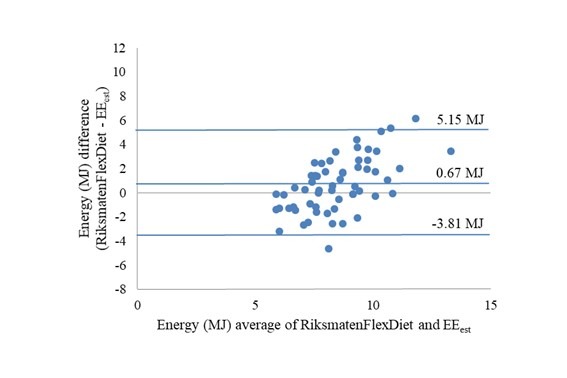
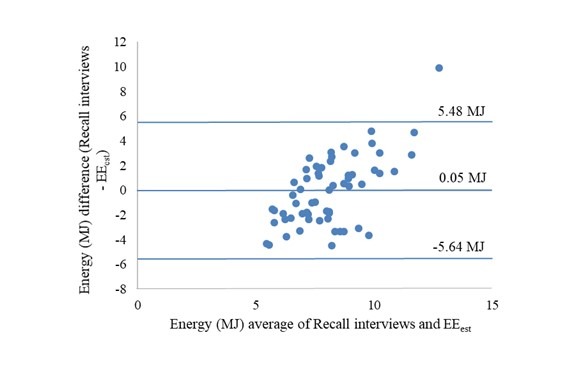
Results: The mean of the reported energy intake was 8.92 (SD 2.77) MJ by RiksmatenFlexDiet and 8.04 (SD 2.67) MJ by the recall interviews (P=.01). Intake of fruit and vegetables was 224 (169) g and 227 (150) g, and whole grain wheat and rye intake was 12.4 (SD 13.2) g and 12.0 (SD 13.1) g, respectively; the intakes of fruit and vegetables as well as whole grain wheat and rye did not differ between methods. Intraclass correlation coefficients ranged from 0.57 for protein and carbohydrates to 0.23 for vegetables. Energy intake by RiksmatenFlexDiet was overreported by 8% (P=.03) but not by the recall interviews (P=.53) compared with EEest. The Spearman correlation coefficient between reported energy intake and EEest was 0.34 (P=.008) for RiksmatenFlexDiet and 0.16 (P=.21) for the recall interviews. Spearman correlation coefficient between whole grain wheat and rye and plasma total alkylresorcinol homologs was 0.36 (P=.002) for RiksmatenFlexDiet and 0.29 (P=.02) for the recall interviews. Spearman correlations between intake of fruit and vegetables and plasma carotenoids were weak for both dietary tools. The strongest correlations were observed between fruit and vegetable intake and lutein/zeaxanthin for RiksmatenFlexDiet (0.46; P<.001) and for recall interviews (0.28; P=.02).
Conclusions: RiksmatenFlexDiet provides information on energy, fruit, vegetables, and whole grain wheat and rye intake, which is comparable with intake obtained from recall interviews in Swedish adolescents. The results are promising for cost-effective dietary data collection in upcoming national dietary surveys and other studies in Sweden. Future research should focus on how, and if, new technological solutions could reduce dietary reporting biases.
Keywords: 24-hour hour dietary recalls; adolescents; alkylresorcinols; biomarkers; carotenoids; internet; validity; dietary assessment.
©Anna Karin Lindroos, Jessica Petrelius Sipinen, Cecilia Axelsson, Gisela Nyberg, Rikard Landberg, Per Leanderson, Marianne Arnemo, Eva Warensjö Lemming. Originally published in the Journal of Medical Internet Research (http://www.jmir.org), 04.10.2019.
Conflict of interest statement
Conflicts of Interest: RL (Chalmers University of Technology) holds research grants funded by Lantmännen Research Foundation and Barilla for specific projects. No other conflicts of interest are declared.
Figures
References
-
- Schatzkin A, Kipnis V, Carroll RJ, Midthune D, Subar AF, Bingham S, Schoeller DA, Troiano RP, Freedman LS. A comparison of a food frequency questionnaire with a 24-hour recall for use in an epidemiological cohort study: results from the biomarker-based Observing Protein and Energy Nutrition (OPEN) study. Int J Epidemiol. 2003 Dec;32(6):1054–62. - PubMed
-
- Subar AF, Kipnis V, Troiano RP, Midthune D, Schoeller DA, Bingham S, Sharbaugh CO, Trabulsi J, Runswick S, Ballard-Barbash R, Sunshine J, Schatzkin A. Using intake biomarkers to evaluate the extent of dietary misreporting in a large sample of adults: the OPEN study. Am J Epidemiol. 2003 Jul 01;158(1):1–13. - PubMed
-
- European Food Safety Authority Guidance on the EU Menu methodology. EFS2. 2014 Dec;12(12):3944. doi: 10.2903/j.efsa.2014.3944. - DOI
-
- Eldridge AL, Piernas C, Illner A, Gibney MJ, Gurinović MA, de Vries JHM, Cade JE. Evaluation of New Technology-Based Tools for Dietary Intake Assessment-An ILSI Europe Dietary Intake and Exposure Task Force Evaluation. Nutrients. 2018 Dec 28;11(1):55. doi: 10.3390/nu11010055. http://www.mdpi.com/resolver?pii=nu11010055 nu11010055 - DOI - PMC - PubMed
-
- Illner A, Freisling H, Boeing H, Huybrechts I, Crispim SP, Slimani N. Review and evaluation of innovative technologies for measuring diet in nutritional epidemiology. Int J Epidemiol. 2012 Aug;41(4):1187–203. doi: 10.1093/ije/dys105. http://ije.oxfordjournals.org/cgi/pmidlookup?view=long&pmid=22933652 dys105 - DOI - PubMed
