


Keeping Your Guard Up: Hypervigilance Among Urban Residents Affected By Community And Police Violence
- PMID: 31589532
- PMCID: PMC7263347
- DOI: 10.1377/hlthaff.2019.00560
Keeping Your Guard Up: Hypervigilance Among Urban Residents Affected By Community And Police Violence
Abstract
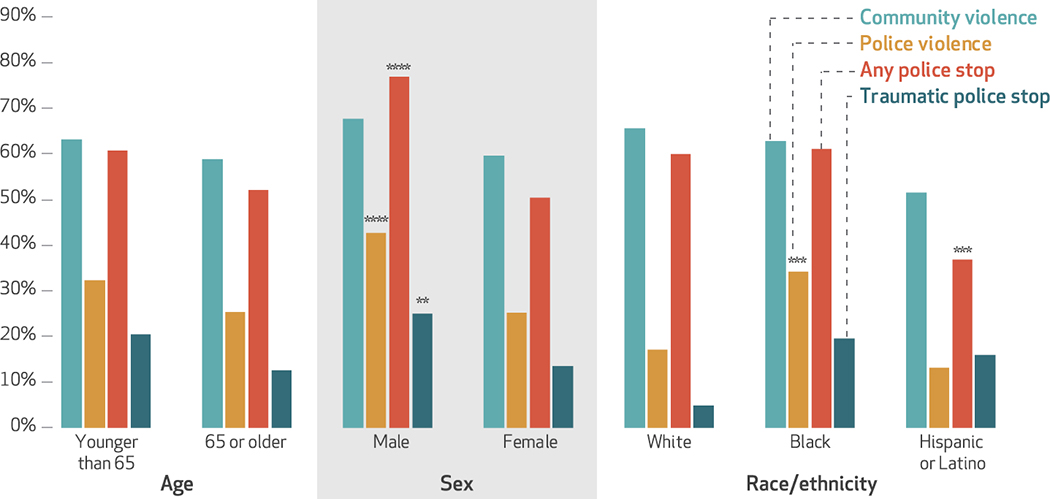
Hypervigilance, a state of heightened awareness and watchfulness, is a consequence of violence that has been linked to adverse psychosocial outcomes. Although well documented in veteran populations, it remains poorly quantified in community populations that are exposed to high levels of neighborhood violence. In-person surveys of 504 adults were conducted in Chicago, Illinois, in 2018 to assess the relationships between hypervigilance and exposure to neighborhood violence, including community and police altercations. Exposure to police violence was associated with a 9.8-percentage-point increase in the hypervigilance score (on a 100-point scale)-nearly twice that associated with exposure to community violence (a 5.5-percentage-point increase). Among participants who reported having had a police stop, experiencing the stop as a traumatic event (defined as exposure to actual or threatened death or serious injury) was associated with a 20.0-percentage-point increase in the hypervigilance score. Scoring in the highest quartile of hypervigilance was associated with higher systolic blood pressure (an increase of 8.6 mmHg). Understanding hypervigilance and, importantly, its linkages with violence and health may help inform policing practices and health care responses to violence in urban communities.
Keywords: Health policy; Hypervigilance; Mental disorders; Neighborhood violence; PTSD; Police violence; Post traumatic stress disorder; Violence.
Figures
References
-
- Dalgleish T, Moradi AR, Taghavi MR, Neshat-Doost HT, Yule W. An experimental investigation of hypervigilance for threat in children and adolescents with post-traumatic stress disorder. Psychol Med. 2001;31(3):541–7. - PubMed
-
- American Psychiatric Association. Diagnostic and statistical manual of mental disorders 5th ed. Arlington (VA): APA; 2013.
-
- Shalev A, Liberzon I, Marmar C. Post-traumatic stress disorder. N Engl J Med. 2017;376(25):2459–69. - PubMed
Publication types
MeSH terms
Grants and funding
LinkOut - more resources
Full Text Sources
Medical
