


The Gut-Microbiome in Gulf War Veterans: A Preliminary Report
- PMID: 31590322
- PMCID: PMC6801913
- DOI: 10.3390/ijerph16193751
The Gut-Microbiome in Gulf War Veterans: A Preliminary Report
Abstract
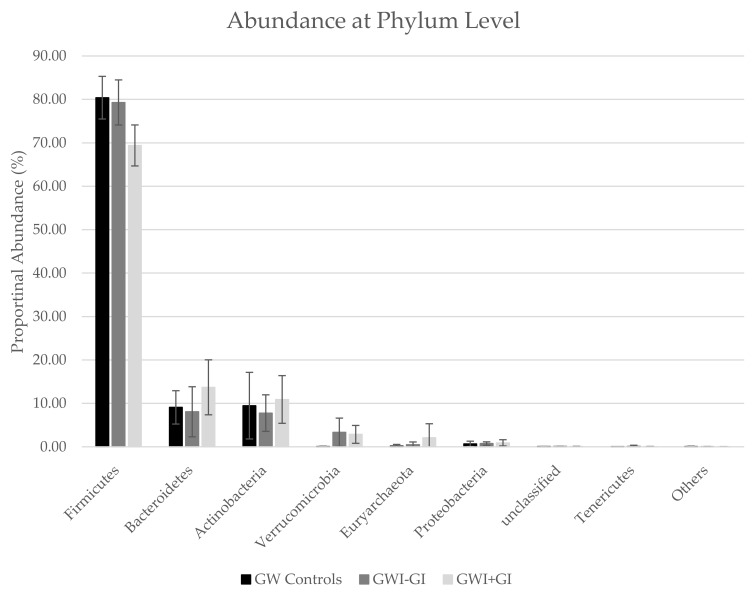
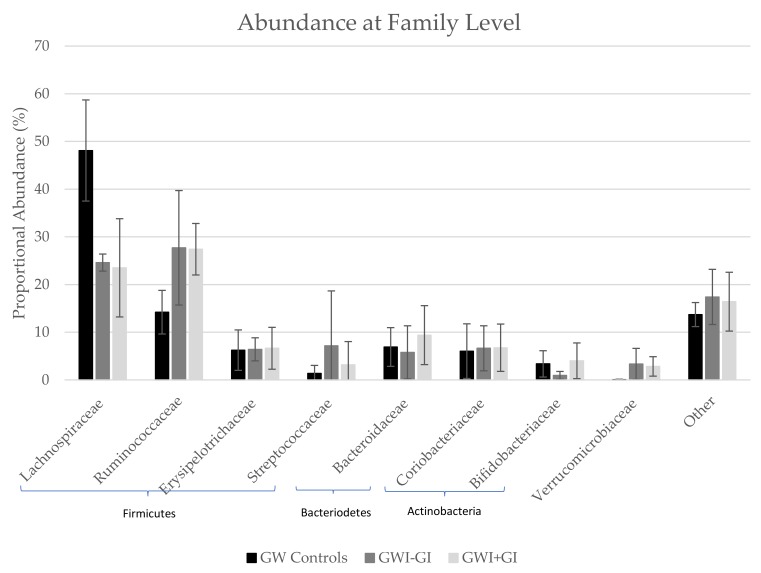
Gulf War Illness (GWI) is a chronic multi-symptom disorder affecting the central nervous system (CNS), immune and gastrointestinal (GI) systems of Gulf War veterans (GWV). We assessed the relationships between GWI, GI symptoms, gut microbiome and inflammatory markers in GWV from the Boston Gulf War Illness Consortium (GWIC). Three groups of GWIC veterans were recruited in this pilot study; GWV without GWI and no gastrointestinal symptoms (controls), GWV with GWI and no gastrointestinal symptoms (GWI-GI), GWV with GWI who reported gastrointestinal symptoms (GW+GI). Here we report on a subset of the first thirteen stool samples analyzed. Results showed significantly different gut microbiome patterns among the three groups and within the GWI +/-GI groups. Specifically, GW controls had a greater abundance of firmicutes and the GWI+GI group had a greater abundance of the phyla bacteroidetes, actinobacteria, euryarchaeota, and proteobacteria as well as higher abundances of the families Bacteroidaceae, Erysipelotrichaceae, and Bifidobacteriaceae. The GWI+GI group also showed greater plasma levels of the inflammatory cytokine TNF-RI and they endorsed significantly more chemical weapons exposure during the war and reported significantly greater chronic pain, fatigue and sleep difficulties than the other groups. Studies with larger samples sizes are needed to confirm these initial findings.
Keywords: Cytokines; Exposure.; Gulf War; Gulf War Illness; Inflammation; Microbiome; Veterans.
Conflict of interest statement
The authors declare no conflict of interest.
Figures
References
-
- White R.F., Steele L., O’Callaghan J.P., Sullivan K., Binns J.H., Golomb B.A., Bloom F.E., Bunker J.A., Crawford F., Graves J.C., et al. Recent research on Gulf War illness and other health problems in veterans of the 1991 Gulf War: Effects of toxicant exposures during deployment. Cortex. 2016;74:449–475. doi: 10.1016/j.cortex.2015.08.022. - DOI - PMC - PubMed
-
- Research Advisory Committee on Gulf War Veterans’ Illnesses . Gulf War Illness and the Health of Gulf War Veterans: Scientific Findings and Recommendations. U.S. Government Printing Office; Washington, DC, USA: 2008.
-
- Sullivan K., Krengel M., Bradford W., Stone C., Thompson T.A., Heeren T., White R.F. Neuropsychological functioning in military pesticide applicators from the Gulf War: Effects on information processing speed, attention and visual memory. Neurotoxicol. Teratol. 2018;65:1–13. doi: 10.1016/j.ntt.2017.11.002. - DOI - PubMed
-
- Sullivan K., Krengel M., Proctor S.P., Devine S., Heeren T., White R.F. Cognitive Functioning in Treatment-Seeking Gulf War Veterans: Pyridostigmine Bromide Use and PTSD. J. Psychopathol. Behav. Assess. 2003;25:95–103. doi: 10.1023/A:1023342915425. - DOI
Publication types
MeSH terms
Substances
LinkOut - more resources
Full Text Sources
