. 2019 Oct 6;11(10):1497.
doi: 10.3390/cancers11101497.

Comprehensive Metabolomic Search for Biomarkers to Differentiate Early Stage Hepatocellular Carcinoma from Cirrhosis

Affiliations

Comprehensive Metabolomic Search for Biomarkers to Differentiate Early Stage Hepatocellular Carcinoma from Cirrhosis

Da Jung Kim et al. Cancers (Basel). .

Abstract

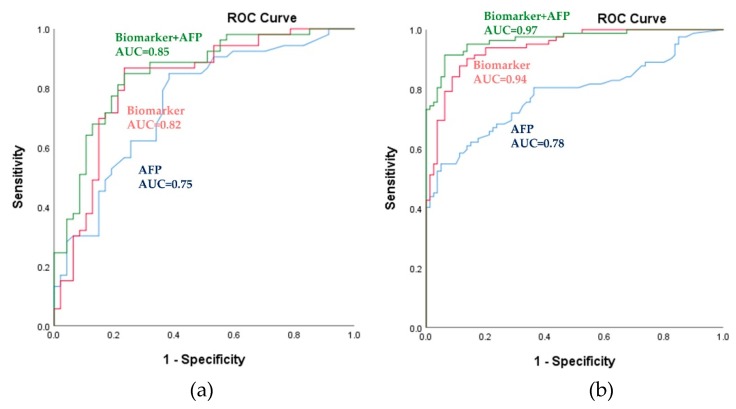
The established biomarker for hepatocellular carcinoma (HCC), serum α-fetoprotein (AFP), has suboptimal performance in early disease stages. This study aimed to develop a metabolite panel to differentiate early-stage HCC from cirrhosis. Cross-sectional metabolomic analyses of serum samples were performed for 53 and 47 patients with early HCC and cirrhosis, respectively, and 50 matched healthy controls. Results were validated in 82 and 80 patients with early HCC and cirrhosis, respectively. To retain a broad spectrum of metabolites, technically distinct analyses (global metabolomic profiling using gas chromatography time-of-flight mass spectrometry and targeted analyses using liquid chromatography with tandem mass spectrometry) were employed. Multivariate analyses classified distinct metabolites; logistic regression was employed to construct a prediction model for HCC diagnosis. Five metabolites (methionine, proline, ornithine, pimelylcarnitine, and octanoylcarnitine) were selected in a panel. The panel distinguished HCC from cirrhosis and normal controls, with an area under the receiver operating curve (AUC) of 0.82; this was significantly better than that of AFP (AUC: 0.75). During validation, the panel demonstrated significantly better predictability (AUC: 0.94) than did AFP (AUC: 0.78). Defects in ammonia recycling, the urea cycle, and amino acid metabolism, demonstrated on enrichment pathway analysis, may reliably distinguish HCC from cirrhosis. Compared with AFP alone, the metabolite panel substantially improved early-stage HCC detection.

Keywords: biomarker; cirrhosis; hepatocellular carcinoma; metabolomics.


Conflict of interest statement

The authors declare no conflict of interest. The funders had no role in the design of the study; in the collection, analyses, or interpretation of data; in the writing of the manuscript, or in the decision to publish the results.

Figures

Figure 1
Figure 1
Design of the study and description of the training and test sets. HCC, hepatocellular carcinoma; LC, liver cirrhosis; NC, normal control; LC-MS, liquid chromatography-mass spectrometry; GC-MS, gas chromatography-mass spectrometry.
Figure 2
Figure 2
Comparisons among metabolic biomarkers. Bar graphs represent the concentration of individual metabolic biomarkers, namely methionine, ornithine, proline, pimelylcarnitine, and octanoylcarnitine. All the metabolites have VIP scores >1.0. FDR-adjusted p-values * < 0.05, ** < 0.001, or *** < 0.0001 represent a statistical significance compared with NC group. FDR-adjusted p-values # < 0.05, ## < 0.001, or ### < 0.0001 represent a statistical significance with LC or V-LC group. NC, LC, and HCC belong to the training set. V-LC and V-HCC belong to the test set. V-LC, liver cirrhosis in test set; V-HCC, hepatocellular carcinoma in test set. HCC, hepatocellular carcinoma; LC, liver cirrhosis; NC, normal control; VIP, variable important in projection; FDR, false discovery rate.
Figure 3
Figure 3
Power of the biomarker panel to discriminate HCC from LC, as assessed using the logistic regression model. (a) Receiver operating characteristic (ROC) curves for the training set. (b) ROC curves for the validation set. The blue-, red-, and green-colored lines indicate AFP, metabolic biomarkers, and metabolic biomarkers with AFP, respectively. AUC, area under the receiver operating curve; HCC, hepatocellular carcinoma; LC, liver cirrhosis; AFP, α-fetoprotein.
Figure 4
Figure 4
Pathway enrichment analysis of metabolic biomarkers in HCC. The network map represents pathways strongly correlated to metabolic dysfunction in HCC. Enrichment pathway analysis was based on the Kyoto Encyclopedia of Genes and Genomes database. All the represented metabolic pathways have FDR-adjusted p-values of less than 0.001. The sizes of the red circle indicate fold enrichment. Solid and dotted red circles represent metabolic pathways with more than four and three metabolic hits, respectively. HCC, hepatocellular carcinoma; FDR, false discovery rate.

References

    1. Galle P.R., Forner A., Llovet J.M., Mazzaferro V., Piscaglia F., Raoul J.-L., Schirmacher P., Vilgrain V. EASL clinical practice guidelines: Management of hepatocellular carcinoma. J. Hepatol. 2018;69:182–236. doi: 10.1016/j.jhep.2018.03.019. - DOI - PubMed
    1. Heimbach J.K., Kulik L.M., Finn R.S., Sirlin C.B., Abecassis M.M., Roberts L.R., Zhu A.X., Murad M.H., Marrero J.A. AASLD guidelines for the treatment of hepatocellular carcinoma. Hepatology. 2018;67:358–380. doi: 10.1002/hep.29086. - DOI - PubMed
    1. Singal A.G., Pillai A., Tiro J. Early detection, curative treatment, and survival rates for hepatocellular carcinoma surveillance in patients with cirrhosis: A meta-analysis. PLoS Med. 2014;11:e1001624. doi: 10.1371/journal.pmed.1001624. - DOI - PMC - PubMed
    1. European Association For the Study of the Liver. European Organisation for Research and Treatment of Cancer EASL-EORTC clinical practice guidelines: Management of hepatocellular carcinoma. Eur. J. Cancer. 2012;48:599–641. doi: 10.1016/j.ejca.2011.12.021. - DOI - PubMed
    1. Johnson C.H., Ivanisevic J., Siuzdak G. Metabolomics: Beyond biomarkers and towards mechanisms. Nat. Rev. Mol. Cell Biol. 2016;17:451–459. doi: 10.1038/nrm.2016.25. - DOI - PMC - PubMed

LinkOut - more resources