. 2019 Dec;18(23):3313-3324.
doi: 10.1080/15384101.2019.1674071. Epub 2019 Oct 7.

Long non-coding RNA SNHG4 promotes cervical cancer progression through regulating c-Met via targeting miR-148a-3p

Affiliations

Long non-coding RNA SNHG4 promotes cervical cancer progression through regulating c-Met via targeting miR-148a-3p

Hanchen Li et al. Cell Cycle. 2019 Dec.

Retraction in

Abstract

Long non-coding RNA (lncRNA) SNHG4 has been shown to be associated with the development of a variety of cancers. The purpose of this study was to investigate the effect of SNHG4 on cervical cancer (CC) and the corresponding mechanism. The qRT-PCR was used to determine the expressions of SNHG4 and miR-148a-3p in CC cell lines and tissues. Cell apoptosis and proliferation were measured by flow cytometry and MTT assay, respectively. The interaction between SNHG4, miR-148a-3p and c-Met was verified by bioinformatics, dual-luciferase reporter gene and RNA immunoprecipitation (RIP), and the effect of SNHG4 on the growth of CC tumor in vivo was explored. The expression of SNHG4 was increased in both CC cell lines and tissues, while the expression of miR-148a-3p was down-regulated. Meanwhile, silencing SNHG4 remarkably inhibited CC cell proliferation and promoted apoptosis. In addition, miR-148a-3p was a direct target gene of SNHG4, and down-regulation of miR-148a-3p could observably reverse the effect of silencing SNHG4 on the proliferation and apoptosis of CC cells. More importantly, SNHG4 could up-regulate the expression of c-Met by targeting and interacting with miR-148a-3p. Finally, in vivo experiments confirmed that silence SNHG4 down-regulated the expression of c-Met by promoting miR-148a-3p, and ultimately suppressed the growth of CC tumor in vivo. In conclusion, SNHG4 could be used as a competitive endogenous RNA to bind to miR-148a-3p, thereby up-regulating the expression of c-Met and ultimately promoting the progression of CC, which provided a potential therapeutic target for the targeted treatment of CC.

Keywords: Cervical cancer; c-Met; lncRNA SNHG4; miR-148a-3p.


Figures
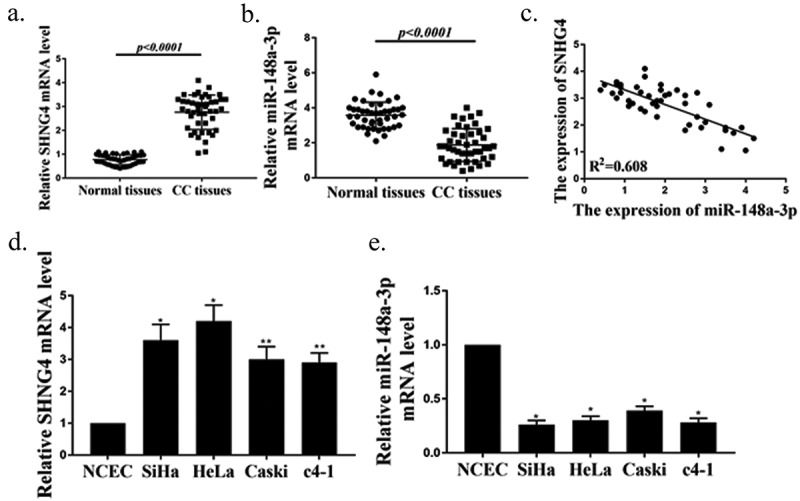
Figure 1.
Figure 1.
Measurement of SNHG4 and miR-148a-3p expressions in CC tissues and cell lines. (a, b) Measurement of expressions of SNHG4 (p < 0.0001) (a) and miR-148a-3p(p < 0.0001) (B) in CC tissues (n = 45) and normal tissues (n = 45). (c) Pearson correlation analysis of SNHG4 and miR-148a-3p expressions in CC tissues (n = 45). (d, e) Measurement of expressions of SNHG4 (d) and miR-148a-3p (e) in CC cells. ** P < 0.001, * P < 0.0001.
Figure 2.
Figure 2.
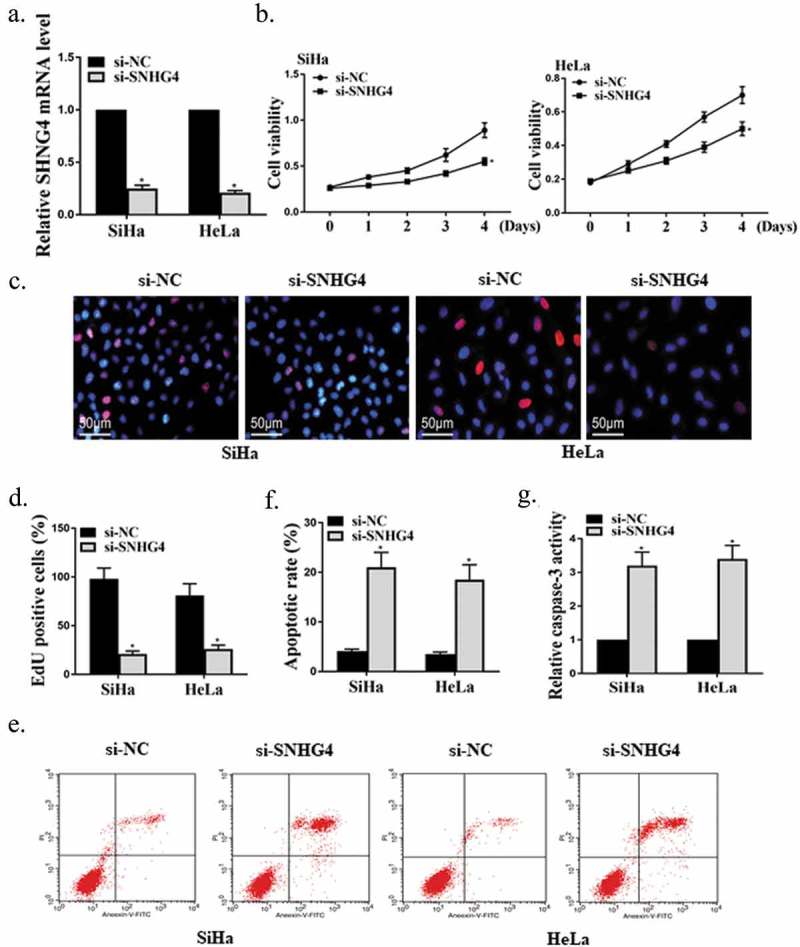
Effects of silencing SNHG4 on the growth of CC cells. (a) Measurement of the effect of transfected si-SNHG4 on the SNHG4 expression in CC cells by qRT-PCR. (b-d) Measurement of the proliferation activity of CC cells by MTT (b) and Edu staining (c, d). (e, f) Detection of the apoptosis rate of CC cells. (g) Determination of the caspase-3 activity in CC cells by colorimetry. * P < 0.0001.
Figure 3.
Figure 3.
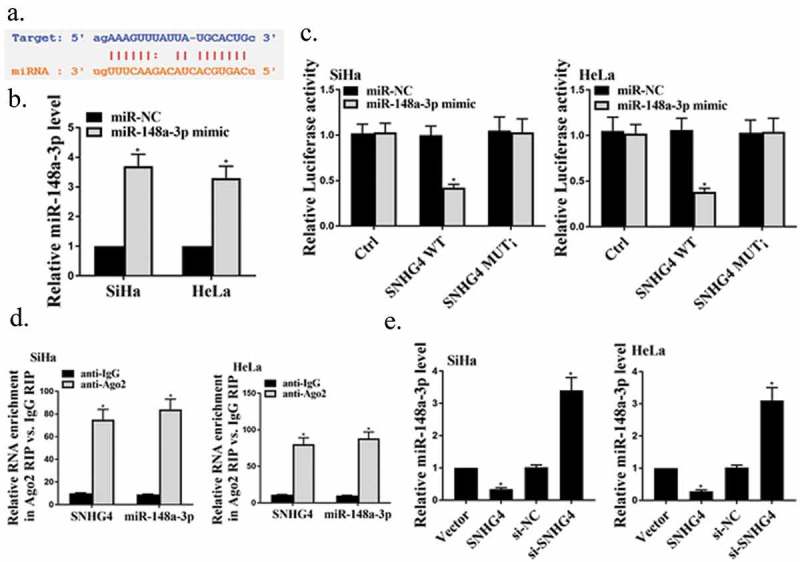
The identification of miR-148a-3p as the direct target gene of SNHG4. (a) Schematic diagram of potential binding sites between SNHG4 and miR-148a-3p. (b) Detection of the miR-148a-3p expression in HeLa and SiHa cells by qRT-PCR. (c) Determination of luciferase activity in HeLa and SiHa cells. (d) RIP analysis of miR-148a-3p and SNHG4 in HeLa and SiHa cells. (e) Measurement of the miR-148a-3p expression in SiHa cells by qRT-PCR. * P < 0.05.
Figure 4.
Figure 4.
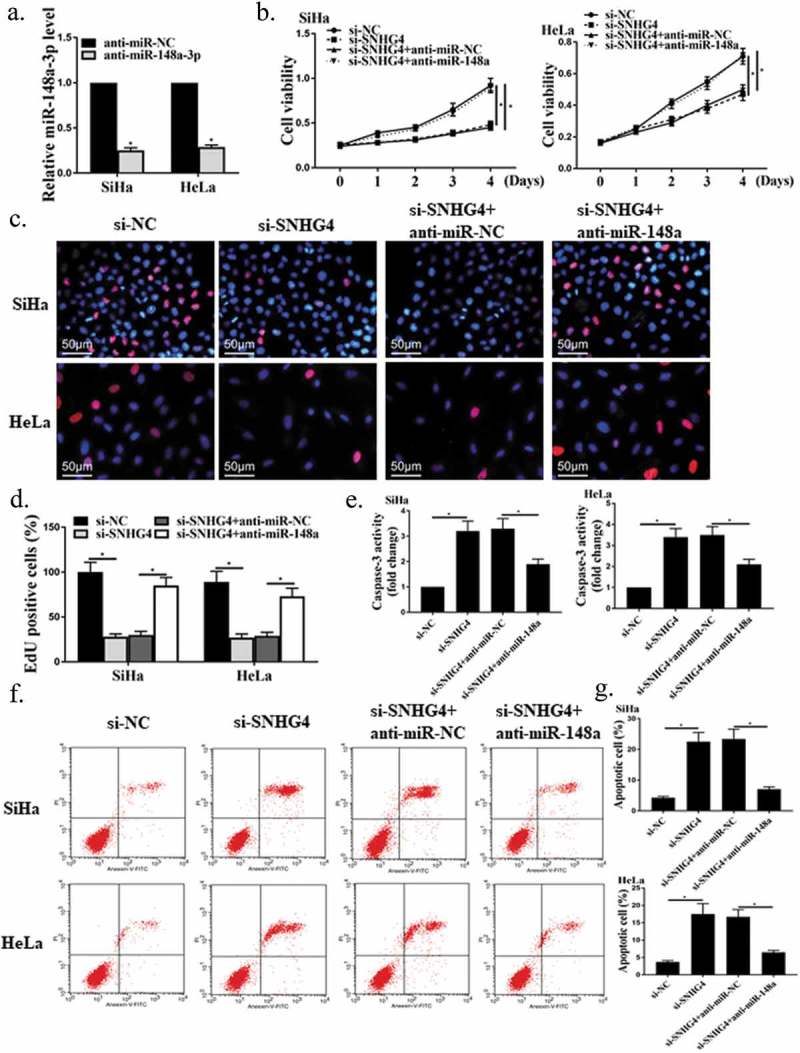
The role of miR-148a-3p in the growth of CC cells promoted by SNHG4. (a) Detection of the miR-148a-3p expression in HeLa and SiHa cells by qRT-PCR. (b-d) Measurement of the proliferation ability of CC cells by MTT (b) and Edu staining (c, d). (e) Determination of the caspase-3 activity in CC cells by colorimetry. (f, g) Measurement of the apoptosis rates of CC cells by flow cytometry. * P < 0.05.
Figure 5.
Figure 5.
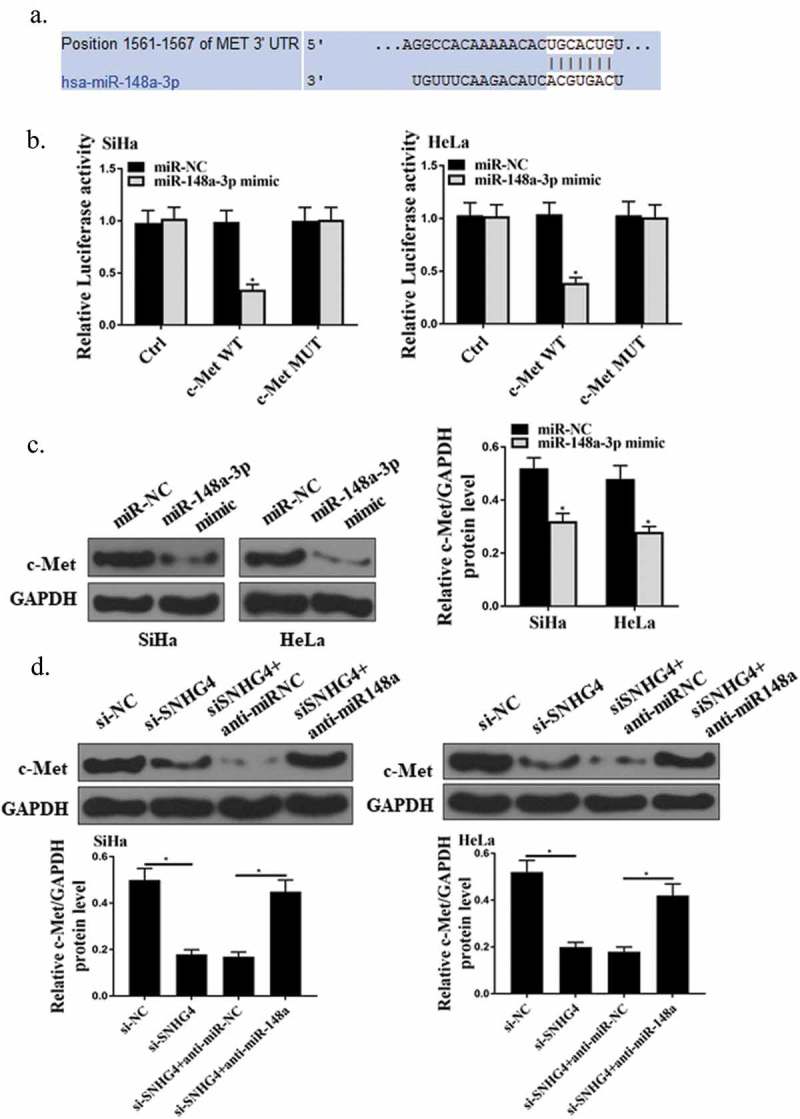
Identification of C-met as the direct target gene of miR-148a-3p. (a) Schematic diagram of potential binding sites of miR-148a-3p in c-Met 3ʹUTR region. (b) Determination of luciferase activity in HeLa and SiHa cells. (c, d) Measurement of the protein expression of c-Met in HeLa and SiHa cells. *P < 0.05.
Figure 6.
Figure 6.
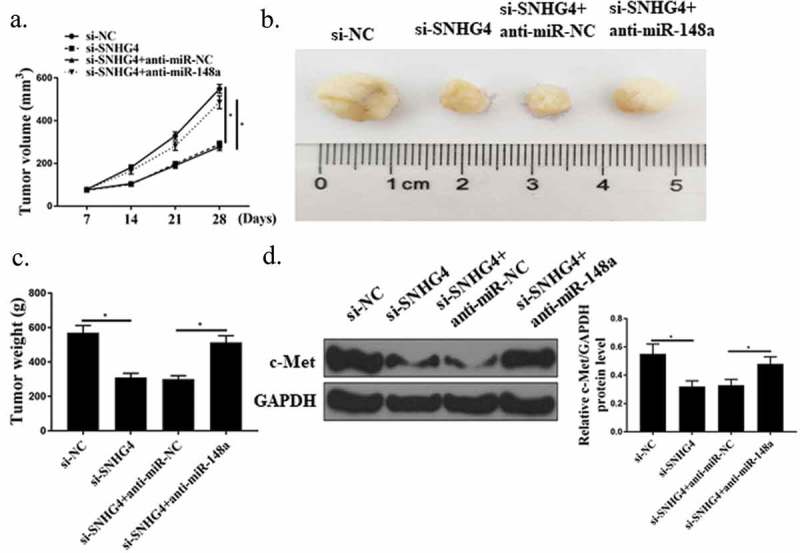
Effect of SNHG4 on tumor growth of CC in vivo. (a) Measurement of tumor volume of mice in each group. (b) Representative images of mouse tumors in each group. (c) Measurement of tumor weight of mice in each group. (d) Determination of c-Met protein expression in tumor tissues of mice in each group. * P < 0.05. n = 6.

References

    1. Roura E, Travier N, Waterboer T, et al. The influence of hormonal factors on the risk of developing cervical cancer and pre-cancer: results from the EPIC cohort. PLoS One. 2016;11(1):e0147029. - PMC - PubMed
    1. Audirac-Chalifour A, Torres-Poveda K, Bahena-Román M, et al. Cervical microbiome and cytokine profile at various stages of cervical cancer: a pilot study. PloS One. 2016;11(4):e0153274. - PMC - PubMed
    1. Herrera FG, Breuneval T, Prior JO, et al. [18 F] FDG-PET/CT metabolic parameters as useful prognostic factors in cervical cancer patients treated with chemo-radiotherapy. Radiat Oncol. 2016;11(1):43. - PMC - PubMed
    1. Catarino R, Petignat P, Dongui G, et al. Cervical cancer screening in developing countries at a crossroad: emerging technologies and policy choices. World J Clin Oncol. 2015;6(6):281. - PMC - PubMed
    1. Laterza RM, Sievert K-D, de Ridder D, et al. Bladder function after radical hysterectomy for cervical cancer. Neurourol Urodyn. 2015;34(4):309–315. - PubMed

Publication types