


Humanistic medicine in anaesthesiology: development and assessment of a curriculum in humanism for postgraduate anaesthesiology trainees
- PMID: 31591019
- PMCID: PMC6993108
- DOI: 10.1016/j.bja.2019.08.021
Humanistic medicine in anaesthesiology: development and assessment of a curriculum in humanism for postgraduate anaesthesiology trainees
Abstract
Background: An unintended consequence of medical technologies is loss of personal interactions and humanism between patients and their healthcare providers, leading to depersonalisation of medicine. As humanism is not integrated as part of formal postgraduate anaesthesiology education curricula, our goal was to design, introduce, and evaluate a comprehensive humanism curriculum into anaesthesiology training.
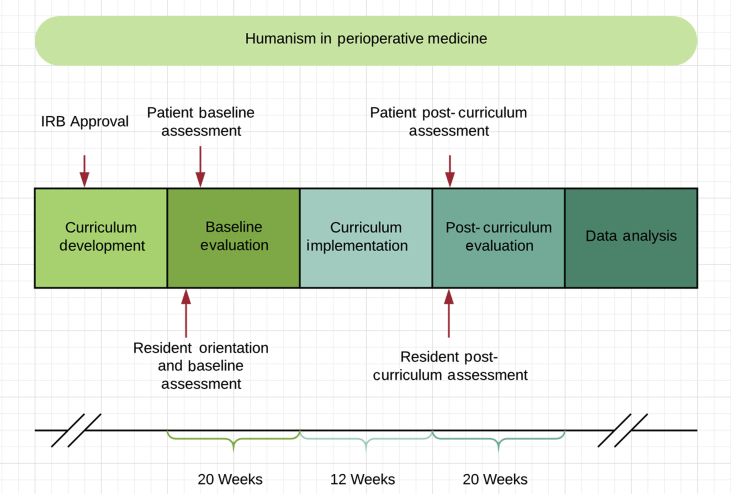
Methods: Subject-matter experts developed and delivered the humanism curriculum, which included interactive workshops, simulation sessions, formal feedback, and patient immersion experience. The effectiveness of the programme was evaluated using pre- and post-curriculum assessments in first-year postgraduate trainee doctors (residents).
Results: The anaesthesiology residents reported high satisfaction scores. Pre-/post-Jefferson Scale of Patient Perceptions of Physician Empathy showed an increase in empathy ratings with a median improvement of 12 points (range; P=0.013). After training, patients rated the residents as more empathetic (31 [4] vs 22 [5]; P<0.001; 95% confidence interval [CI]: 7-12) and professional (47 [3] vs 35 [8]; P<0.001; 95% CI: 9-16). Patient overall satisfaction with their anaesthesia provider improved after training (51 [6] vs 37 [10]; P<0.001; 95% CI: 10-18). Patients rated their anxiety lower in the post-training period compared with pretraining (1.8 [2.3] vs 3.6 [1.6]; P=0.001; 95% CI: 0.8-2.9). Patient-reported pain scores decreased after training (2.3 [2.5] vs 3.8 [2.1]; P=0.010; 95% CI: 0.4-2.8).
Conclusions: Implementation of a humanism curriculum during postgraduate anaesthesiology training was well accepted, and can result in increased physician empathy and professionalism. This may improve patient pain, anxiety, and overall satisfaction with perioperative care.
Keywords: anaesthesia curriculum; burnout; humanism; patient outcomes; postgraduate medical education; simulation.
Copyright © 2019 British Journal of Anaesthesia. Published by Elsevier Ltd. All rights reserved.
Figures
Comment in
-
Can we go too far with empathy? Shifting from empathy to compassion.Br J Anaesth. 2020 Feb;124(2):129-131. doi: 10.1016/j.bja.2019.10.014. Epub 2019 Nov 25. Br J Anaesth. 2020. PMID: 31780141 No abstract available.
-
Anaesthesiology residency humanism education program: putting outcomes in context.Br J Anaesth. 2020 May;124(5):e211-e212. doi: 10.1016/j.bja.2019.12.033. Epub 2020 Jan 21. Br J Anaesth. 2020. PMID: 31980162 No abstract available.
-
Can empathy improve surgical and patient-reported outcomes: benefit to an 'identifiable patient effect'?Br J Anaesth. 2020 Jun;124(6):e225-e226. doi: 10.1016/j.bja.2020.02.014. Epub 2020 Mar 20. Br J Anaesth. 2020. PMID: 32200993 No abstract available.
References
-
- Gold A., Gold S. Humanism in medicine from the perspective of the Arnold Gold Foundation: challenges to maintaining the care in health care. J Child Neurol. 2006;21:546–549. - PubMed
-
- Glass R.M. The patient-physician relationship. JAMA focuses on the center of medicine. JAMA. 1996;275:147–148. - PubMed
-
- Hojat M., Mangione S., Gonnella J.S., Nasca T., Veloski J.J., Kane G. Empathy in medical education and patient care. Acad Med. 2001;76:669. - PubMed
-
- Hyman S.A., Michaels D.R., Berry J.M., Schildcrout J.S., Mercaldo N.D., Weinger M.B. Risk of burnout in perioperative clinicians: a survey study and literature review. Anesthesiology. 2011;114:194–204. - PubMed
