Review
. 2019 Dec;7(12):1068-1083.
doi: 10.1016/S2213-2600(19)30249-8. Epub 2019 Oct 4.

Challenges in the diagnosis of paediatric pneumonia in intervention field trials: recommendations from a pneumonia field trial working group

Collaborators, Affiliations
Review

Challenges in the diagnosis of paediatric pneumonia in intervention field trials: recommendations from a pneumonia field trial working group

Dina Goodman et al. Lancet Respir Med. 2019 Dec.

Abstract

Pneumonia is a leading killer of children younger than 5 years despite high vaccination coverage, improved nutrition, and widespread implementation of the Integrated Management of Childhood Illnesses algorithm. Assessing the effect of interventions on childhood pneumonia is challenging because the choice of case definition and surveillance approach can affect the identification of pneumonia substantially. In anticipation of an intervention trial aimed to reduce childhood pneumonia by lowering household air pollution, we created a working group to provide recommendations regarding study design and implementation. We suggest to, first, select a standard case definition that combines acute (≤14 days) respiratory symptoms and signs and general danger signs with ancillary tests (such as chest imaging and pulse oximetry) to improve pneumonia identification; second, to prioritise active hospital-based pneumonia surveillance over passive case finding or home-based surveillance to reduce the risk of non-differential misclassification of pneumonia and, as a result, a reduced effect size in a randomised trial; and, lastly, to consider longitudinal follow-up of children younger than 1 year, as this age group has the highest incidence of severe pneumonia.


Figures

Figure 1
Figure 1
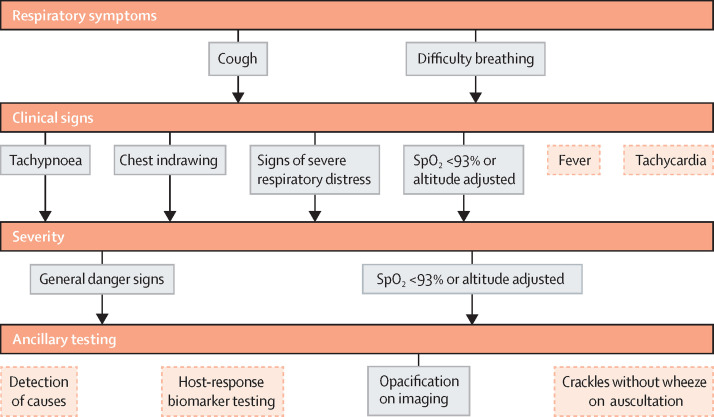
Severe pneumonia diagnostic flow chart for field trials in resource-poor settings Severe pneumonia diagnosis involves a combination of respiratory symptoms, clinical signs, and severity. The solid grey boxes indicate our recommended approach for diagnosing severe pneumonia in field trials, while the dotted orange boxes indicate additional symptoms and signs that are commonly available in clinical practice but not recommended for diagnosis of severe pneumonia in field studies. Both cough and difficulty breathing can be based on report or observation. Observed difficulty breathing is defined as any abnormal breathing pattern not limited to tachypnoea, chest indrawing, wheeze or noisy breathing, or other signs of respiratory distress. Hypoxaemia can be used as a clinical sign, marker of disease severity, or ancillary test. Severe respiratory distress includes any of the following: head nodding, persistent nasal flaring, grunting, stridor while calm, tracheal tugging, intercostal retractions, pronounced lower chest wall indrawing, very fast breathing for age. General danger signs include inability to drink, vomiting everything, convulsions, lethargy or unconsciousness, severe malnutrition, or stridor in a calm child. Opacification on imaging refers to the finding of a primary endpoint pneumonia on chest radiography or lung ultrasound.
Figure 2
Figure 2
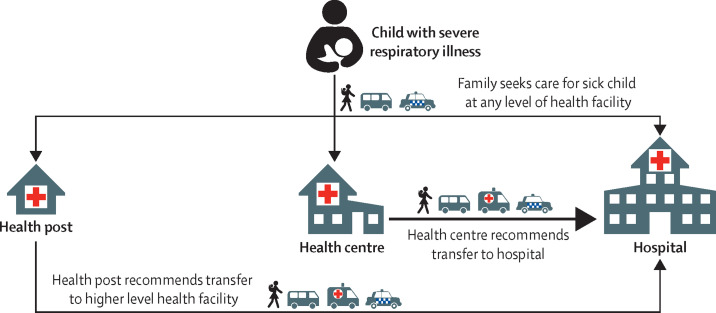
Example of a framework of health-seeking behaviour for pneumonia This figure describes the locations at which families seek care for their sick child, the process of referral between levels of care, and transport. The arrows represent potential modes of transportation (walking, public transportation represented with a bus icon, or private taxi or car represented with a car icon) between home and a health facility, or between health facilities. This example health system comprises of health posts (small remote outposts, generally with one health provider and minimal equipment, available during limited hours), health centres, and hospitals. In this hypothetical setting, health posts rarely refer to health centres, instead they refer directly to hospitals.

References

    1. Smith KR, Samet JM, Romieu I, Bruce N. Indoor air pollution in developing countries and acute lower respiratory infections in children. Thorax. 2000;55:518–532. - PMC - PubMed
    1. International Vaccine Access Center (IVAC) Pneumonia & diarrhea progress report 2016: reach goals through action and innovation. 2016. https://ipa-world.org/uploadedbyfck/IVAC-2016-Pneumonia-Diarrhea-Progres...
    1. Cai X, Wardlaw T, Brown DW. Global trends in exclusive breastfeeding. Int Breastfeed J. 2012;7:12. - PMC - PubMed
    1. Black RE, Allen LH, Bhutta ZA, et al. Maternal and child undernutrition: global and regional exposures and health consequences. Lancet. 2008;371:243–260. - PubMed
    1. Wessells KR, Brown KH. Estimating the global prevalence of zinc deficiency: results based on zinc availability in national food supplies and the prevalence of stunting. PLoS One. 2012;7 - PMC - PubMed