. 2019 Oct 7:367:l5460.
doi: 10.1136/bmj.l5460.

Efficacy and safety of first line treatments for patients with advanced epidermal growth factor receptor mutated, non-small cell lung cancer: systematic review and network meta-analysis

Affiliations

Efficacy and safety of first line treatments for patients with advanced epidermal growth factor receptor mutated, non-small cell lung cancer: systematic review and network meta-analysis

Yi Zhao et al. BMJ. .

Abstract

Objective: To compare the efficacy and safety of first line treatments for patients with advanced epidermal growth factor receptor (EGFR) mutated non-small cell lung cancer (NSCLC).

Design: Systematic review and network meta-analysis.

Data sources: PubMed, Embase, Cochrane Central Register of Controlled Trials, ClinicalTrials.gov, and several international conference databases, from inception to 20 May 2019.

Eligibility criteria for selecting studies: Published and unpublished randomised controlled trials comparing two or more treatments in the first line setting for patients with advanced EGFR mutated NSCLC were included in a bayesian network meta-analysis. Eligible studies reported at least one of the following clinical outcome measures: progression free survival, overall survival, objective response rate, and adverse events of grade 3 or higher.

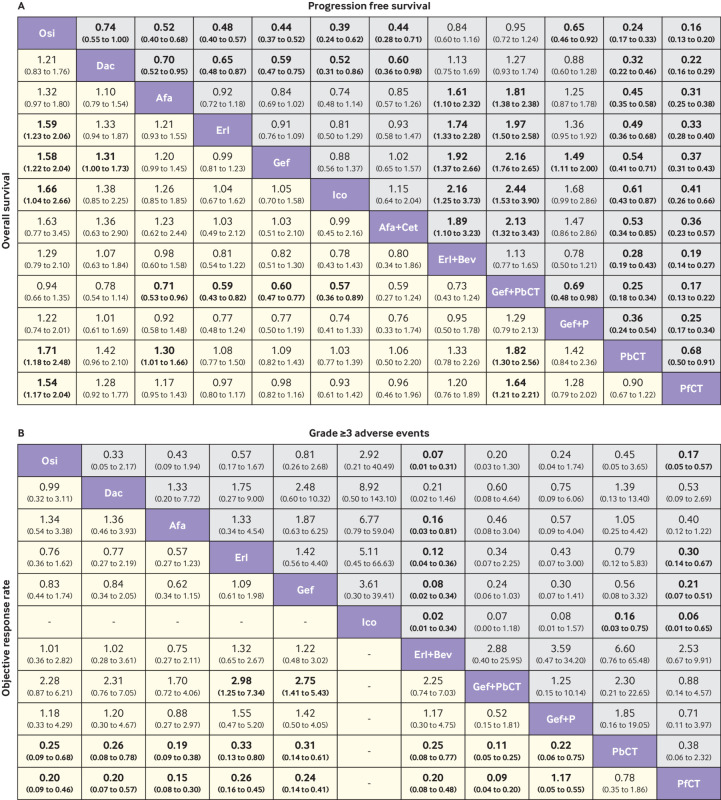
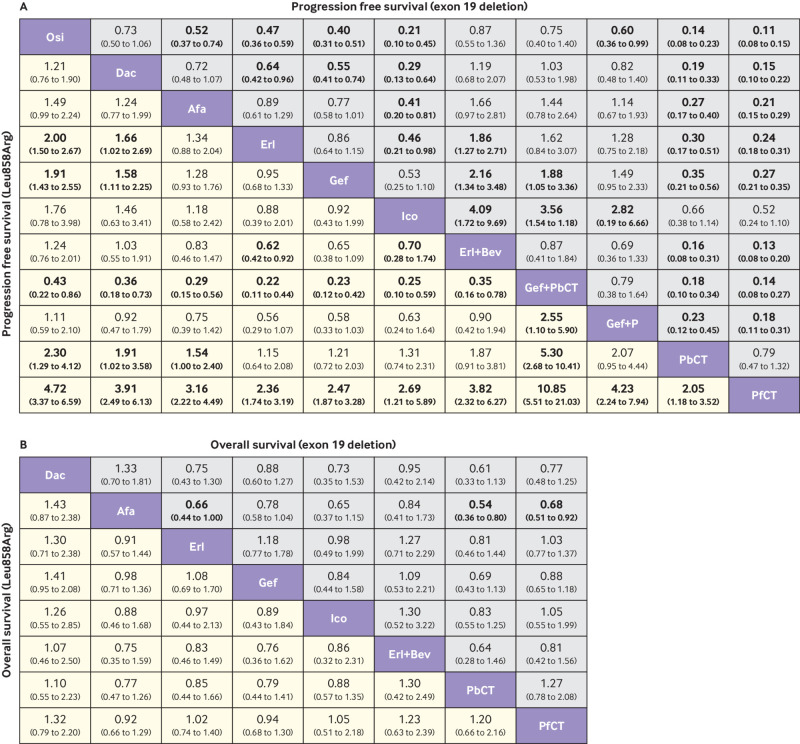
Results: 18 eligible trials involved 4628 patients and 12 treatments: EGFR tyrosine kinase inhibitors (TKIs; osimertinib, dacomitinib, afatinib, erlotinib, gefitinib, and icotinib), pemetrexed based chemotherapy, pemetrexed free chemotherapy, and combination treatments (afatinib plus cetuximab, erlotinib plus bevacizumab, gefitinib plus pemetrexed based chemotherapy, and gefitinib plus pemetrexed). Consistent with gefitinib plus pemetrexed based chemotherapy (hazard ratio 0.95, 95% credible interval 0.72 to 1.24), osimertinib showed the most favourable progression free survival, with significant differences versus dacomitinib (0.74, 0.55 to 1.00), afatinib (0.52, 0.40 to 0.68), erlotinib (0.48, 0.40 to 0.57), gefitinib (0.44, 0.37 to 0.52), icotinib (0.39, 0.24 to 0.62), pemetrexed based chemotherapy (0.24, 0.17 to 0.33), pemetrexed free chemotherapy (0.16, 0.13 to 0.20), afatinib plus cetuximab (0.44, 0.28 to 0.71), and gefitinib plus pemetrexed (0.65, 0.46 to 0.92). Osimertinib and gefitinib plus pemetrexed based chemotherapy were also consistent (0.94, 0.66 to 1.35) in providing the best overall survival benefit. Combination treatments caused more toxicity in general, especially erlotinib plus bevacizumab, which caused the most adverse events of grade 3 or higher. Different toxicity spectrums were revealed for individual EGFR-TKIs. Subgroup analyses by the two most common EGFR mutation types indicated that osimertinib was associated with the best progression free survival in patients with the exon 19 deletion, and gefitinib plus pemetrexed based chemotherapy was associated with the best progression free survival in patients with the Leu858Arg mutation.

Conclusions: These results indicate that osimertinib and gefitinib plus pemetrexed based chemotherapy were associated with the best progression free survival and overall survival benefits for patients with advanced EGFR mutated NSCLC, compared with other first line treatments. The treatments resulting in the best progression free survival for patients with the exon 19 deletion and Leu858Arg mutations were osimertinib and gefitinib plus pemetrexed based chemotherapy, respectively.

Systematic review registration: PROSPERO CRD42018111954.


Conflict of interest statement

Competing interests: All authors have completed the ICMJE uniform disclosure form at www.icmje.org/coi_disclosure.pdf and declare: no support from any organisation for the submitted work; no financial relationships with any organisations that might have an interest in the submitted work in the previous three years; no other relationships or activities that could appear to have influenced the submitted work.

Figures
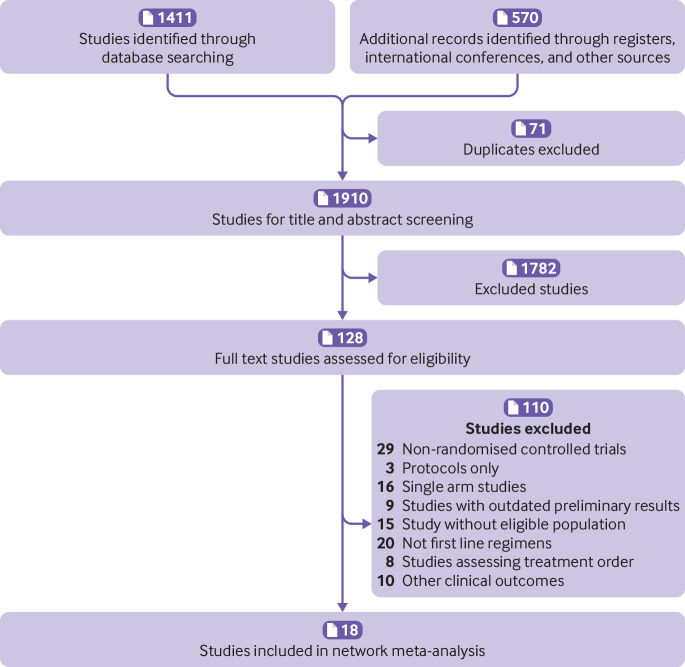
Fig 1
Fig 1
Study selection
Fig 2
Fig 2
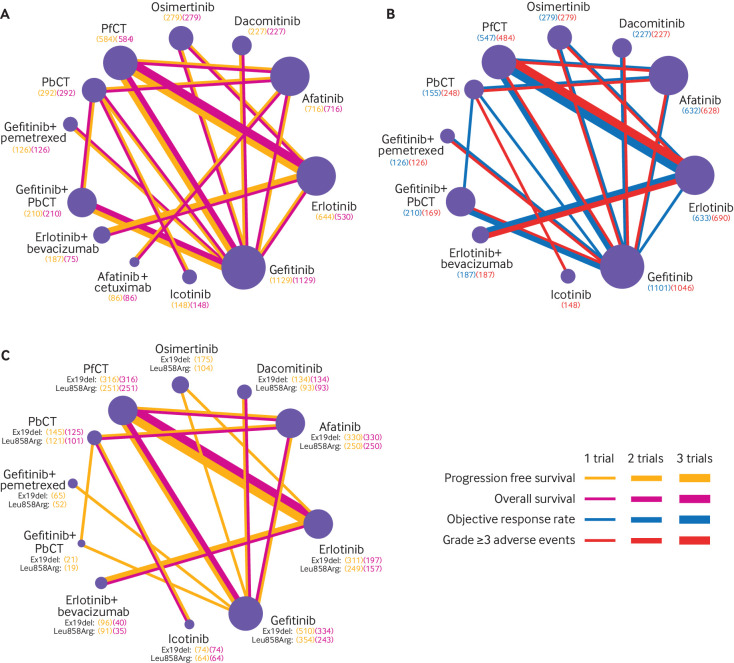
Network diagrams of comparisons on different outcomes of treatments in different groups of patients with advanced epidermal growth factor receptor (EGFR) mutated non-small cell lung cancer (NSCLC). (A) Comparisons on progression free survival and overall survival in patients with advanced EGFR mutated NSCLC. (B) Comparisons on objective response rate and adverse events of grade 3 or higher in patients with advanced EGFR mutated NSCLC. (C) Comparisons on progression free survival and overall survival in subgroups of study patients with exon 19 deletion (Ex19del) and Leu858Arg mutation types. Each circular node represents a type of treatment. The node size is proportional to the total number of patients receiving a treatment (in brackets). Each line represents a type of head-to-head comparison. The width of lines is proportional to the number of trials comparing the connected treatments. PbCT=pemetrexed based chemotherapy; PfCT=pemetrexed free chemotherapy
Fig 3
Fig 3
Pooled estimates of the network meta-analysis. (A) Pooled hazard ratios (95% credible intervals) for progression free survival (upper triangle) and overall survival (lower triangle). (B) Pooled odds ratios (95% credible intervals) for adverse events of grade 3 or higher (upper triangle) and objective response rate (lower triangle). Data in each cell are hazard or odds ratios (95% credible intervals) for the comparison of row-defining treatment versus column-defining treatment. Hazard ratios less than 1 and odds ratios more than 1 favour row-defining treatment. Significant results are in bold. Osi=osimertinib; Dac=dacomitinib; Afa=afatinib; Erl=erlotinib; Gef=gefitinib; Ico=icotinib; Cet=cetuximab; Bev=bevacizumab; Gef+P=gefitinib plus pemetrexed; PbCT=pemetrexed based chemotherapy; PfCT=pemetrexed free chemotherapy
Fig 4
Fig 4
Pooled estimates of subgroup analyses (patients stratified into exon 19 deletion and Leu858Arg subgroups). (A) Pooled hazard ratios (95% credible intervals) for progression free survival of exon 19 deletion (upper triangle) and Leu858Arg (lower triangle) subgroups. (B) Pooled hazard ratios (95% credible intervals) for overall survival of exon 19 deletion (upper triangle) and Leu858Arg (lower triangle) subgroups. Data in each cell are hazard ratios (95% credible interval) for the comparison of row-defining treatment versus column-defining treatment. Hazard ratios less than 1 favours row-defining treatment. Significant results are in bold. Osi=osimertinib; Dac=dacomitinib; Afa=afatinib; Erl=erlotinib; Gef=gefitinib; Ico=icotinib; Bev=bevacizumab; Gef+P=gefitinib plus pemetrexed; PbCT=pemetrexed based chemotherapy; PfCT=pemetrexed free chemotherapy
Fig 5
Fig 5
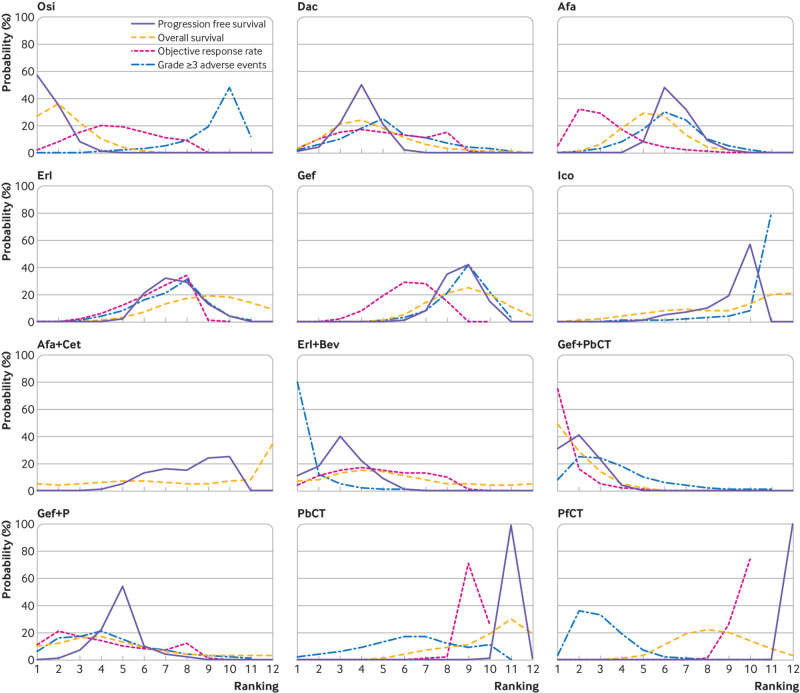
Bayesian ranking profiles of comparable treatments on efficacy for patients with advanced epidermal growth factor receptor mutated, non-small cell lung cancer. Profiles indicate the probability of each comparable treatment being ranked from first to last on progression free survival, overall survival, objective response rate, and grade ≥3 adverse events. Ranking curves are described according to the bayesian ranking results presented in supplementary table S3. Osi=osimertinib; Dac=dacomitinib; Afa=afatinib; Erl=erlotinib; Gef=gefitinib; Ico=icotinib; Cet=cetuximab; Bev=bevacizumab; Gef+P=gefitinib plus pemetrexed; PbCT=pemetrexed based chemotherapy; PfCT=pemetrexed free chemotherapy
Fig 6
Fig 6
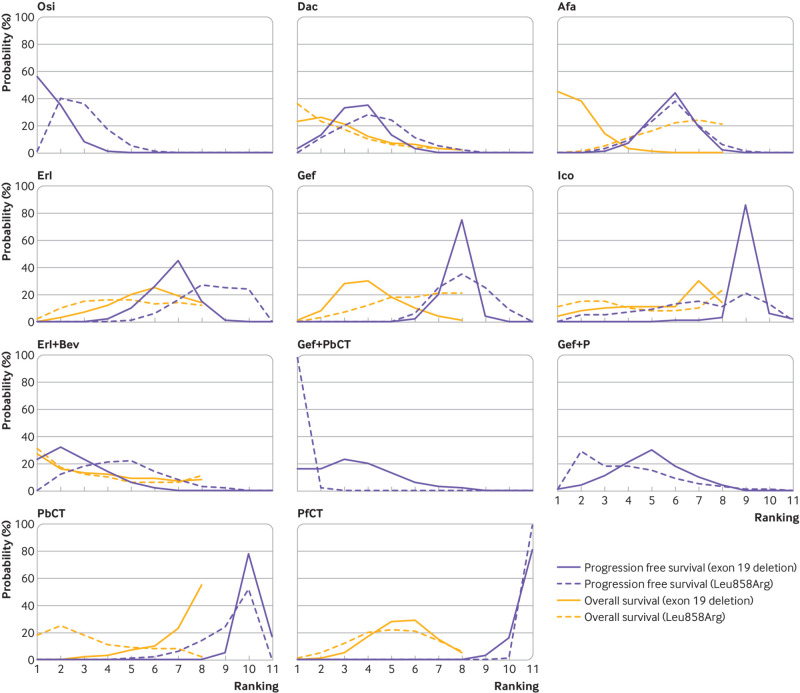
Bayesian ranking profiles of comparable treatments on safety for patients with advanced epidermal growth factor receptor mutated, non-small cell lung cancer, stratified into exon 19 deletion and Leu858Arg subgroups. Profiles indicate the probability of each comparable treatment being ranked from first to last on progression free survival and overall survival. Ranking curves are described according to the bayesian ranking results presented in supplementary table S3. Osi=osimertinib; Dac=dacomitinib; Afa=afatinib; Erl=erlotinib; Gef=gefitinib; Ico=icotinib; Bev=bevacizumab; Gef+P=gefitinib plus pemetrexed; PbCT=pemetrexed based chemotherapy; PfCT=pemetrexed free chemotherapy

References

    1. Torre LA, Bray F, Siegel RL, Ferlay J, Lortet-Tieulent J, Jemal A. Global cancer statistics, 2012. CA Cancer J Clin 2015;65:87-108. 10.3322/caac.21262. - DOI - PubMed
    1. Rosell R, Moran T, Queralt C, et al. Spanish Lung Cancer Group Screening for epidermal growth factor receptor mutations in lung cancer. N Engl J Med 2009;361:958-67. 10.1056/NEJMoa0904554. - DOI - PubMed
    1. Greenhalgh J, Dwan K, Boland A, et al. First-line treatment of advanced epidermal growth factor receptor (EGFR) mutation positive non-squamous non-small cell lung cancer. Cochrane Database Syst Rev 2016;(5):CD010383. 10.1002/14651858.CD010383.pub2. - DOI - PubMed
    1. NCCN clinical practice guidelines in oncology for non-small cell lung cancer. Version 2. 2019. https://www.nccn.org/patients. Accessed 21 November 2018.
    1. Yu HA, Arcila ME, Rekhtman N, et al. Analysis of tumor specimens at the time of acquired resistance to EGFR-TKI therapy in 155 patients with EGFR-mutant lung cancers. Clin Cancer Res 2013;19:2240-7. 10.1158/1078-0432.CCR-12-2246. - DOI - PMC - PubMed

Publication types

MeSH terms