


Electronic-cigarette smoke induces lung adenocarcinoma and bladder urothelial hyperplasia in mice
- PMID: 31591243
- PMCID: PMC6815158
- DOI: 10.1073/pnas.1911321116
Electronic-cigarette smoke induces lung adenocarcinoma and bladder urothelial hyperplasia in mice
Erratum in
-
Correction for Tang et al., Electronic-cigarette smoke induces lung adenocarcinoma and bladder urothelial hyperplasia in mice.Proc Natl Acad Sci U S A. 2019 Nov 5;116(45):22884. doi: 10.1073/pnas.1918000116. Epub 2019 Oct 28. Proc Natl Acad Sci U S A. 2019. PMID: 31659029 Free PMC article. No abstract available.
Abstract
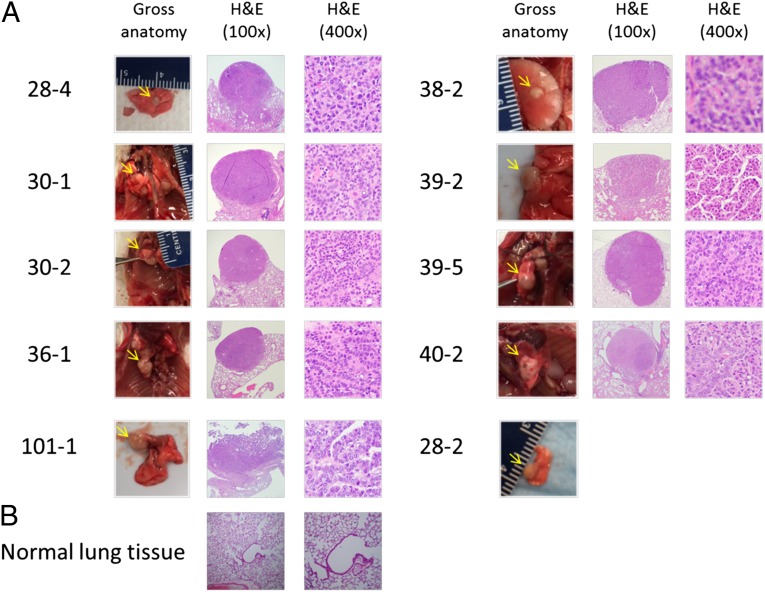
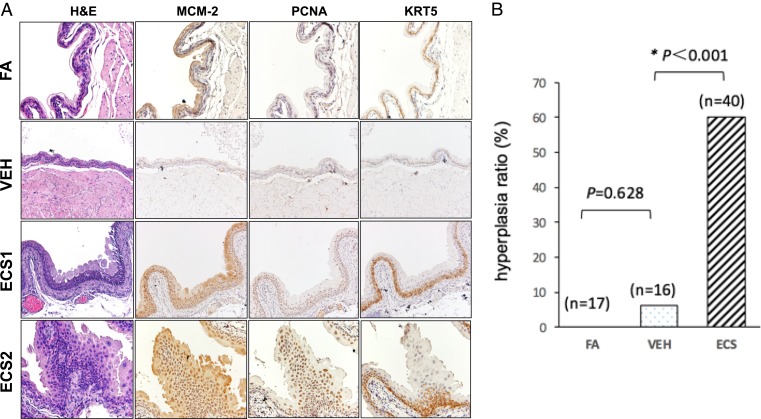
Electronic-cigarettes (E-cigs) are marketed as a safe alternative to tobacco to deliver the stimulant nicotine, and their use is gaining in popularity, particularly among the younger population. We recently showed that mice exposed to short-term (12 wk) E-cig smoke (ECS) sustained extensive DNA damage in lungs, heart, and bladder mucosa and diminished DNA repair in lungs. Nicotine and its nitrosation product, nicotine-derived nitrosamine ketone, cause the same deleterious effects in human lung epithelial and bladder urothelial cells. These findings raise the possibility that ECS is a lung and bladder carcinogen in addition to nicotine. Given the fact that E-cig use has become popular in the past decade, epidemiological data on the relationship between ECS and human cancer may not be known for a decade to come. In this study, the carcinogenicity of ECS was tested in mice. We found that mice exposed to ECS for 54 wk developed lung adenocarcinomas (9 of 40 mice, 22.5%) and bladder urothelial hyperplasia (23 of 40 mice, 57.5%). These lesions were extremely rare in mice exposed to vehicle control or filtered air. Current observations that ECS induces lung adenocarcinomas and bladder urothelial hyperplasia, combined with our previous findings that ECS induces DNA damage in the lungs and bladder and inhibits DNA repair in lung tissues, implicate ECS as a lung and potential bladder carcinogen in mice. While it is well established that tobacco smoke poses a huge threat to human health, whether ECS poses any threat to humans is not yet known and warrants careful investigation.
Keywords: DNA damage; DNA repair; bladder hyperplasia; electronic-cigarette; lung cancer.
Copyright © 2019 the Author(s). Published by PNAS.
Conflict of interest statement
The authors declare no competing interest.
Figures
Comment in
-
Reply to Young and Scott: Nicotine and nicotinic acetylcholine receptor mutations in electronic-cigarette smoke lung carcinogenicity.Proc Natl Acad Sci U S A. 2020 Mar 3;117(9):4462-4463. doi: 10.1073/pnas.1922490117. Epub 2020 Feb 11. Proc Natl Acad Sci U S A. 2020. PMID: 32047046 Free PMC article. No abstract available.
-
Inhaled nicotine and lung cancer: Potential role of the nicotinic acetylcholine receptor.Proc Natl Acad Sci U S A. 2020 Mar 3;117(9):4460-4461. doi: 10.1073/pnas.1921567117. Epub 2020 Feb 11. Proc Natl Acad Sci U S A. 2020. PMID: 32047047 Free PMC article. No abstract available.
References
-
- Hecht S. S., Hoffmann D., Tobacco-specific nitrosamines, an important group of carcinogens in tobacco and tobacco smoke. Carcinogenesis 9, 875–884 (1988). - PubMed
-
- Hecht S. S., Tobacco smoke carcinogens and lung cancer. J. Natl. Cancer Inst. 91, 1194–1210 (1999). - PubMed
-
- Howlader N., et al., Eds., SEER Cancer Statistics Review, 1975-2014 (National Cancer Institute, Bethesda, MD, 2016). https://seer.cancer.gov/csr/1975_2014/, based on November 2016 SEER data submission, posted to the SEER website, April 2017. Accessed 2 April 2018.
Publication types
MeSH terms
Substances
Grants and funding
LinkOut - more resources
Full Text Sources
Medical
Molecular Biology Databases
Miscellaneous
