


Early hominins evolved within non-analog ecosystems
- PMID: 31591246
- PMCID: PMC6815188
- DOI: 10.1073/pnas.1909284116
Early hominins evolved within non-analog ecosystems
Abstract
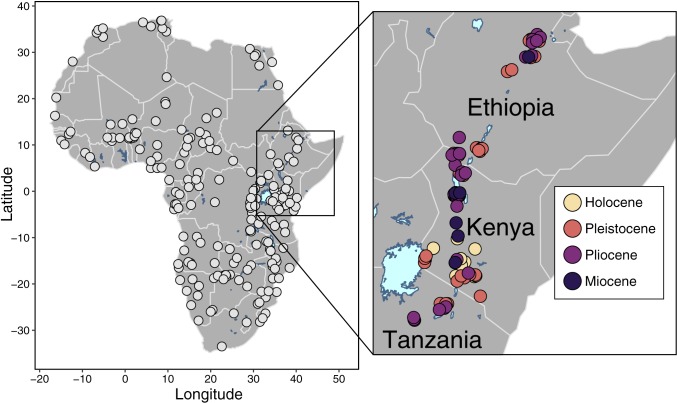
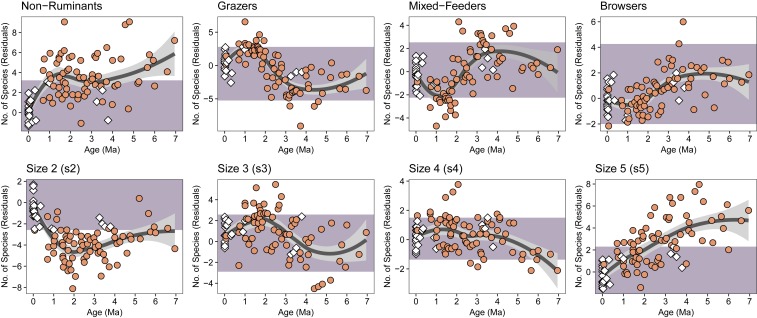
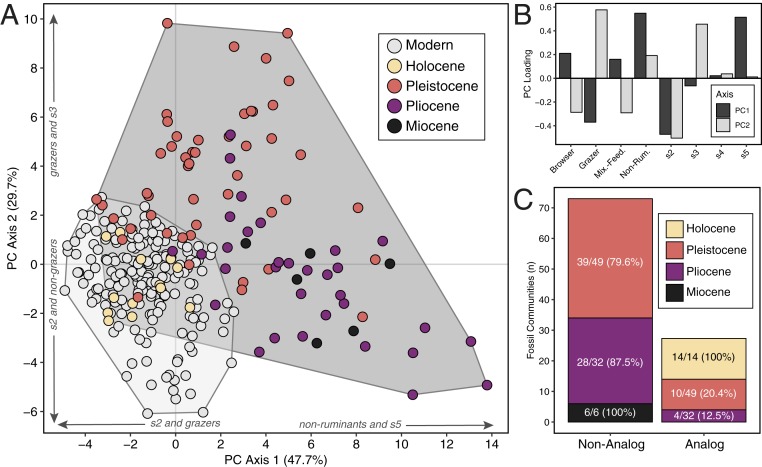
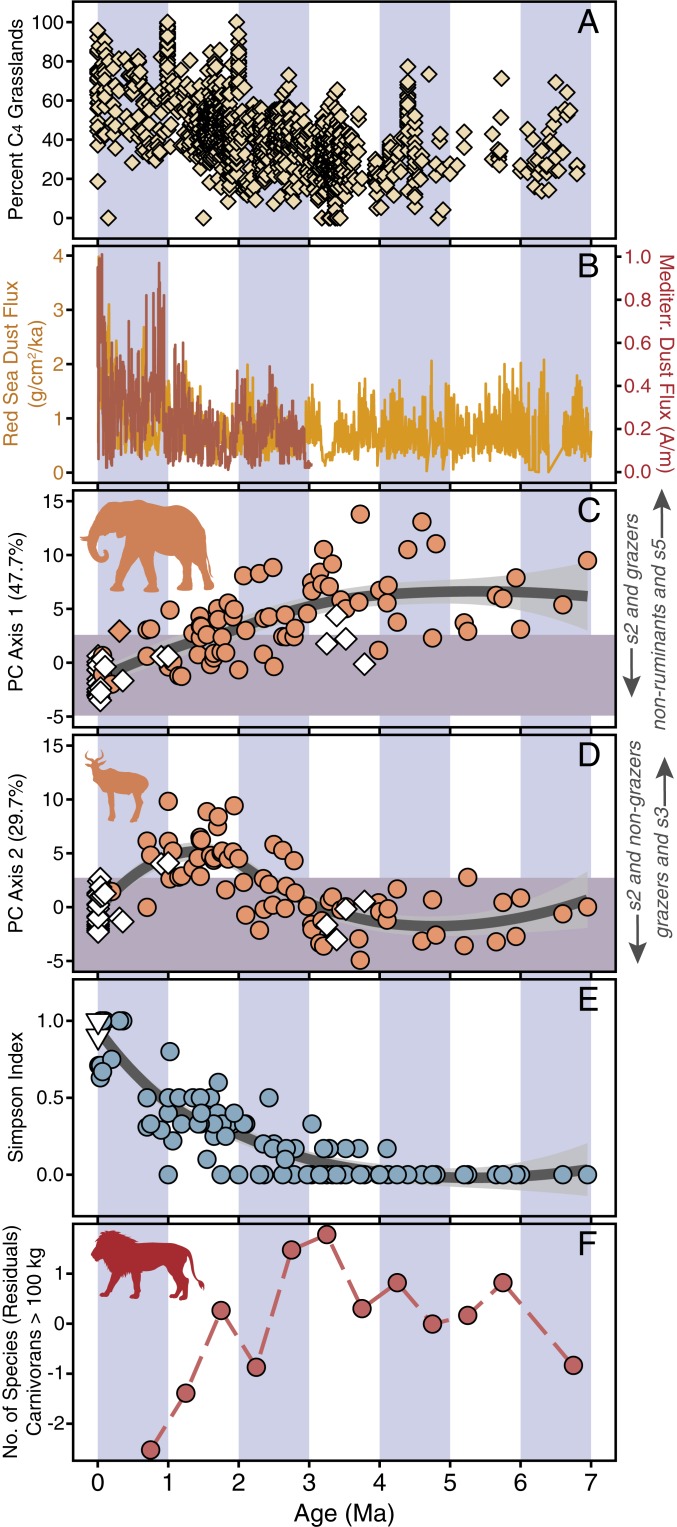
Present-day African ecosystems serve as referential models for conceptualizing the environmental context of early hominin evolution, but the degree to which modern ecosystems are representative of those in the past is unclear. A growing body of evidence from eastern Africa's rich and well-dated late Cenozoic fossil record documents communities of large-bodied mammalian herbivores with ecological structures differing dramatically from those of the present day, implying that modern communities may not be suitable analogs for the ancient ecosystems of hominin evolution. To determine when and why the ecological structure of eastern Africa's herbivore faunas came to resemble those of the present, here we analyze functional trait changes in a comprehensive dataset of 305 modern and fossil herbivore communities spanning the last ∼7 Myr. We show that nearly all communities prior to ∼700 ka were functionally non-analog, largely due to a greater richness of non-ruminants and megaherbivores (species >1,000 kg). The emergence of functionally modern communities precedes that of taxonomically modern communities by 100,000s of years, and can be attributed to the combined influence of Plio-Pleistocene C4 grassland expansion and pulses of aridity after ∼1 Ma. Given the disproportionate ecological impacts of large-bodied herbivores on factors such as vegetation structure, hydrology, and fire regimes, it follows that the vast majority of early hominin evolution transpired in the context of ecosystems that functioned unlike any today. Identifying how past ecosystems differed compositionally and functionally from those today is key to conceptualizing ancient African environments and testing ecological hypotheses of hominin evolution.
Keywords: functional traits; megaherbivore; non-analog faunas; paleoanthropology; paleoecology.
Conflict of interest statement
The authors declare no competing interest.
Figures
Comment in
-
Paleoecology: The Functional Uniqueness of Ancient Megafauna.Curr Biol. 2020 Jan 6;30(1):R32-R35. doi: 10.1016/j.cub.2019.11.017. Curr Biol. 2020. PMID: 31910375
-
Species richness and composition are not sufficient for determining the functionality of ancient ecosystems.Proc Natl Acad Sci U S A. 2020 Feb 18;117(7):3368-3369. doi: 10.1073/pnas.1920054117. Epub 2020 Feb 4. Proc Natl Acad Sci U S A. 2020. PMID: 32019877 Free PMC article. No abstract available.
-
Reply to Weihmann: Fifty gazelles do not equal an elephant, and other ecological misunderstandings.Proc Natl Acad Sci U S A. 2020 Feb 18;117(7):3370-3371. doi: 10.1073/pnas.1920565117. Epub 2020 Feb 4. Proc Natl Acad Sci U S A. 2020. PMID: 32019886 Free PMC article. No abstract available.
References
-
- Potts R., Environmental hypotheses of hominin evolution. Am. J. Phys. Anthropol. 41 (suppl. 27), 93–136 (1998). - PubMed
-
- deMenocal P. B., African climate change and faunal evolution during the Pliocene-Pleistocene. Earth Planet. Sci. Lett. 220, 3–24 (2004).
-
- Behrensmeyer A. K., Climate change and human evolution. Science 311, 476–478 (2006). - PubMed
-
- Marean C. W., et al. , A new research strategy for integrating studies of paleoclimate, paleoenvironment, and paleoanthropology. Evol. Anthropol. 24, 62–72 (2015). - PubMed
-
- Kingston J. D., Shifting adaptive landscapes: Progress and challenges in reconstructing early hominid environments. Am. J. Phys. Anthropol. 50 (suppl. 45), 20–58 (2007). - PubMed
Publication types
MeSH terms
LinkOut - more resources
Full Text Sources
Miscellaneous
