Higher thoracic radiation dose is beneficial in patients with extensive small cell lung cancer
- PMID: 31591866
- PMCID: PMC6790797
- DOI: 10.3857/roj.2019.00192
Higher thoracic radiation dose is beneficial in patients with extensive small cell lung cancer
Abstract
Purpose: The effectiveness of thoracic radiation therapy (TRT) in extensive-stage small cell lung cancer (ES-SCLC) patients is increasingly reported, but there is no definite consensus on its application. The aim of this study was to identify factors associated with better outcomes of TRT among patients with ES-SCLC, focusing on whether a higher TRT dose could improve treatment outcome.
Materials and methods: The medical records of 85 patients with ES-SCLC who received TRT between January 2008 and June 2017 were retrospectively reviewed. Eligibility criteria were a biological effective dose with α/β = 10 (BED) higher than 30 Gy10 and completion of planned radiotherapy.
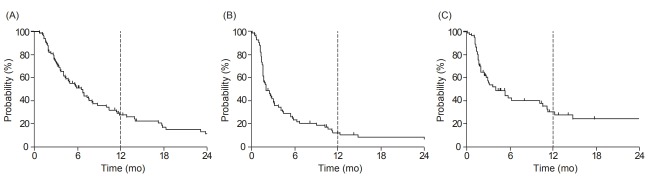
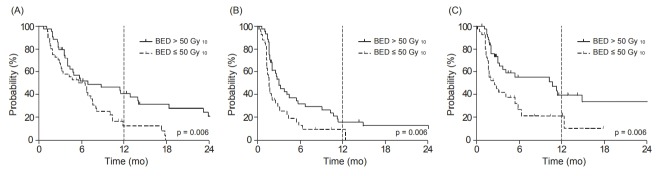
Results: During a median follow-up of 5.3 months, 68 patients (80.0%) experienced disease progression. In univariate analysis, a BED >50 Gy10 was a significant prognostic factor for overall survival (OS; 40.8% vs. 12.5%, p = 0.006), progression-free survival (PFS; 15.9% vs. 9.6%, p = 0.004), and intrathoracic PFS (IT-PFS; 39.3% vs. 20.5%, p = 0.004) at 1 year. In multivariate analysis, a BED >50 Gy10 remained a significant prognostic factor for OS (hazard ratio [HR] = 0.502; 95% confidence interval [CI], 0.287-0.876; p = 0.015), PFS (HR = 0.453; 95% CI, 0.265-0.773; p = 0.004), and IT-PFS (HR = 0.331; 95% CI, 0.171-0.641; p = 0.001). Response to the last chemotherapy was also associated with better OS in both univariate and multivariate analysis.
Conclusion: A TRT dose of BED >50 Gy10 may be beneficial for patients with ES-SCLC. Further studies are needed to select patients who will most benefit from high-dose TRT.
Keywords: Extensive-stage; Radiotherapy dosage; Small cell lung carcinoma.
Conflict of interest statement
No potential conflict of interest relevant to this article was reported.
Figures
References
-
- Govindan R, Page N, Morgensztern D, et al. Changing epidemiology of small-cell lung cancer in the United States over the last 30 years: analysis of the surveillance, epidemiologic, and end results database. J Clin Oncol. 2006;24:4539–44. - PubMed
-
- Siegel R, Ward E, Brawley O, Jemal A. Cancer statistics, 2011: the impact of eliminating socioeconomic and racial disparities on premature cancer deaths. CA Cancer J Clin. 2011;61:212–36. - PubMed
-
- Jeremic B. Thoracic radiation therapy in extensive disease small cell lung Cancer. Int J Radiat Oncol Biol Phys. 2015;93:7–9. - PubMed
-
- Slotman B, Faivre-Finn C, Kramer G, et al. Prophylactic cranial irradiation in extensive small-cell lung cancer. N Engl J Med. 2007;357:664–72. - PubMed
-
- Slotman BJ, van Tinteren H, Praag JO, et al. Use of thoracic radiotherapy for extensive stage small-cell lung cancer: a phase 3 randomised controlled trial. Lancet. 2015;385:36–42. - PubMed
Grants and funding
LinkOut - more resources
Full Text Sources