Review
. 2019 Oct;20(2):96-127.
doi: 10.1177/1529100619860513.

A Neurobehavioral Approach to Addiction: Implications for the Opioid Epidemic and the Psychology of Addiction

Affiliations
Review

A Neurobehavioral Approach to Addiction: Implications for the Opioid Epidemic and the Psychology of Addiction

Antoine Bechara et al. Psychol Sci Public Interest. 2019 Oct.

Abstract

Two major questions about addictive behaviors need to be explained by any worthwhile neurobiological theory. First, why do people seek drugs in the first place? Second, why do some people who use drugs seem to eventually become unable to resist drug temptation and so become "addicted"? We will review the theories of addiction that address negative-reinforcement views of drug use (i.e., taking opioids to alleviate distress or withdrawal), positive-reinforcement views (i.e., taking drugs for euphoria), habit views (i.e., growth of automatic drug-use routines), incentive-sensitization views (i.e., growth of excessive "wanting" to take drugs as a result of dopamine-related sensitization), and cognitive-dysfunction views (i.e., impaired prefrontal top-down control), including those involving competing neurobehavioral decision systems (CNDS), and the role of the insula in modulating addictive drug craving. In the special case of opioids, particular attention is paid to whether their analgesic effects overlap with their reinforcing effects and whether the perceived low risk of taking legal medicinal opioids, which are often prescribed by a health professional, could play a role in the decision to use. Specifically, we will address the issue of predisposition or vulnerability to becoming addicted to drugs (i.e., the question of why some people who experiment with drugs develop an addiction, while others do not). Finally, we review attempts to develop novel therapeutic strategies and policy ideas that could help prevent opioid and other substance abuse.

Keywords: decision making; incentive sensitization; insula; opioid abuse.


Conflict of interest statement

Declaration of Conflicting Interests

The author(s) declared that there were no conflicts of interest with respect to the authorship or the publication of this article.

Figures
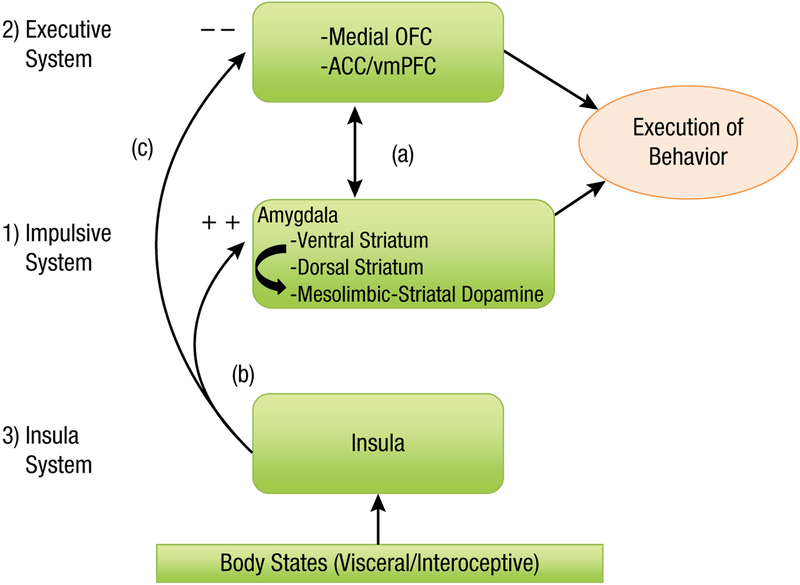
Fig. 1.
Fig. 1.
A schematic neurocognitive model illustrating a proposed functional role for three key neural systems in addiction: The first two systems include the competing-neurobehavioral-decision-systems (CNDS) model, which consists of an impulsive system that includes the amygdala and its connections to the ventral and dorsal striatum, and their associated mesolimbic dopamine systems. This system mediates, at least in part, the motivational wanting and habitual/compulsive seeking of drug reward. The executive system includes the prefrontal in general (i.e., dorsal and medial sectors), but in particular, the regions more concerned with decision making and “willpower”: the medial orbitofrontal/ventromedial prefrontal cortex (OFC/vmPFC), and adjacent anterior cingulate cortex (ACC). This system forecasts the future consequences of a behavior such as seeking drugs, and normally exerts control over the impulsive system (a). The functional role of the insula system emerged more recently, and it seems to play a role in modulating the functions of the impulsive and executive systems in response to perturbances in the viscera and homeostasis. More specifically, internal factors associated with deprivation states (e.g., withdrawal or pain) or emotional states (e.g., anxiety and stress) are viewed as a “gate” that determines how effective the incentive input is in exciting the motivational circuits that “pull” and “steer” the person toward the appropriate goal object. This process depends on the insula. Interoceptive signals arising from the body, reflecting the status of the viscera and homeostasis, and mediated through the insula, will adjust the strengths of the conflicting signals, thereby increasing the influence of the impulsive system (b), and potentially overriding the inhibitory control of the executive system (c). An additional possibility is that insula signals may subvert the decision-making processes of the reflective system that supports planning actions to seek and procure drugs.
Fig. 2.
Fig. 2.
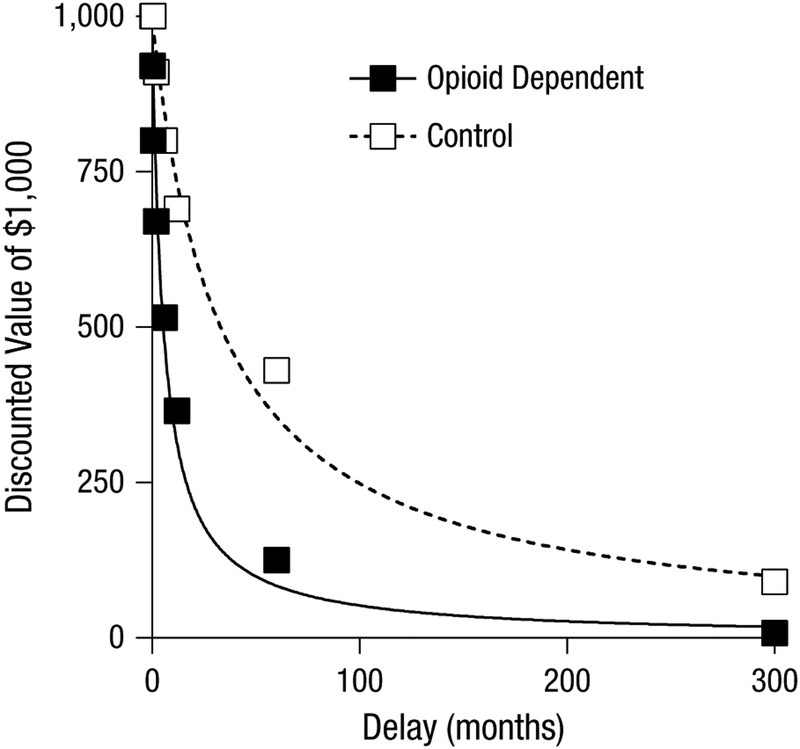
Evidence of greater discounting in opioid users compared with demographically matched controls. Data replotted from Madden et al. (1997).
Fig. 3.
Fig. 3.
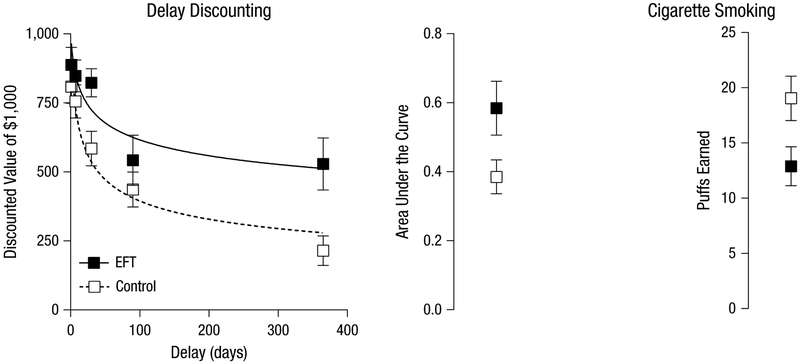
Effects of an episodic future thinking (EFT) intervention on delay discounting (left) and the number of cigarette puffs earned during a self-administration task (right) in cigarette smokers. Data replotted from Stein et al. (2016).

Comment in

References

    1. Ainslie G, & Monterosso J (2003). Hyperbolic discounting as a factor in addiction: A critical analysis. In Vuchinich RE & Heather N (Eds.), Choice, behavioural economics and addiction (pp. 35–69). doi:10.1016/B978-008044056-9/50043-9 - DOI
    1. Al-Hasani R, McCall JG, Shin G, Gomez AM, Schmitz GP, Bernardi JM, … Bruchas MR (2015). Distinct subpopulations of nucleus accumbens dynorphin neurons drive aversion and reward. Neuron, 87, 1063–1077. doi:10.1016/j.neuron.2015.08.019 - DOI - PMC - PubMed
    1. Amiaz R, Levy D, Vainiger D, Grunhaus L, & Zangen A (2009). Repeated high-frequency transcranial magnetic stimulation over the dorsolateral prefrontal cortex reduces cigarette craving and consumption. Addiction, 104, 653–660. doi:10.1111/j.1360-0443.2008.02448.x - DOI - PubMed
    1. Amlung M, Sweet LH, Acker J, Brown CL, & MacKillop J (2014). Dissociable brain signatures of choice conflict and immediate reward preferences in alcohol use disorders. Addiction Biology, 19, 743–753. doi:10.1111/adb.12017 - DOI - PMC - PubMed
    1. Amlung M, Vedelago L, Acker J, Balodis I, & MacKillop J (2017). Steep delay discounting and addictive behavior: A meta-analysis of continuous associations. Addiction, 112, 51–62. doi:10.1111/add.13535 - DOI - PMC - PubMed