


Are We Witnessing a Paradigm Shift?: A Systematic Review of Social Media in Residency
- PMID: 31592016
- PMCID: PMC6756642
- DOI: 10.1097/GOX.0000000000002288
Are We Witnessing a Paradigm Shift?: A Systematic Review of Social Media in Residency
Abstract
As social media's applications continue to evolve, the pitfalls and dangers associated with misuse have been accentuated in the literature. Consequently, academic institutions across the nation have implemented social media policies. This study is aimed to evaluate the state of social media literature examining postgraduate trainees (residents/fellows).
Methods: A systematic search was performed identifying peer-reviewed publications presenting original research. Studies published through December 8, 2018, focusing on social media use among postgraduate trainees were considered for inclusion.
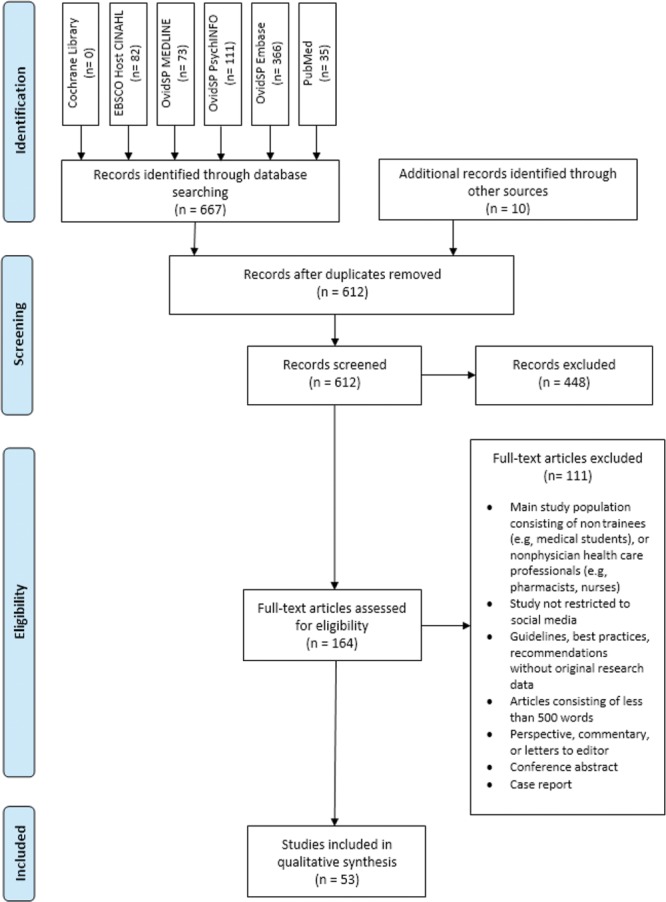
Results: Fifty-three studies were categorized into 4 domains: (1) resident recruitment, (2) graduate medical education, (3) professional development, and (4) academic scholarship. Thirty-four (64.15%) investigated social media's impact on professional development, of which 16 (47.05%) highlighted the detrimental potential on trainee professionalism. The remaining 18 (52.94%) focused on promoting social media training during residency, and/or enhancing social media competency to benefit professional development. Fourteen (26.42%) rationalized social media use in augmenting graduate medical education. Ten (18.87%) assessed social media's influence on resident recruitment, of which 7 (70%) depicted use as a screening instrument for program directors on resident applicants. Two (3.77%) of the studies introduced social media as a platform for academic scholarship with indicators as altmetrics.
Conclusions: The well-established disadvantages of social media use by the postgraduate trainee continue to persist in the literature. However, there is recognition of social media as a valuable resource in influencing resident recruitment, graduate medical education, professional development, and academic scholarship, representing a paradigm shift-from cautiously avoidant to thoughtful capitalization on its immense potential.
Copyright © 2019 The Authors. Published by Wolters Kluwer Health, Inc. on behalf of The American Society of Plastic Surgeons.
Figures

References
-
- Pew Research Center. Social media fact sheet. Pew Research Center: Internet, Science & Tech. 2017. https://www.pewinternet.org/fact-sheet/social-media/. Accessed December 2018.
-
- Fan KL, Economides JM, Song DH. To bot or not? Challenging the top social media influencers in #plasticsurgery. Plast Reconstr Surg. 2019;143:337–343. - PubMed
-
- Branford OA, Kamali P, Rohrich RJ, et al. #Plasticsurgery. Plast Reconstr Surg. 2016;138:1354–1365. - PubMed
-
- Mabvuure NT, Rodrigues J, Klimach S, et al. A cross-sectional study of the presence of United Kingdom (UK) plastic surgeons on social media. J Plast Reconstr Aesthet Surg. 2014;67:362–367. - PubMed
-
- Chandawarkar AA, Gould DJ, Stevens WG. Insta-grated plastic surgery residencies: the rise of social media use by trainees and responsible guidelines for use. Aesthet Surg J. 2018;38:1145–1152. - PubMed
LinkOut - more resources
Full Text Sources
Research Materials