Linking Daily-Life Interpersonal Stressors and Health Problems Via Affective Reactivity in Borderline Personality and Depressive Disorders
- PMID: 31592936
- PMCID: PMC6934909
- DOI: 10.1097/PSY.0000000000000728
Linking Daily-Life Interpersonal Stressors and Health Problems Via Affective Reactivity in Borderline Personality and Depressive Disorders
Abstract
Objective: Borderline personality disorder (BPD) is associated with unstable interpersonal relationships, affective instability, and physical health problems. In individuals with BPD, intense affective reactions to interpersonal stressors may contribute to the increased prevalence of health problems.
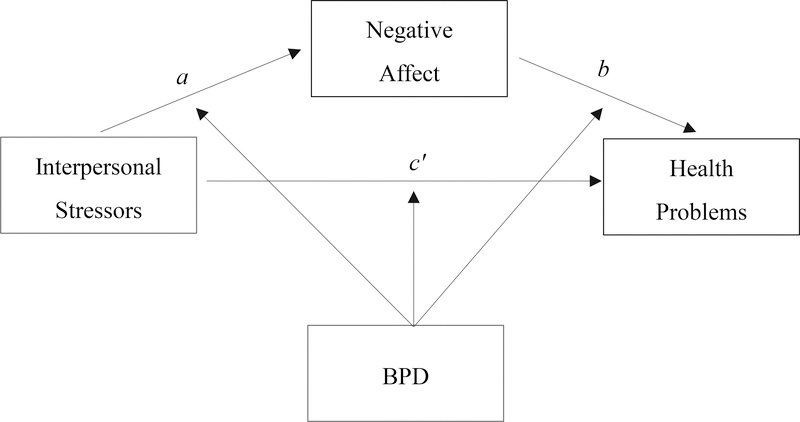
Methods: BPD (n = 81) and depressed participants (DD; n = 50) completed six daily ambulatory assessment prompts for 28 days. At each prompt, participants reported interpersonal stressors (disagreements, rejections, feeling let down), negative affect, and health problems in four domains (gastrointestinal, respiratory, aches, depressive symptoms). In multilevel moderated mediation models, we examined the indirect effects of interpersonal stressors on health problems via negative affect, by group.
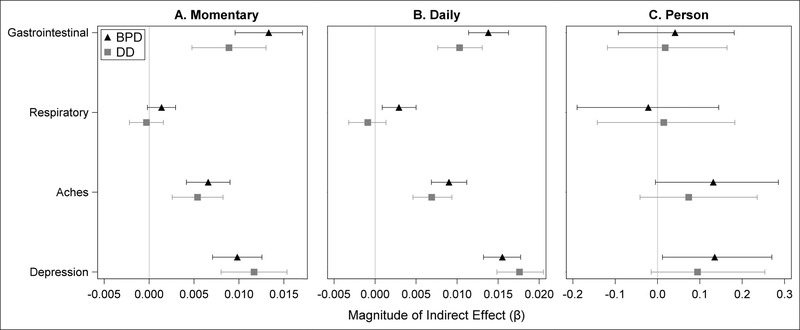
Results: Interpersonal stressors were positively associated with negative affect in both groups (β values > 0.12, p values < .001), but more so for participants with BPD (βDay = 0.05, p < .001). Negative affect was positively associated with health problems across all domains (βMoment/Day values > 0.01, p values < .046), but associations were larger at the day level for respiratory symptoms in BPD (β = 0.02, p = .025) and for depressive symptoms in DD (β = 0.04, p < .001). Negative affect mediated the association of interpersonal stressors and health problems in both groups, with larger effects for the DD group for depressive problems (β = 0.02, p = .092) and for the BPD group for the other three domains (β values > 0.02, p values < .090).
Conclusions: Interpersonal stressors may contribute to increased physical health problems via an inability to regulate affective responses to such events. This pathway may be stronger in several health domains for those with BPD and may contribute to an elevated risk of morbidity and mortality in this disorder, suggesting a target for intervention to reduce these risks.
Figures
References
-
- American Psychiatric Association; Diagnostic and Statistical Manual of Mental Disorders: DSM-5. Washington, DC: American Psychiatric Association; 2013.
-
- Fok M, Hotopf M, Stewart R, Hatch S, Hayes R, Moran P. Personality disorder and self-rated health: a population-based cross-sectional survey. J Pers Disord. 2014;28:319–33. - PubMed
-
- Grant BF, Chou SP, Goldstein RB, Huang B, Stinson FS, Saha TD, Smith SM, Dawson DA, Pulay AJ, Pickering RP. Prevalence, correlates, disability, and comorbidity of DSM-IV borderline personality disorder: results from the Wave 2 National Epidemiologic Survey on Alcohol and Related Conditions. J Clin Psychiatry. 2008;69:533. - PMC - PubMed
-
- El-Gabalawy R, Katz LY, Sareen J. Comorbidity and associated severity of borderline personality disorder and physical health conditions in a nationally representative sample. Psychosom Med. 2010;72:641–7. - PubMed
Publication types
MeSH terms
Grants and funding
LinkOut - more resources
Full Text Sources
Medical