Review
. 2019 Dec:59:178-187.
doi: 10.1016/j.sbi.2019.08.003. Epub 2019 Oct 6.

cGAS and CD-NTase enzymes: structure, mechanism, and evolution

Affiliations
Review

cGAS and CD-NTase enzymes: structure, mechanism, and evolution

Philip J Kranzusch. Curr Opin Struct Biol. 2019 Dec.

Abstract

Cyclic GMP-AMP synthase (cGAS) is a signaling enzyme in human cells that controls immune-sensing of cytosolic DNA. The recent discoveries of diverse structural homologs of cGAS in animals and bacteria reveal that cGAS-like signaling is surprisingly ancient and widespread in biology. Together with the Vibrio cholerae protein dinucleotide cyclase in Vibrio (DncV), cGAS and DncV homologs comprise a family of cGAS/DncV-like nucleotidyltransferase (CD-NTase) enzymes that synthesize noncanonical RNA signals including cyclic dinucleotides, cyclic trinucleotides, and linear oligonucleotides. Structural and biochemical breakthroughs provide a framework to understand how CD-NTase signaling allows cells to respond to changing environmental conditions. The CD-NTase family also includes uncharacterized human genes like MB21D2 and Mab21L1, highlighting emerging functions of cGAS-like signaling beyond innate immunity.


Figures

Figure 1
Figure 1
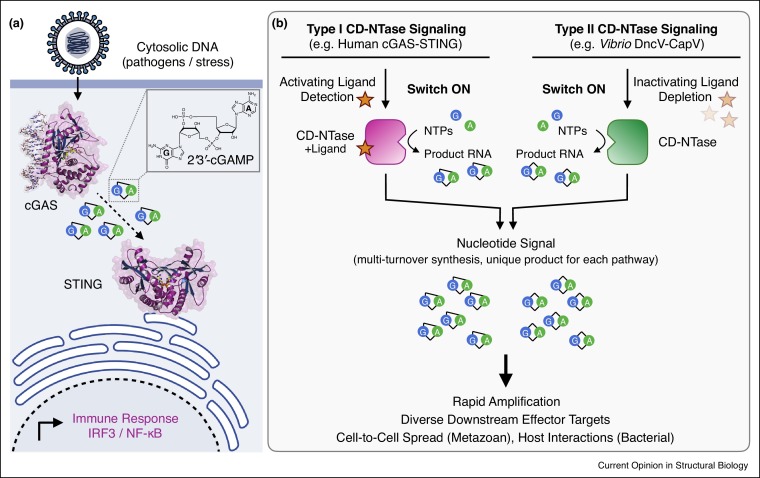
CD-NTase signaling in animals and bacteria. (a) Cartoon schematic of the human cGAS-STING signaling pathway. cGAS binds to cytosolic double-stranded DNA and is activated to produce the second messenger 2′3′-cGAMP. 2′3′-cGAMP is recognized by STING, and initiates a downstream IRF3/NF-κB-dependent immune response. (b) Overview of Type I and Type II CD-NTase Signaling. Type I CD-NTase pathways like human cGAS-STING rely on detection of an activating ligand (e.g. cytosolic DNA) depicted here as a star. In contrast, Type II CD-NTase pathways like Vibrio DncV-CapV are active in the absence of ligand, and may rely on depletion of a ligand (e.g. folate-like metabolites) that represses enzyme activation. In either case, activated CD-NTases catalyze multi-turnover synthesis of a nucleotide second messenger (e.g. 2′3′-cGAMP or 3′3′-cGAMP) to amplify signaling and initiate downstream effector responses.
Figure 2
Figure 2
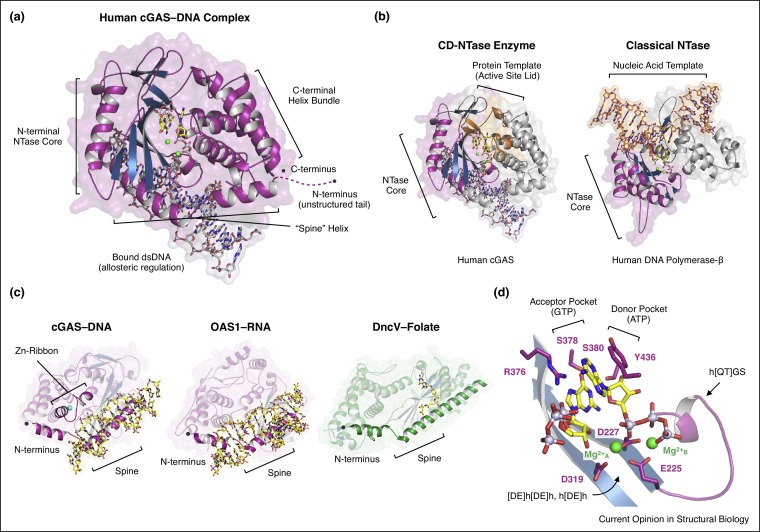
Structural anatomy of cGAS and CD-NTase enzymes. (a) Structural overview of the human cGAS–DNA complex. CD-NTase enzymes adopt a conserved cage-like structure where a long α-helix ‘spine’ braces an N-terminal NTase core and C-terminal helix bundle. Note, a 1:1 unit of cGAS–DNA is shown for clarity, but the minimally active complex is a 2:2 unit. (b) The cage-like architecture creates a deep cavity for nucleotide substrate coordination and enzymatic catalysis. Unlike classical nucleotidyltransferases (NTases) like DNA polymerase-β that require a nucleic acid template (orange, right) to dictate nucleotide substrate specificity, amino-acid side chains in the CD-NTase active-site lid (orange, left) directly control nucleotide interactions. (c) Structural overview of the ligand binding surfaces in the cGAS–DNA, OAS–RNA, and DncV–folate complexes. Structures are shown rotated 180° from the orientation in (a). Activating and inactivating CD-NTase ligands (yellow) bind on the back of the enzyme along the α-helix spine. Insertion of a zinc-ribbon (Zn-Ribbon) along the ligand-binding surface in part explains evolution of cGAS specificity for DNA interactions. (d) CD-NTase active sites contain a highly conserved h[QT]GS, DE[h[DE]h, h[DE]h catalytic triad and distinct ‘acceptor’ and ‘donor’ nucleotide pockets. Each CD-NTase catalyzes a multi-step reaction that proceeds through a defined reaction path (e.g. the cGAS intermediate product is pppG[2′–5′]pA).
Figure 3
Figure 3
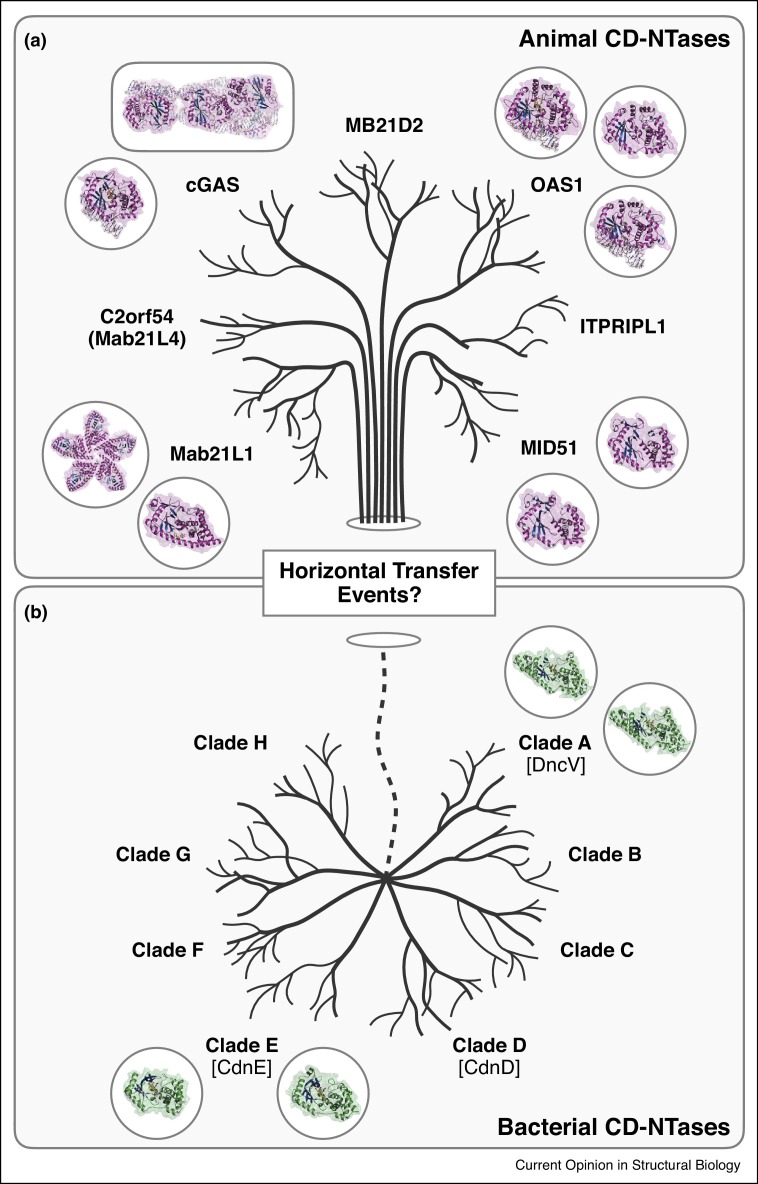
Conservation and evolution of the CD-NTase enzyme family. (a, b) Overview of shared conservation of animal (top, magenta) and bacterial (bottom, green) CD-NTases. Distinct branches of individual animal CD-NTase proteins may have arisen from ancestral enzymes rooted in bacteria. Known structures are shown as schematics, and the hypothesized horizontal transfer events are indicated as a dashed line.

References

    1. Ablasser A., Goldeck M., Cavlar T., Deimling T., Witte G., Rohl I., Hopfner K.P., Ludwig J., Hornung V. cGAS produces a 2’-5’-linked cyclic dinucleotide second messenger that activates STING. Nature. 2013;498:380–384. - PMC - PubMed
    1. Diner E.J., Burdette D.L., Wilson S.C., Monroe K.M., Kellenberger C.A., Hyodo M., Hayakawa Y., Hammond M.C., Vance R.E. The innate immune DNA sensor cGAS produces a noncanonical cyclic dinucleotide that activates human STING. Cell Rep. 2013;3:1355–1361. - PMC - PubMed
    1. Gao P., Ascano M., Wu Y., Barchet W., Gaffney B.L., Zillinger T., Serganov A.A., Liu Y., Jones R.A., Hartmann G., et al. Cyclic [G(2',5')pA(3',5')p] is the metazoan second messenger produced by DNA-activated cyclic GMP-AMP synthase. Cell. 2013;153:1094–1107. - PMC - PubMed
    2. One of two papers (see also Civril et al. [9]) reporting the first structure of the cGAS–DNA complex and the mechanism of 2'3' cGAMP product formation.

    1. Sun L., Wu J., Du F., Chen X., Chen Z.J. Cyclic GMP-AMP synthase is a cytosolic DNA sensor that activates the type I interferon pathway. Science. 2013;339:786–791. - PMC - PubMed
    2. Discovery of cGAS as a cytosolic DNA sensor and first reported connection between cGAS and OAS1.

    1. Zhang X., Shi H., Wu J., Zhang X., Sun L., Chen C., Chen Z.J. Cyclic GMP-AMP containing mixed phosphodiester linkages is an endogenous high-affinity ligand for STING. Mol Cell. 2013;51:226–235. - PMC - PubMed

Publication types

MeSH terms

Substances

LinkOut - more resources