


Neurobehavioral phenotype of autism spectrum disorder associated with germline heterozygous mutations in PTEN
- PMID: 31594918
- PMCID: PMC6783427
- DOI: 10.1038/s41398-019-0588-1
Neurobehavioral phenotype of autism spectrum disorder associated with germline heterozygous mutations in PTEN
Abstract
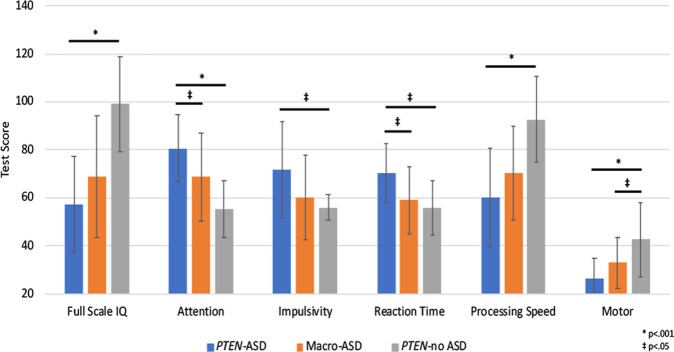
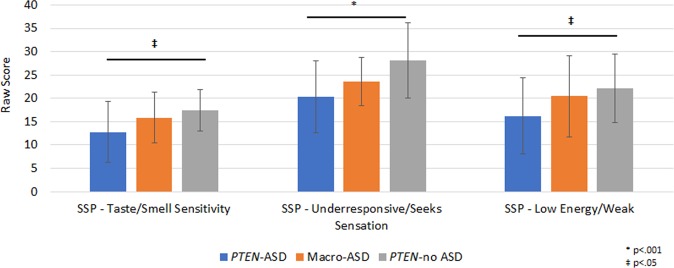
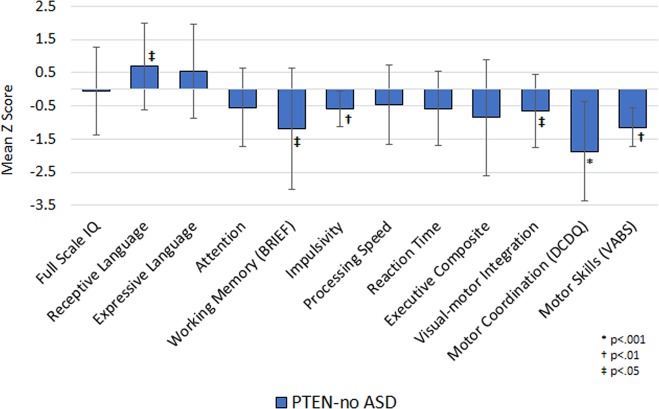
Germline mutations in PTEN, the gene that encodes phosphatase and tensin homolog, have been identified in up to 20% of children with autism spectrum disorder (ASD) and macrocephaly and are associated with marked abnormalities in the white matter of the brain. This study sought to characterize the neurobehavioral phenotype of PTEN-ASD. Comprehensive neurobehavioral evaluations were conducted in 36 participants (ages 3-21 years) with PTEN-ASD and compared to two groups of controls: non-syndromic ASD with macrocephaly (Macro-ASD, n = 25) and those with PTEN mutations without ASD (PTEN-no ASD, n = 23). Linear regression analysis or Kruskal-Wallis tests were used to examine group differences on neurobehavioral measures (cognitive, behavioral, sensory, and adaptive functioning) and, for select measures, one-sample t-tests were used to compare group performance to healthy control norms. These analyses revealed a distinct neuropsychological profile associated with mutations in PTEN suggesting primary disruption of frontal lobe systems (i.e., attention, impulsivity, reaction time, processing speed, and motor coordination). Cognitive deficits in PTEN-ASD are more severe than those in PTEN-no ASD and extend to other areas of neurobehavioral function, specifically, adaptive behavior and sensory deficits. While core ASD symptoms are similar in PTEN-ASD and Macro-ASD, PTEN-ASD had lower clinical ratings of autism severity and showed more sensory abnormalities suggestive of less sensory responsiveness. Together, these results suggest that PTEN-ASD has a distinct neurobehavioral phenotype compared to idiopathic ASD that is likely to warrant special consideration for overall assessment and treatment.
Conflict of interest statement
Dr. Busch has no relevant financial interests or potential conflicts of interest to report. Dr. Srivastava has no relevant financial interests or potential conflicts of interest to report. Ms. Hogue has no relevant financial interests or potential conflicts of interest to report. Dr. Frazier has received federal funding or research support from, acted as a consultant to, received travel support from, and/or received a speaker’s honorarium from the Cole Family Research Fund, Simons Foundation, Ingalls Foundation, Forest Laboratories, Ecoeos, IntegraGen, Kugona LLC, Shire Development, Bristol-Myers Squibb, Roche Pharma, National Institutes of Health, and the Brain and Behavior Research Foundation. Dr. Klaas has no relevant financial interests or potential conflicts of interest to report. Dr. Hardan has no relevant financial interests or potential conflicts of interest to report. Dr. Martinez-Agosto has no relevant financial interests or potential conflicts of interest to report. Dr. Sahin reports grant support from Novartis, Roche, Pfizer, Ipsen, LAM Therapeutics and Quadrant Biosciences, and he has served on Scientific Advisory Boards for Sage, Roche, Celgene and Takeda, all unrelated to this project. Dr. Eng has no relevant financial interests or potential conflicts of interest to report.
Figures
References
-
- American Psychiatric Association. Diagnostic and Statistical Manual of Mental Disorders, Fifth Edition. American Psychiatric Association. Retrieved July 5, 2016, from http://psychiatryonline.org/doi/book/10.1176/appi.books.9780890425596. (2013). - DOI
