Review
. 2020;11(2):158-171.
doi: 10.1080/19490976.2019.1674124. Epub 2019 Oct 9.

Diversification of host bile acids by members of the gut microbiota

Affiliations
Review

Diversification of host bile acids by members of the gut microbiota

Jenessa A Winston et al. Gut Microbes. 2020.

Abstract

Bile acid biotransformation is a collaborative effort by the host and the gut microbiome. Host hepatocytes synthesize primary bile acids from cholesterol. Once these host-derived primary bile acids enter the gastrointestinal tract, the gut microbiota chemically modify them into secondary bile acids. Interest into the gut-bile acid-host axis is expanding in diverse fields including gastroenterology, endocrinology, oncology, and infectious disease. This review aims to 1) describe the physiologic aspects of collaborative bile acid metabolism by the host and gut microbiota; 2) to evaluate how gut microbes influence bile acid pools, and in turn how bile acid pools modulate the gut microbial community structure; 3) to compare species differences in bile acid pools; and lastly, 4) discuss the effects of ursodeoxycholic acid (UDCA) administration, a common therapeutic bile acid, on the gut microbiota-bile acid-host axis.

Keywords: C. difficile; FXR; bile acids; gut microbiota; ursodeoxycholic acid (UDCA).


Figures
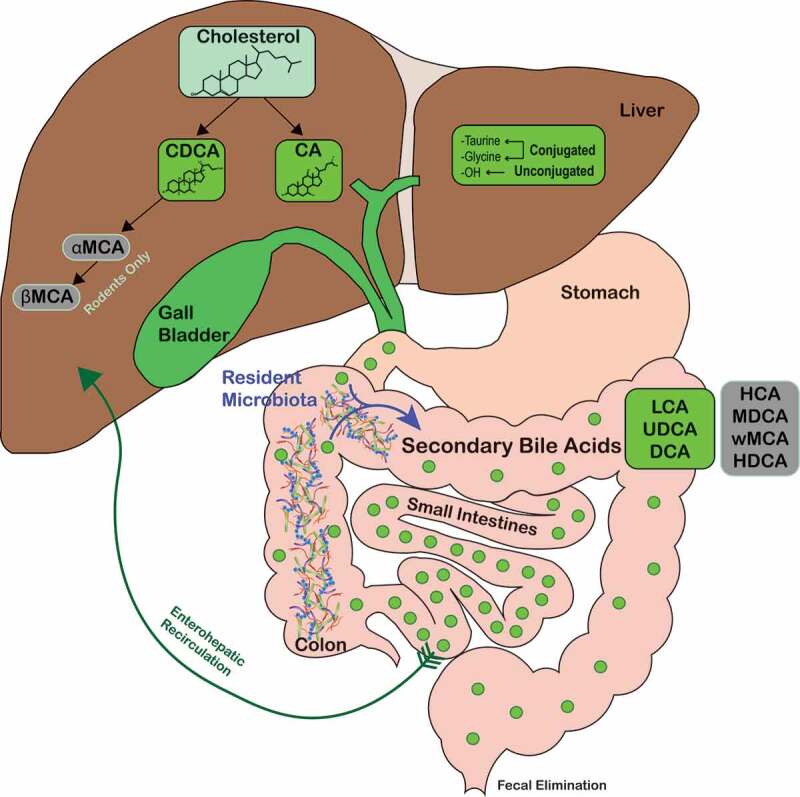
Figure 1.
Figure 1.
Overview of bile acid metabolism and enterohepatic recirculation. Host-derived primary bile acids are synthesized by heptocytes (CA and CDCA in humans, and CA, CDCA, αMCA, and βMCA in rodents) and conjugated with either taurine or glycine. Primary bile acids are then secreted into the bile and stored in the gallbladder until secreted in the duodenum. Resident gut microbiota biotransform primary bile acids into secondary bile acids such as LCA, UDCA, and DCA (green shaded circles) and HCA, MDCA, ωMCA, and HDCA in rodents (gray-shaded circles). Abbreviations: CA, cholate; CDCA, chenodeoxycholate; DCA, deoxycholate; HCA, hyocholate; HDCA, hyodeoxycholate; LCA, lithocholate; MDCA, murideoxycholate; UDCA, ursodeoxycholate; αMCA, α-muricholate; βMCA, β-muricholate; ωMCA, ω-muricholate.
Figure 2.
Figure 2.
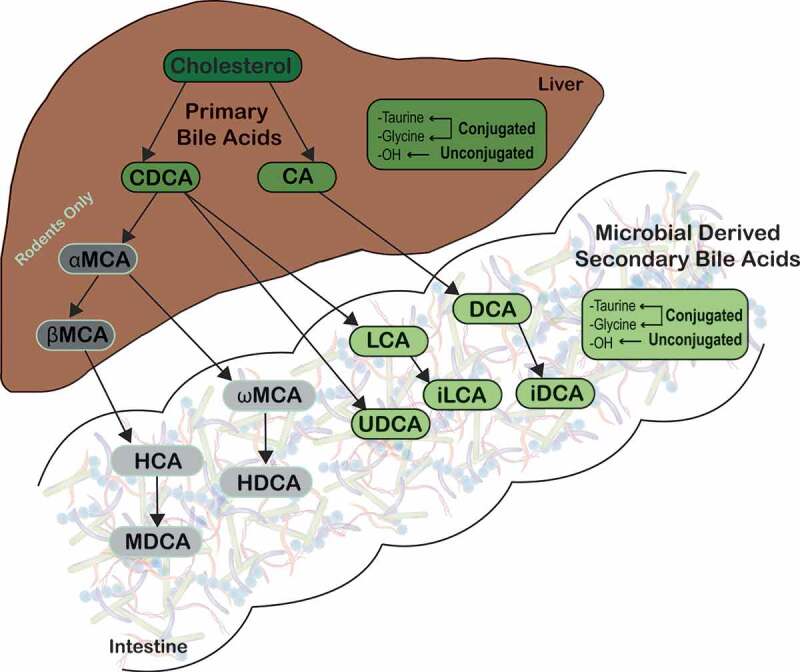
Microbial metabolism of host-derived primary bile acids. Primary bile acids are synthesized from cholesterol by hepatocytes. Primary bile acids are then biotransformed by resident bacteria in the gastrointestinal tract to secondary bile acids, such as LCA and DCA, which predominate in humans. Abbreviations: CA, cholate; CDCA, chenodeoxycholate; DCA, deoxycholate; HCA, hyocholate; HDCA, hyodeoxycholate; LCA, lithocholate; MDCA, murideoxycholate; UDCA, ursodeoxycholate; αMCA, α-muricholate; βMCA, β-muricholate; ωMCA, ω-muricholate.
Figure 3.
Figure 3.
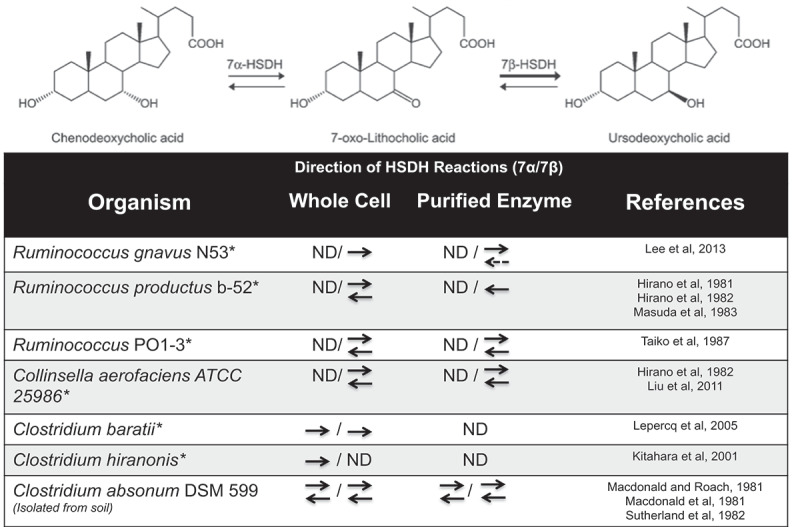
Directions of 7α/7β-HSDH reactions form UDCA-producing bacteria. Epimerization reaction from CDCA to UDCA, which is catalyzed by the 7α-HSDH and 7β-HSDH enzymes. ND: Not determined; *: Found in the gastrointestinal tract. Dashed line denotes weak reaction. Figure modified from Lee et al. 2013.61

References

    1. Begley M, Gahan CG, Hill C.. The interaction between bacteria and bile. FEMS Microbiol Rev. 2005;29(4):625–651. doi:10.1016/j.femsre.2004.09.003. - DOI - PubMed
    1. Setchell KD, Lawson AM, Tanida N, Sjovall J. General methods for the analysis of metabolic profiles of bile acids and related compounds in feces. J Lipid Res. 1983;24:1085–1100. - PubMed
    1. Ridlon JM, Bajaj JS. The human gut sterolbiome: bile acid-microbiome endocrine aspects and therapeutics. Acta Pharmaceutica Sinica B. 2015;5(2):99–105. doi:10.1016/j.apsb.2015.01.006. - DOI - PMC - PubMed
    1. Fiorucci S, Distrutti E. Bile acid-activated receptors, intestinal microbiota, and the treatment of metabolic disorders. Trends Mol Med. 2015;21:702–714. doi:10.1016/j.molmed.2015.09.001. - DOI - PubMed
    1. Kuipers F, Bloks VW, Groen AK. Beyond intestinal soap–bile acids in metabolic control. Nat Rev Endocrinol. 2014;10(8):488–498. doi:10.1038/nrendo.2014.60. - DOI - PubMed

Publication types

MeSH terms

LinkOut - more resources