


Youth Participatory Action Research for Youth Substance Use Prevention: A Systematic Review
- PMID: 31596160
- PMCID: PMC8034545
- DOI: 10.1080/10826084.2019.1668014
Youth Participatory Action Research for Youth Substance Use Prevention: A Systematic Review
Abstract
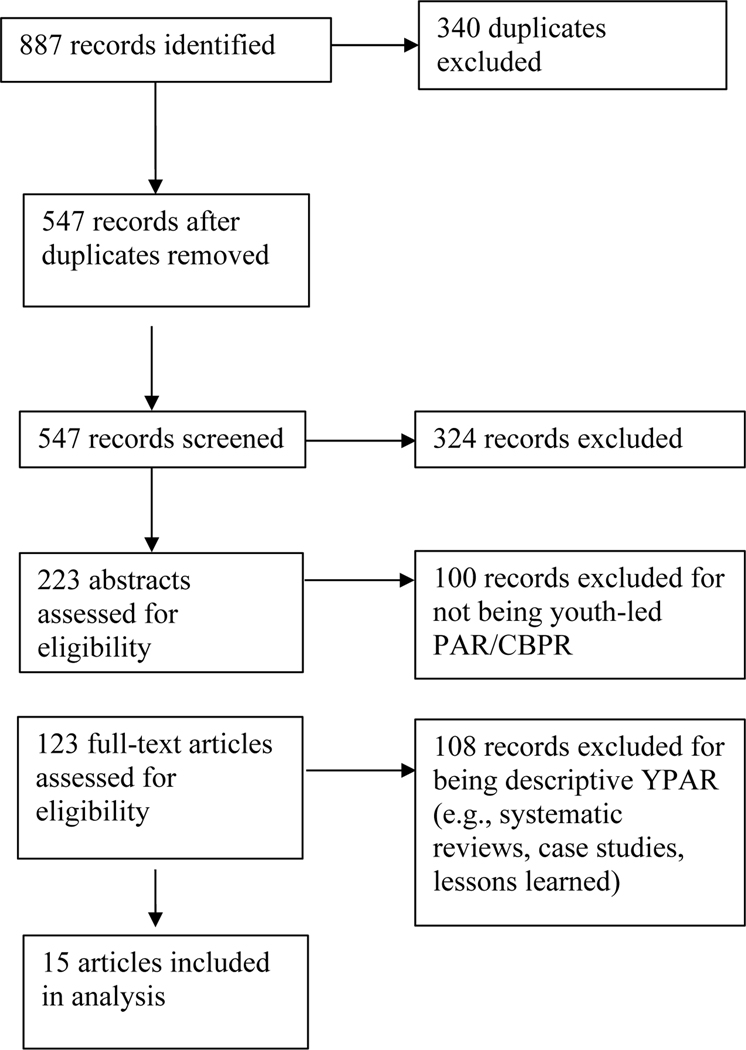
Background: A growing body of research points to the efficacy of participatory methods in decreasing rates of alcohol, tobacco, and other drug use and other risky behaviors among youth. However, to date, no systematic review of the literature has been conducted on Youth Participatory Action Research (YPAR) for youth substance use prevention. This review draws on the peer-reviewed literature on YPAR in the context of youth substance use prevention published from January 1, 1998 through April 30, 2018. Methods: We summarize (1) the published evidence regarding YPAR for youth substance use prevention; (2) the level of youth engagement in the research process; (3) the methodologies used in YPAR studies for youth substance use prevention; and (4) where more research is needed. We used Reliability-Tested Guidelines for Assessing Participatory Research Projects to assess the level of youth engagement in the research process. Results: In all, we identified 15 unduplicated peer-reviewed, English-language articles that referenced YPAR, Community Based Participatory Research, youth, and substance use prevention. Conclusions: Our findings indicated that youth participation in research and social action resulted in increased community awareness of substance use and related solutions. This supports the premise of youth participation as an agent of community change by producing community-specific substance use data and prevention materials. Identified weaknesses include inconsistent levels of youth engagement throughout the research process, a lack of formalized agreements between youth and researchers with regard to project and data management, and a lack of outcome evaluation measures for assessing YPAR for youth substance use prevention.
Keywords: Adolescent; Community Based Participatory Research; Systematic Review; Youth Participatory Action Research; Youth Substance Use.
Conflict of interest statement
Declaration of Interests
The authors report no conflicts of interest
References
-
- *Ager R, Parquet R, & Kreutzinger S. (2008). The youth video project: An innovative program for substance abuse prevention. Journal of Social Work Practice in the Addictions, 8(3), 303–321.
-
- Airhihenbuwa CO, Ford CL, & Iwelunmor JI (2014). Why culture matters in health interventions: lessons from HIV/AIDS stigma and NCDs. Health Education & Behavior, 41(1), 78–84. - PubMed
-
- Anyon Y, Bender K, Kennedy H, & Dechants J. (2018). A systematic review of youth participatory action research (YPAR) in the United States: methodologies, youth outcomes, and future directions. Health Education & Behavior, 1090198118769357. - PubMed
-
- *Berg M, Coman E, & Schensul JJ. (2009). Youth action research for prevention: A multi-level intervention designed to increase efficacy and empowerment among urban youth. American Journal of Community Psychology, 43(3–4), 345–359. - PubMed
Publication types
MeSH terms
Grants and funding
LinkOut - more resources
Full Text Sources
Medical
Miscellaneous
