


Impact of Mutation Rate and Selection at Linked Sites on DNA Variation across the Genomes of Humans and Other Homininae
- PMID: 31596481
- PMCID: PMC6944223
- DOI: 10.1093/gbe/evz215
Impact of Mutation Rate and Selection at Linked Sites on DNA Variation across the Genomes of Humans and Other Homininae
Abstract
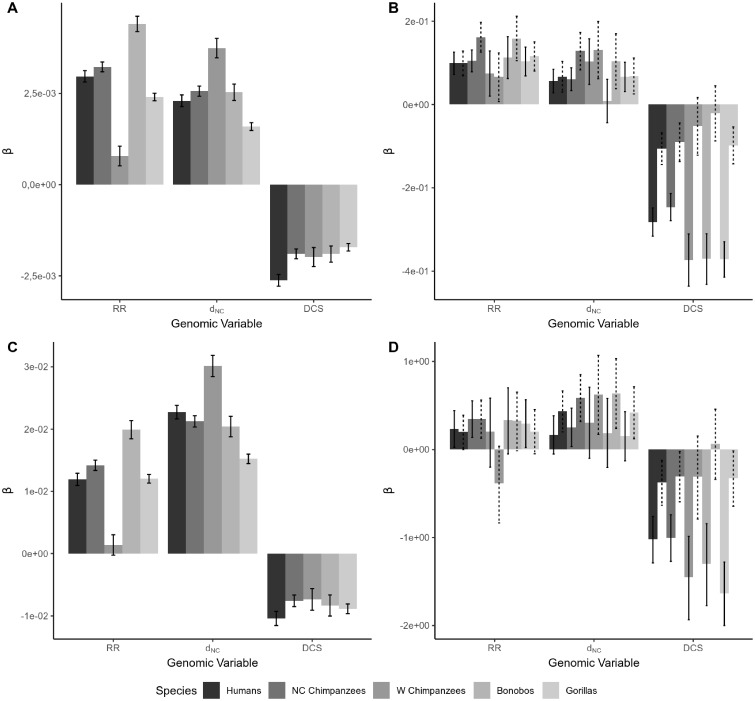
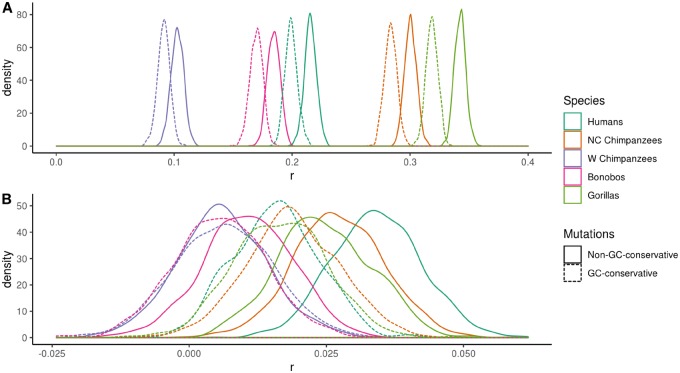
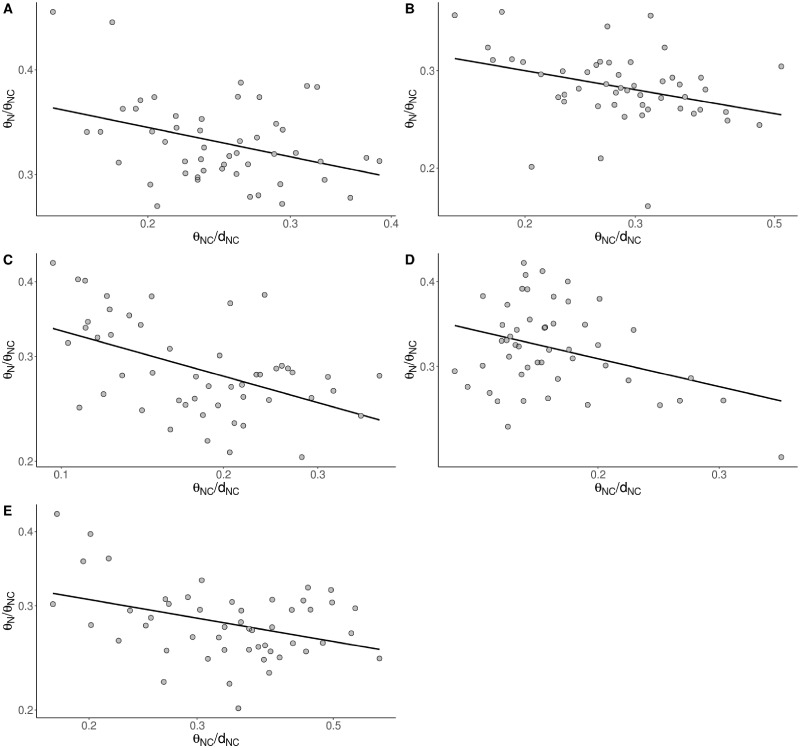
DNA diversity varies across the genome of many species. Variation in diversity across a genome might arise from regional variation in the mutation rate, variation in the intensity and mode of natural selection, and regional variation in the recombination rate. We show that both noncoding and nonsynonymous diversity are positively correlated to a measure of the mutation rate and the recombination rate and negatively correlated to the density of conserved sequences in 50 kb windows across the genomes of humans and nonhuman homininae. Interestingly, we find that although noncoding diversity is equally affected by these three genomic variables, nonsynonymous diversity is mostly dominated by the density of conserved sequences. The positive correlation between diversity and our measure of the mutation rate seems to be largely a direct consequence of regions with higher mutation rates having more diversity. However, the positive correlation with recombination rate and the negative correlation with the density of conserved sequences suggest that selection at linked sites also affect levels of diversity. This is supported by the observation that the ratio of the number of nonsynonymous to noncoding polymorphisms is negatively correlated to a measure of the effective population size across the genome. We show these patterns persist even when we restrict our analysis to GC-conservative mutations, demonstrating that the patterns are not driven by GC biased gene conversion. In conclusion, our comparative analyses describe how recombination rate, gene density, and mutation rate interact to produce the patterns of DNA diversity that we observe along the hominine genomes.
Keywords: gene density; genetic diversity; great apes; purifying selection; recombination rate.
© The Author(s) 2020. Published by Oxford University Press on behalf of the Society for Molecular Biology and Evolution.
Figures
References
Publication types
MeSH terms
Substances
LinkOut - more resources
Full Text Sources
Miscellaneous
