Feasibility of Using Real-World Data to Replicate Clinical Trial Evidence
- PMID: 31596493
- PMCID: PMC6802419
- DOI: 10.1001/jamanetworkopen.2019.12869
Feasibility of Using Real-World Data to Replicate Clinical Trial Evidence
Abstract
Importance: Although randomized clinical trials are considered to be the criterion standard for generating clinical evidence, the use of real-world evidence to evaluate the efficacy and safety of medical interventions is gaining interest. Whether observational data can be used to address the same clinical questions being answered by traditional clinical trials is still unclear.
Objective: To identify the number of clinical trials published in high-impact journals in 2017 that could be feasibly replicated using observational data from insurance claims and/or electronic health records (EHRs).
Design, setting, and participants: In this cross-sectional analysis, PubMed was searched to identify all US-based clinical trials, regardless of randomization, published between January 1, 2017, and December 31, 2017, in the top 7 highest-impact general medical journals of 2017. Trials were excluded if they did not involve human participants, did not use end points that represented clinical outcomes among patients, were not characterized as clinical trials, and had no recruitment sites in the United States.
Main outcomes and measures: The primary outcomes were the number and percentage of trials for which the intervention, indication, trial inclusion and exclusion criteria, and primary end points could be ascertained from insurance claims and/or EHR data.
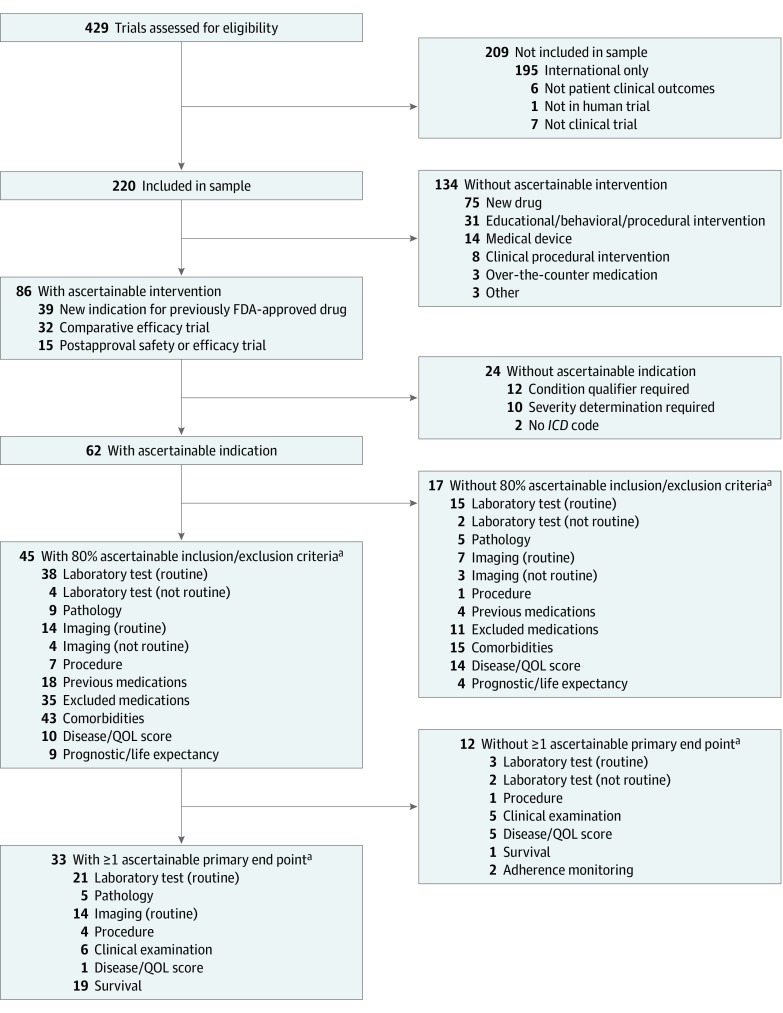
Results: Of the 220 US-based trials analyzed, 33 (15.0%) could be replicated using observational data because their intervention, indication, inclusion and exclusion criteria, and primary end points could be routinely ascertained from insurance claims and/or EHR data. Of the 220 trials, 86 (39.1%) had an intervention that could be ascertained from insurance claims and/or EHR data. Among the 86 trials, 62 (72.1%) had an indication that could be ascertained. Forty-five (72.6%) of 62 trials had at least 80% of inclusion and exclusion criteria data that could be ascertained. Of these 45 studies, 33 (73.3%) had at least 1 primary end point that could be ascertained.
Conclusions and relevance: This study found that only 15% of the US-based clinical trials published in high-impact journals in 2017 could be feasibly replicated through analysis of administrative claims or EHR data. This finding suggests the potential for real-world evidence to complement clinical trials, both by examining the concordance between randomized experiments and observational studies and by comparing the generalizability of the trial population with the real-world population of interest.
Conflict of interest statement
Figures
References
-
- Institute of Medicine Forum on Drug Discovery, Development, and Translation Transforming Clinical Research in the United States: Challenges and Opportunities: Workshop Summary. Washington, DC:National Academies Press; 2010. - PubMed
-
- US Food and Drug Administration Use of real-world evidence to support regulatory decision-making for medical devices: guidance for industry and Food and Drug Administration staff. https://www.fda.gov/downloads/medicaldevices/deviceregulationandguidance.... Published August 2017. Accessed August 31, 2019.
-
- National Academies of Sciences, Engineering, and Medicine; Health and Medicine Division; Board on Health Sciences Policy; Forum on Drug Discovery, Development, and Translation. Real-World Evidence Generation and Evaluation of Therapeutics: Proceedings of a Workshop Washington, DC: National Academies Press; 2017. - PubMed
Publication types
MeSH terms
Grants and funding
LinkOut - more resources
Full Text Sources
Medical