


Estimation of Eating Disorders Prevalence by Age and Associations With Mortality in a Simulated Nationally Representative US Cohort
- PMID: 31596495
- PMCID: PMC6802241
- DOI: 10.1001/jamanetworkopen.2019.12925
Estimation of Eating Disorders Prevalence by Age and Associations With Mortality in a Simulated Nationally Representative US Cohort
Abstract
Importance: Eating disorders (EDs) are common psychiatric disorders associated with high mortality. However, data on ED disease dynamics and treatment coverage are sparse.
Objectives: To model the individual-level disease dynamics of ED from birth to age 40 years and to estimate the association of increased treatment coverage with ED-related mortality.
Design, setting, and participants: In this decision analytical model study, an individual-level Markov state transition model was empirically calibrated in April 2019 using a Bayesian approach to synthesize available clinical and epidemiologic ED data. The simulation model was calibrated to nationally representative US survey data from 2007 and 2011. A virtual cohort of 100 000 individuals (50 000 [50%] male) was modeled from birth to age 40 years for 4 ED diagnoses: anorexia nervosa, bulimia nervosa, binge eating disorder, and other specified feeding and eating disorders.
Exposures: Age-specific ED incidence and mortality rates and background (all-cause) mortality.
Main outcomes and measures: The main outcomes were age-specific 12-month and lifetime ED prevalence and number of deaths per 100 000 general population individuals by age 40 years. The mean and 95% uncertainty intervals (UIs) of 1000 simulations, accounting for stochastic and parameter uncertainty, are reported.
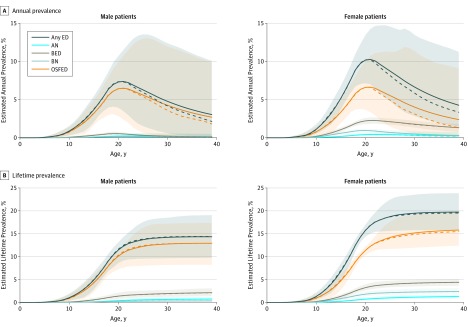
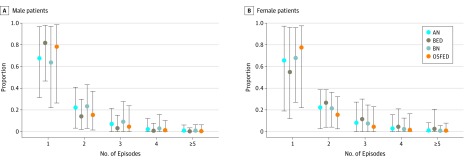
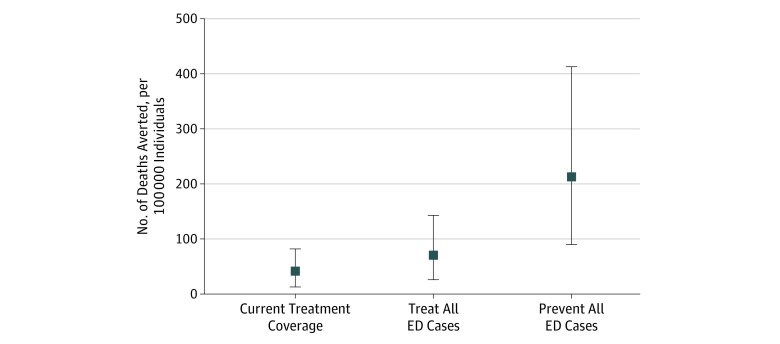
Results: The highest estimated mean annual prevalence of ED occurred at approximately age 21 years for both male individuals (7.4%; 95% UI, 3.5%-11.5%) and female individuals (10.3%; 95% UI, 7.0%-14.2%), with lifetime mean prevalence estimates increasing to 14.3% (95% UI, 9.7%-19.0%) for male individuals and 19.7% (95% UI, 15.8%-23.9%) for female individuals by age 40 years. Ninety-five percent of first-time cases occurred by age 25 years. Current treatment coverage averts an estimated mean of 41.7 deaths per 100 000 people (95% UI, 13.0-82.0 deaths per 100 000 people) by age 40 years, whereas increasing treatment coverage for all patients with ED could avert an estimated mean of 70.5 deaths per 100 000 people by age 40 years (95% UI, 26.0-143.0 deaths per 100 000 people).
Conclusions and relevance: In this simulation modeling study, the estimated lifetime prevalence of ED was high, with approximately 1 in 7 male and 1 in 5 female individuals having an ED by age 40 years. The initial onset of EDs was highly concentrated during adolescence and young adulthood, suggesting that this is a critical period for prevention efforts. However, the high estimated prevalence of recurring ED later in life highlights the importance of identification and treatment of ED at older ages as well. These findings suggest that increasing treatment coverage could substantially reduce ED-related mortality.
Conflict of interest statement
Figures
References
-
- American Psychiatric Association Diagnostic and Statistical Manual of Mental Disorders. 5th ed Arlington, VA: American Psychiatric Association; 2013.
Publication types
MeSH terms
Grants and funding
LinkOut - more resources
Full Text Sources
Medical
Miscellaneous
