


Dietary Habits Related to Food Packaging and Population Exposure to PFASs
- PMID: 31596611
- PMCID: PMC6867167
- DOI: 10.1289/EHP4092
Dietary Habits Related to Food Packaging and Population Exposure to PFASs
Erratum in
-
Erratum: Dietary Habits Related to Food Packaging and Population Exposure to PFASs.Environ Health Perspect. 2023 Jun;131(6):69001. doi: 10.1289/EHP12343. Epub 2023 Jun 14. Environ Health Perspect. 2023. PMID: 37314307 Free PMC article. No abstract available.
Abstract
Background: Per- and polyfluoroalkyl substances (PFASs) are common industrial and consumer product chemicals with widespread human exposures that have been linked to adverse health effects. PFASs are commonly detected in foods and food-contact materials (FCMs), including fast food packaging and microwave popcorn bags.
Objectives: Our goal was to investigate associations between serum PFASs and consumption of restaurant food and popcorn in a representative sample of Americans.
Methods: We analyzed 2003-2014 serum PFAS and dietary recall data from the National Health and Nutrition Examination Survey (NHANES). We used multivariable linear regressions to investigate relationships between consumption of fast food, restaurant food, food eaten at home, and microwave popcorn and serum levels of perfluorooctanoic acid (PFOA), perfluorononanoic acid (PFNA), perfluorodecanoic acid (PFDA), perfluorohexanesulfonic acid (PFHxS), and perfluorooctanesulfonic acid (PFOS).
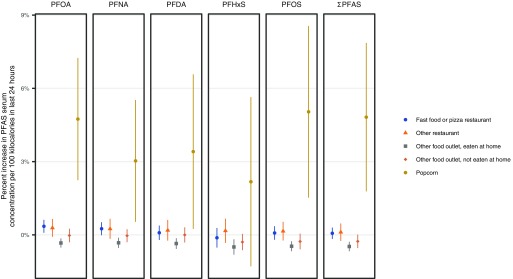
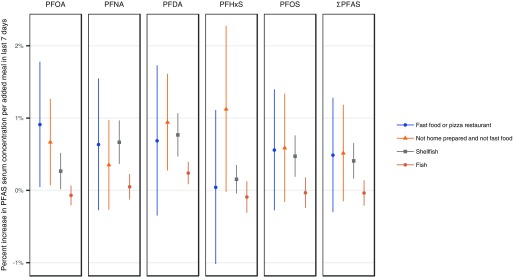
Results: Calories of food eaten at home in the past 24 h had significant inverse associations with serum levels of all five PFASs; these associations were stronger in women. Consumption of meals from fast food/pizza restaurants and other restaurants was generally associated with higher serum PFAS concentrations, based on 24-h and 7-d recall, with limited statistical significance. Consumption of popcorn was associated with significantly higher serum levels of PFOA, PFNA, PFDA, and PFOS, based on 24-h and 12-month recall, up to a 63% (95% CI: 34, 99) increase in PFDA among those who ate popcorn daily over the last 12 months.
Conclusions: Associations between serum PFAS and popcorn consumption may be a consequence of PFAS migration from microwave popcorn bags. Inverse associations between serum PFAS and food eaten at home-primarily from grocery stores-is consistent with less contact between home-prepared food and FCMs, some of which contain PFASs. The potential for FCMs to contribute to PFAS exposure, coupled with concerns about toxicity and persistence, support the use of alternatives to PFASs in FCMs. https://doi.org/10.1289/EHP4092.
Figures
Comment in
-
PFAS in Food Packaging: A Hot, Greasy Exposure.Environ Health Perspect. 2020 May;128(5):54002. doi: 10.1289/EHP6335. Epub 2020 May 28. Environ Health Perspect. 2020. PMID: 32463326 Free PMC article.
References
-
- Bjermo H, Darnerud PO, Pearson M, Barbieri HE, Lindroos AK, Nälsén C. 2013. Serum concentrations of perfluorinated alkyl acids and their associations with diet and personal characteristics among Swedish adults. Mol Nutr Food Res 57(12):2206–2215, PMID: 23934649, 10.1002/mnfr.201200845. - DOI - PubMed
Publication types
MeSH terms
Substances
Grants and funding
LinkOut - more resources
Full Text Sources
Research Materials
Miscellaneous