


Illuminating biological pathways for drug targeting in head and neck squamous cell carcinoma
- PMID: 31596908
- PMCID: PMC6785123
- DOI: 10.1371/journal.pone.0223639
Illuminating biological pathways for drug targeting in head and neck squamous cell carcinoma
Abstract
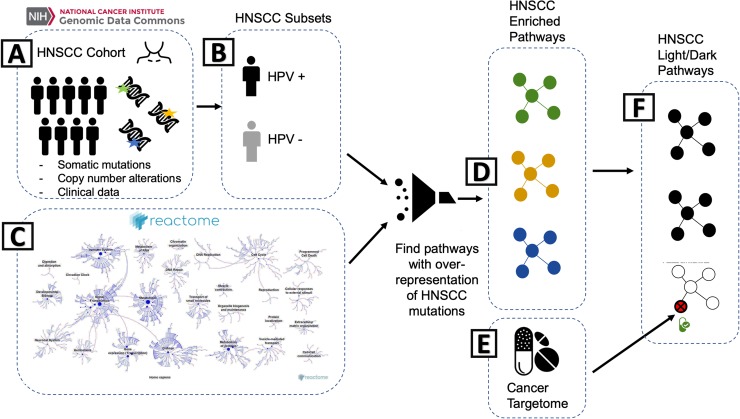
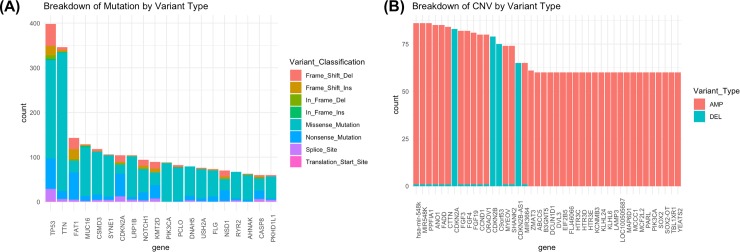
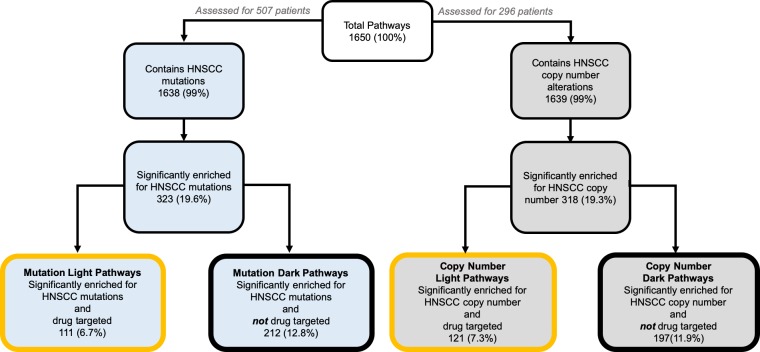
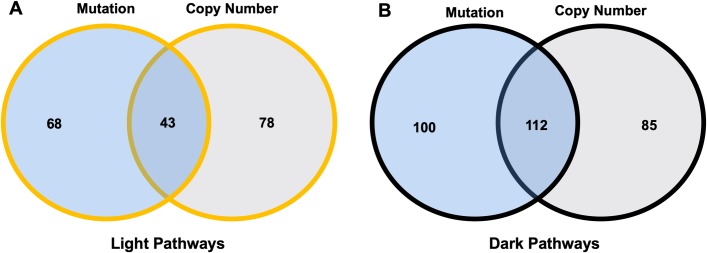
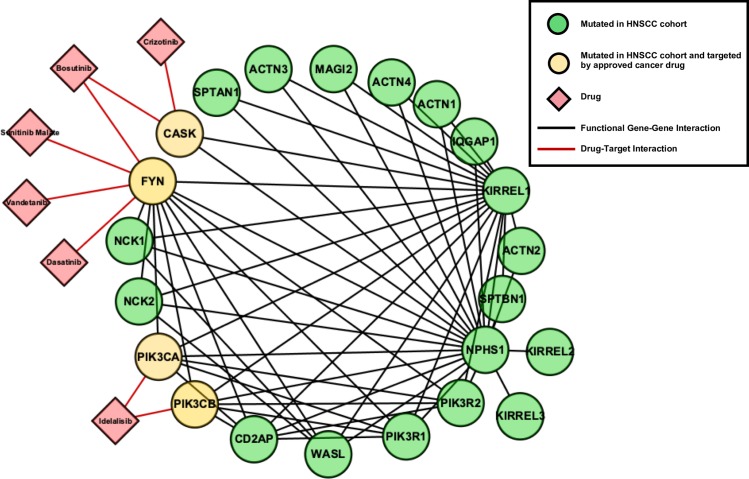
Head and neck squamous cell carcinoma (HNSCC) remains a morbid disease with poor prognosis and treatment that typically leaves patients with permanent damage to critical functions such as eating and talking. Currently only three targeted therapies are FDA approved for use in HNSCC, two of which are recently approved immunotherapies. In this work, we identify biological pathways involved with this disease that could potentially be targeted by current FDA approved cancer drugs and thereby expand the pool of potential therapies for use in HNSCC treatment. We analyzed 508 HNSCC patients with sequencing information from the Genomic Data Commons (GDC) database and assessed which biological pathways were significantly enriched for somatic mutations or copy number alterations. We then further classified pathways as either "light" or "dark" to the current reach of FDA-approved cancer drugs using the Cancer Targetome, a compendium of drug-target information. Light pathways are statistically enriched with somatic mutations (or copy number alterations) and contain one or more targets of current FDA-approved cancer drugs, while dark pathways are enriched with somatic mutations (or copy number alterations) but not currently targeted by FDA-approved cancer drugs. Our analyses indicated that approximately 35-38% of disease-specific pathways are in scope for repurposing of current cancer drugs. We further assess light and dark pathways for subgroups of patient tumor samples according to HPV status. The framework of light and dark pathways for HNSCC-enriched biological pathways allows us to better prioritize targeted therapies for further research in HNSCC based on the HNSCC genetic landscape and FDA-approved cancer drug information. We also highlight the importance in the identification of sub-pathways where targeting and cross targeting of other pathways may be most beneficial to predict positive or negative synergy with potential clinical significance. This framework is ideal for precision drug panel development, as well as identification of highly aberrant, untargeted candidates for future drug development.
Conflict of interest statement
Samuel Higgins is now employed by Roche Sequencing Solutions and Gabrielle Choonoo is now employed by Regeneron Pharmaceuticals. Their affiliation with these companies does not alter our adherence to PLOS ONE policies on sharing data and materials.
Figures
References
-
- Union for International Cancer Control. Locally Advanced Squamous cell carcinoma of the head and neck [Internet]. World Health Organization; 2014. Available: https://www.who.int/selection_medicines/committees/expert/20/application...
-
- Cancer Facts & Figures 2018 [Internet]. American Cancer Society; 2018. Available: https://www.cancer.org/content/dam/cancer-org/research/cancer-facts-and-...
-
- Gillison ML, D’Souza G, Westra W, Sugar E, Xiao W, Begum S, et al. Distinct Risk Factor Profiles for Human Papillomavirus Type 16–Positive and Human Papillomavirus Type 16–Negative Head and Neck Cancers. JNCI: Journal of the National Cancer Institute. 2008;100: 407–420. 10.1093/jnci/djn025 - DOI - PubMed
Publication types
MeSH terms
Substances
Grants and funding
LinkOut - more resources
Full Text Sources
Medical
