


Can Asset-Based Community Development with Children and Youth Enhance the Level of Participation in Health Promotion Projects? A Qualitative Meta-Synthesis
- PMID: 31597340
- PMCID: PMC6801434
- DOI: 10.3390/ijerph16193778
Can Asset-Based Community Development with Children and Youth Enhance the Level of Participation in Health Promotion Projects? A Qualitative Meta-Synthesis
Abstract
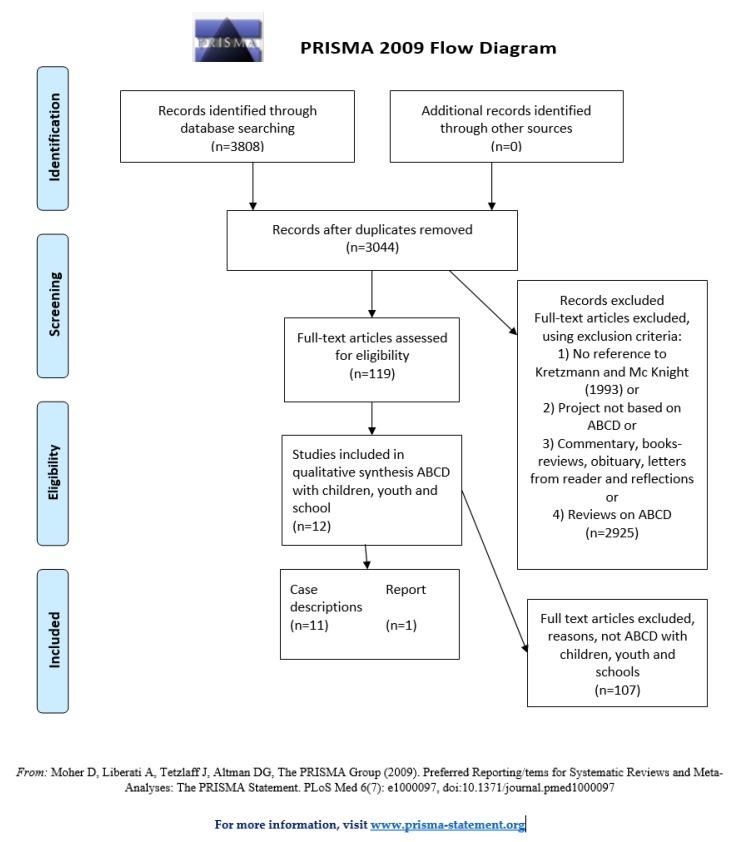
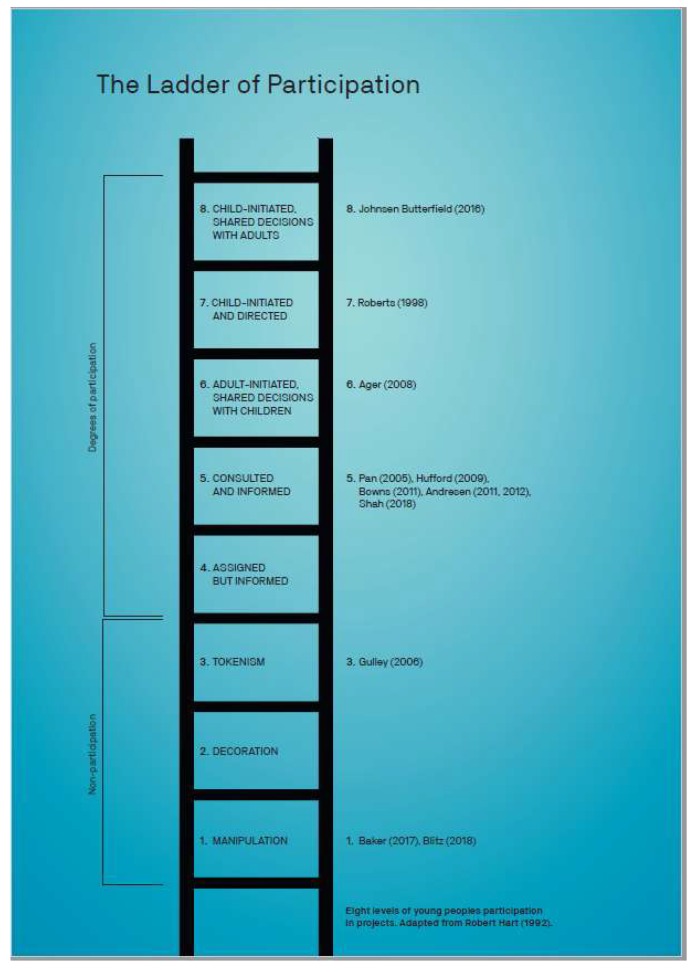
The asset-based community development (ABCD) approach have been widely used to map local assets and to ensure participation of local communities in public health promotion strategies. Participatory practices, such as ABCD, have been applied to shift public health strategies towards addressing health inequities. In this meta-synthesis, we ask if, and how, ABCD enhance the level of participation for children, youth and schools. Three thousand eight hundred eight titles and abstracts were identified in ten databases and transferred to the online program Rayyan. Through a blinded process we excluded texts that did not meet the inclusion criteria. The twelve included texts on ABCD for children, youth and schools are of varying quality. The research on ABCD for children, youth and schools have not been cumulative. Nevertheless, the texts show that ABCD provides strategies that enhance the participation of children, youth, and schools, in health promotion projects. The projects were categorized according to Robert Hart's classical participation ladder, and we found that the projects with the highest level of adherence to ABCD principles also had the highest level of participation. The projects with high levels of participation were supported by adult facilitators that created learning environments where children and youth developed their participatory skills.
Keywords: adolescent; child; child advocacy; community-based participatory research; health promotion/methods; public health.
Conflict of interest statement
The authors declare no conflict of interest. The sponsors had no role in the design, execution, interpretation, or writing of the study.
Figures
References
-
- Morgan A., Ziglio E., Davies M. Health Assets in a Global Context: Theory, Methods, Action. Springer; Berlin/Heidelberg, Germany: 2010.
-
- Department of Health . Real Involvement: Working with People to Improve Health Services. DH London; London, UK: 2008. p. 143.
Publication types
MeSH terms
LinkOut - more resources
Full Text Sources
Medical
