Review
. 2019 Oct 8;20(19):4962.
doi: 10.3390/ijms20194962.

Pharmacological Targeting of GLUT1 to Control Autoreactive T Cell Responses

Affiliations
Review

Pharmacological Targeting of GLUT1 to Control Autoreactive T Cell Responses

Carla Di Dedda et al. Int J Mol Sci. .

Abstract

An increasing body of evidence indicates that bio-energetic metabolism of T cells can be manipulated to control T cell responses. This potentially finds a field of application in the control of the T cell responses in autoimmune diseases, including in type 1 diabetes (T1D). Of the possible metabolic targets, Glut1 gained considerable interest because of its pivotal role in glucose uptake to fuel glycolysis in activated T cells, and the recent development of a novel class of small molecules that act as selective inhibitor of Glut1. We believe we can foresee a possible application of pharmacological Glut1 blockade approach to control autoreactive T cells that destroy insulin producing beta cells. However, Glut1 is expressed in a broad range of cells in the body and off-target and side effect are possible complications. Moreover, the duration of the treatment and the age of patients are critical aspects that need to be addressed to reduce toxicity. In this paper, we will review recent literature to determine whether it is possible to design a pharmacological Glut1 blocking strategy and how to apply this to autoimmunity in T1D.

Keywords: Glut1; T cells; autoimmunity; type 1 diabetes.


Conflict of interest statement

The authors declare no conflict of interest.

Figures
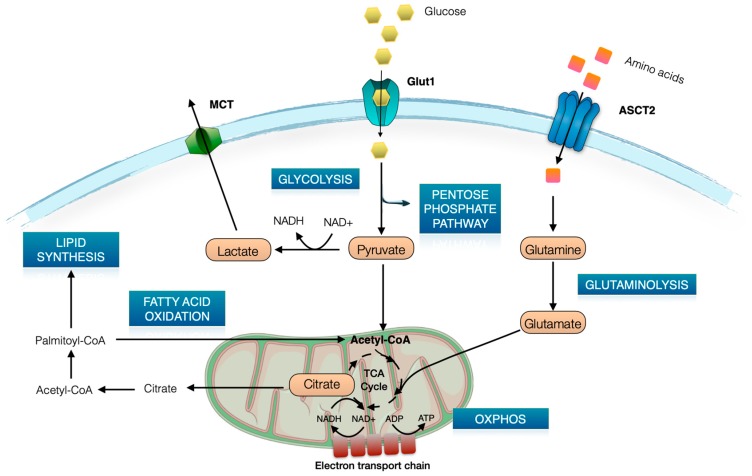
Figure 1
Figure 1
Schematic summary of the metabolic network. ATP can be generated from glucose though two integrated pathways. Glucose enters the cell via Glut1 and undergoes to enzymatic breakdown to pyruvate in the glycolysis pathway in the cytoplasm. The tricarboxylic acid (TCA) cycle encompasses the second pathway, where pyruvate is converted to acetyl-CoA in the mitochondria to fuel oxidative phosphorylation (OXPHOS). Anaerobic glucose catabolism transforms pyruvate into lactate that is transported out of the cell. Other substrates can also be metabolized in the TCA cycle, such as fatty acids via β-oxidation and glutamine via glutaminolysis.
Figure 2
Figure 2
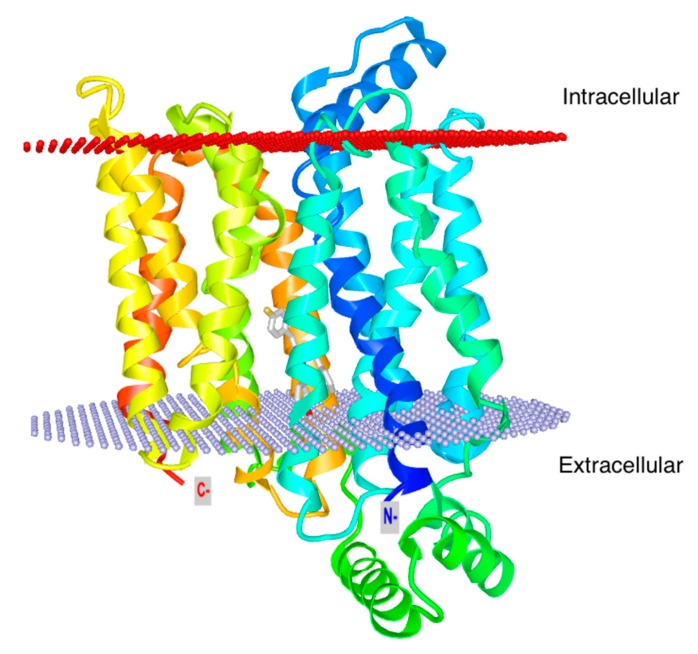
Glut1 structure. Ribbon model of GLUT1 in the ligand-bound inward facing conformation (PDB: 4PYP; https://www.rcsb.org/structure/4PYP). The N terminus is colored in blue and the C terminus in red. The corresponding transmembrane segments in the four 3-helix repeats are colored the same. The position of glucose bound in the inward facing state is depicted in gray sticks. The structure figure is customized with iCn3D.
Figure 3
Figure 3
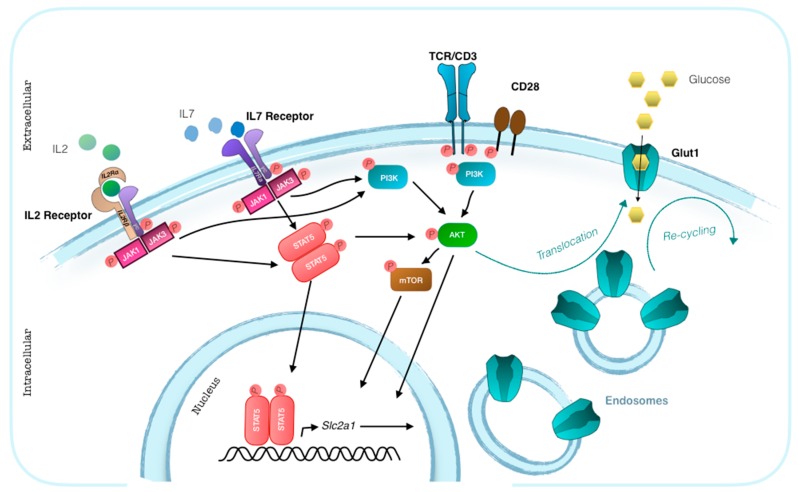
Glut1 expression and trafficking in T cells. The T cell surface expression of Glut 1 is regulated by extrinsic signals. The transcription of the Slc2a1 gene is induced by engagement of TCR and CD28 co-stimulation or by cytokine signaling through phosphorylated STAT5. The translocation of the intracellular pool of Glut1 to the cell surface is mainly regulated by Akt. Akt activation is the result of TCR and CD28 engagement or can be activated by phosphorylated STAT5 through the IL-2 or IL-7 signaling pathways.
Figure 4
Figure 4
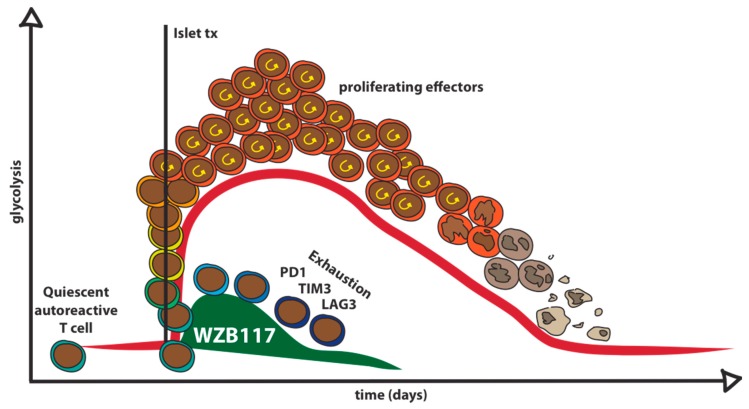
Graphical model of Glut1 blockade approach in patients with T1D undergoing to islet transplantation. Resting memory clones are activated by islet transplantation and rapidly increase glucose uptake via Glut1 to fuel glycolysis necessary for expansion, proliferation, and effector functions. Treatment with the Glut1 inhibitor WZB117 prevents metabolic re-programming to glycolysis and failure to fulfill bio-energetic needs drive T cells in a state of anergy and exhaustion.

References

    1. Babaya N., Nakayama M., Eisenbarth G.S. The stages of type 1A diabetes. Ann. N. Y. Acad. Sci. 2005;1051:194–204. doi: 10.1196/annals.1361.061. - DOI - PubMed
    1. Kent S.C., Chen Y., Bregoli L., Clemmings S.M., Kenyon N.S., Ricordi C., Hering B.J., Hafler D.A. Expanded T cells from pancreatic lymph nodes of type 1 diabetic subjects recognize an insulin epitope. Nature. 2005;435:224–228. doi: 10.1038/nature03625. - DOI - PubMed
    1. Coppieters K.T., Dotta F., Amirian N., Campbell P.D., Kay T.W.H., Atkinson M.A., Roep B.O., von Herrath M.G. Demonstration of islet-autoreactive CD8 T cells in insulitic lesions from recent onset and long-term type 1 diabetes patients. J. Exp. Med. 2012;209:51–60. doi: 10.1084/jem.20111187. - DOI - PMC - PubMed
    1. Bluestone J.A., Buckner J.H., Fitch M., Gitelman S.E., Gupta S., Hellerstein M.K., Herold K.C., Lares A., Lee M.R., Li K., et al. Type 1 diabetes immunotherapy using polyclonal regulatory T cells. Sci. Transl. Med. 2015;7:315ra189. doi: 10.1126/scitranslmed.aad4134. - DOI - PMC - PubMed
    1. Smith E.L., Peakman M. Peptide immunotherapy for type 1 diabetes-clinical advances. Front. Immunol. 2018;9:1–5. doi: 10.3389/fimmu.2018.00392. - DOI - PMC - PubMed

MeSH terms

Substances

LinkOut - more resources