. 2020 Jan 8;48(D1):D307-D313.
doi: 10.1093/nar/gkz823.

EuRBPDB: a comprehensive resource for annotation, functional and oncological investigation of eukaryotic RNA binding proteins (RBPs)

Affiliations

EuRBPDB: a comprehensive resource for annotation, functional and oncological investigation of eukaryotic RNA binding proteins (RBPs)

Jian-You Liao et al. Nucleic Acids Res. .

Abstract

RNA binding proteins (RBPs) are a large protein family that plays important roles at almost all levels of gene regulation through interacting with RNAs, and contributes to numerous biological processes. However, the complete list of eukaryotic RBPs including human is still unavailable. Here, we systematically identified RBPs in 162 eukaryotic species based on both computational analysis of RNA binding domains (RBDs) and large-scale RNA binding proteomic data, and established a comprehensive eukaryotic RBP database, EuRBPDB (http://EuRBPDB.syshospital.org). We identified a total of 311 571 RBPs with RBDs (corresponding to 6368 ortholog groups) and 3,651 non-canonical RBPs without known RBDs. EuRBPDB provides detailed annotations for each RBP, including basic information and functional annotation. Moreover, we systematically investigated RBPs in the context of cancer biology based on published literatures, PPI-network and large-scale omics data. To facilitate the exploration of the clinical relevance of RBPs, we additionally designed a cancer web interface to systematically and interactively display the biological features of RBPs in various types of cancers. EuRBPDB has a user-friendly web interface with browse and search functions, as well as data downloading function. We expect that EuRBPDB will be a widely-used resource and platform for both the communities of RNA biology and cancer biology.


Figures

Figure 1.
Figure 1.
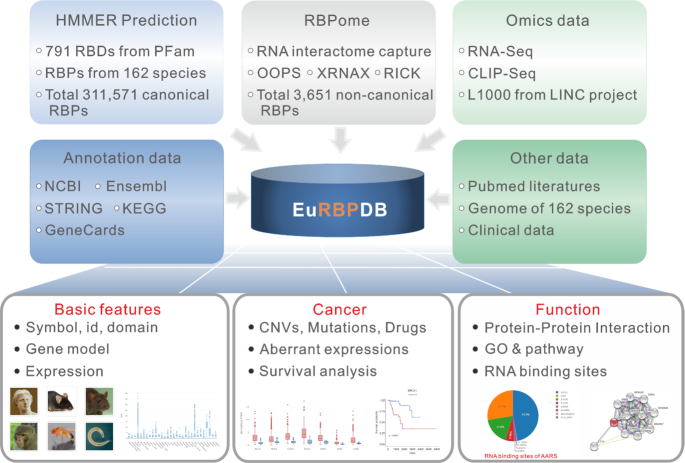
A system-level overview of the EuRBPDB core framework. A total of 315 222 RBPs, including 311 571 canonical RBPs and 3651 non-canonical RBPs, were identified by combination of computational RBP searching with RBPome profiling. All RBPs were annotated by information retrieved from public database, like NCBI, Ensembl, STRING, KEGG and GeneCards. Cancer-relevant RBPs were identified by literature mining and systematic TCGA data analysis. All the results generated by EuRBPDB were deposited in MySQL relational databases and displayed in the web pages. All species photos were downloaded from Ensembl database (24).
Figure 2.
Figure 2.
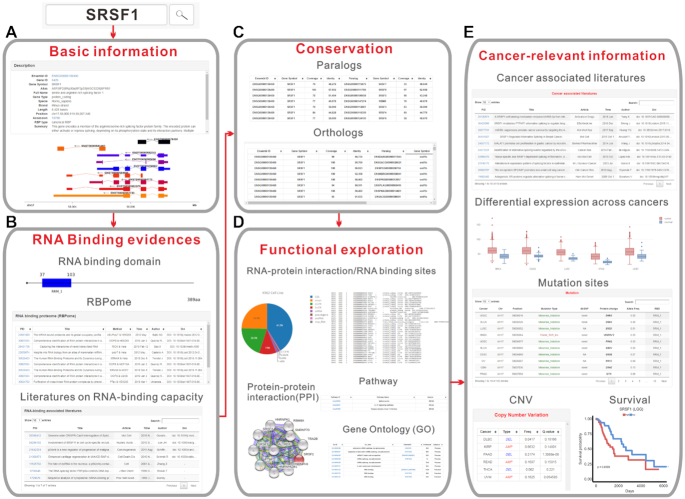
Illustration of RBP exploration in EuRBPDB: SRSF1 as an example. Through EuRBPDB searching, (A) first, users can easily obtain the detailed basic information of SRSF1, (B) then users can obtain multiple lines of RNA binding evidences of the SRSF1 including canonical RNA binding domain it contains, all RBPome datasets that detected SRSF1, and literatures that reported the binding RNA capacity of SRSF1. (C) Next, users can find the conservation status of SRSF1 through looking over the list of paralog and ortholog of SRSF1. (D) Users can further explore the function of SRSF1 through systematically investigate the protein-RNA interaction/RNA binding sites of RBP, protein-protein interaction network, pathway and gene ontology (GO) information provides by EuRBPDB. (E) Finally, users can systematically acquire the aberrant information of SRSF1 across cancers, including differential expression, mutations, copy number variations, survival correlation and literatures that reported the cancer regulatory role of SRSF1.
Figure 3.
Figure 3.
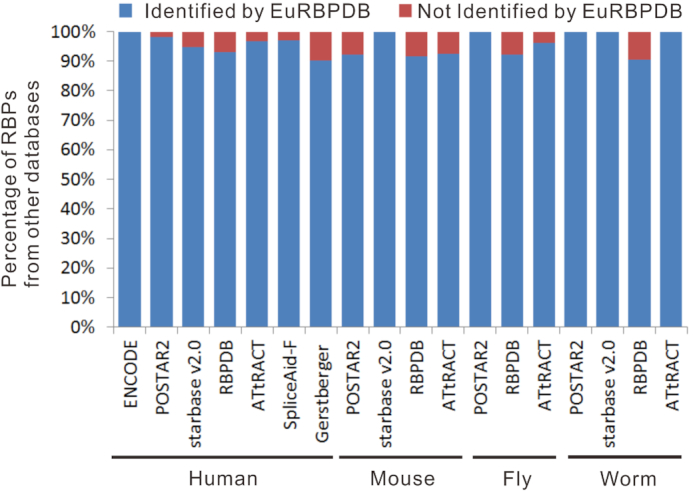
EuRBPDB contained most of RBPs deposited in other databases. 100% (157/157), 98.3% (168/171), 94.7% (36/38), 93.0% (385/414), 96.9% (154/159), 97.0% (65/67), and 90.1% (1389/1542) human RBPs from ENCODE database, POSTAR2, starBase v2.0, RBPDB, ATtRACT, SpliceAid-F and Gerstberger et al. RBP sets (25) were contained, respectively, in EuRBPDB. 92.31% (36/39), 100% (14/14), 91.7% (373/407) and 92.6% (25/27) mouse RBPs from POSTAR2, starBase v2.0, RBPDB and ATtRACt were included, respectively, in EuRBPDB. 100% (3/3), 92.2% (226/245) and 96.2% (51/53) Drosophila melanogaster RBPs from POSTAR2, RBPDB and ATtRACT were included, respectively, in EuRBPDB. 100% (5/5), 100% (2/2), 90.4% (208/230) and 100% (20/20) Caenorhabditis elegans RBPs from POSTAR2, starBase v2.0, RBPDB and ATtRACT were included, respectively, in EuRBPDB.

References

    1. Hentze M.W., Castello A., Schwarzl T., Preiss T.. A brave new world of RNA-binding proteins. Nat. Rev. Mol. Cell Biol. 2018; 19:327–341. - PubMed
    1. Pereira B., Billaud M., Almeida R.. RNA-Binding proteins in Cancer: Old players and new actors. Trends Cancer. 2017; 3:506–528. - PubMed
    1. Cooper T.A., Wan L., Dreyfuss G.. RNA and disease. Cell. 2009; 136:777–793. - PMC - PubMed
    1. Lukong K.E., Chang K.W., Khandjian E.W., Richard S.. RNA-binding proteins in human genetic disease. Trends Genet. 2008; 24:416–425. - PubMed
    1. Cook K.B., Kazan H., Zuberi K., Morris Q., Hughes T.R.. RBPDB: a database of RNA-binding specificities. Nucleic Acids Res. 2011; 39:D301–D308. - PMC - PubMed

Publication types

Substances