Review
. 2019 Dec;110(12):3630-3638.
doi: 10.1111/cas.14211. Epub 2019 Oct 25.

Tumor-suppressive circular RNAs: Mechanisms underlying their suppression of tumor occurrence and use as therapeutic targets

Affiliations
Review

Tumor-suppressive circular RNAs: Mechanisms underlying their suppression of tumor occurrence and use as therapeutic targets

Zhe Li et al. Cancer Sci. 2019 Dec.

Abstract

Circular RNAs (circRNAs) have a covalently closed circular conformation and are structurally stable. Those circRNAs with tumor-suppressive properties play an important role in tumorigenesis and metastasis and thus may be used as therapeutic targets of cancers. Herein, we review the current understanding of the classification of circRNAs and summarize the functions and mechanisms of circRNAs that have tumor-suppressive roles in various cancers, including liver cancer (circARSP91, circADAMTS13, circADAMTS14, circMTO1, hsa_circ_0079299, and circC3P1), bladder cancer (circFNDC3B, circITCH, circHIPK3, circRNA-3, cdrlas, and circLPAR1), gastric cancer (circLARP4, circYAP1, hsa_cric_0000096, hsa_circ_0000993, and circPSMC3), breast cancer (circ_000911, hsa_circ_0072309, and circASS1), lung cancer (hsa_circ_0000977, circPTK2, circ_0001649, hsa_circ_100395, and circ_0006916), glioma (circ_0001946, circSHPRH, and circFBXW7), and colorectal cancer (circITGA7 and hsa_circ_0014717). Thanks to their structural stability, these tumor-suppressive circRNAs may be used as potential and potent therapeutic targets. Moreover, we propose a new method for the classification of circRNAs. Based on whether they can be translated, circRNAs can be divided into noncoding circRNAs and coding circRNAs.

Keywords: biogenesis; cancer; circular RNA; mechanism; therapeutic target.


Conflict of interest statement

Authors declare no conflicts of interest for this article. The funders had no role in study design, data collection, data analysis, interpretation, or writing of the report.

Figures
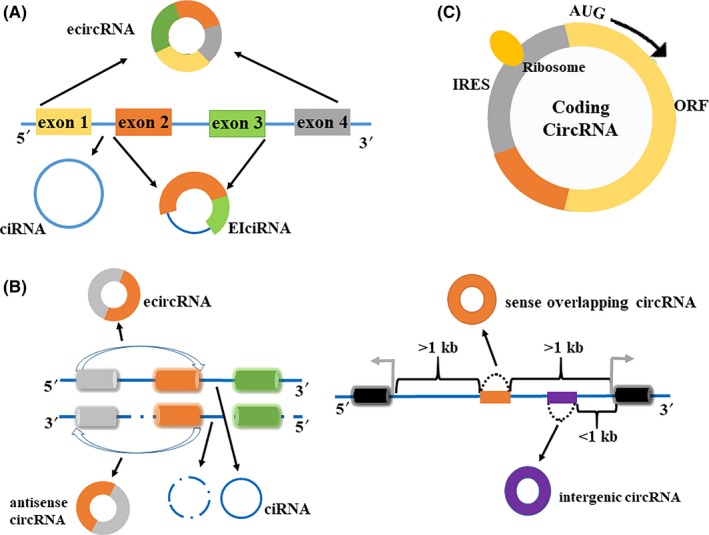
Figure 1
Figure 1
Categories of circular RNAs (circRNAs). A, Classification of circRNAs based on their compositions: Exonic circRNAs (ecircRNAs), circular intronic RNAs (ciRNAs), and exon‐intronic circRNAs (EIciRNAs). B, Classification of circRNAs based on their positions and their adjacent mRNAs: ecircRNAs, ciRNAs, antisense circRNAs, sense overlapping circRNAs, and intergenic circRNAs. C, Coding circRNAs may have at least one internal ribosome entry site (IRES) and have an open reading frame (ORF)
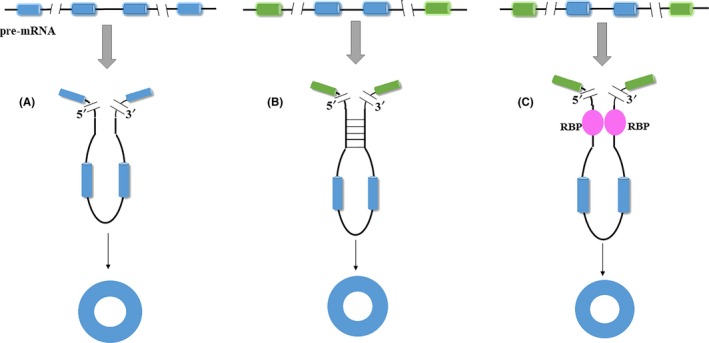
Figure 2
Figure 2
Biogenesis of circular RNAs (circRNAs). A, Produced by reverse splicing of pre‐mRNA. B, Intron pairing cycle produces circRNA. C, RNA‐binding protein (RBP) induces circulation
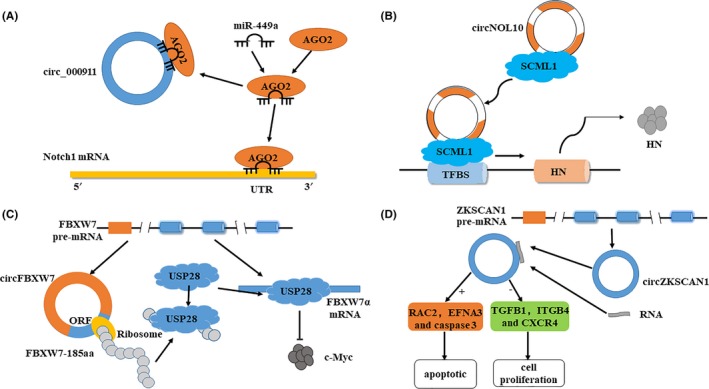
Figure 3
Figure 3
Biological functions of cancer‐suppressive circular RNAs (circRNAs). A, Acting as a sponge of microRNA (miRNA). For example, circ_000911 competitively binds with miR‐449a, which binds with Argonaute 2 (Ago2) and targets notch homolog 1 (Notch 1) mRNA. B, Interacting with proteins. For example, circNOL10 first binds with sex comb on midleg‐like 1 (SCML1), then moves transcription factor binding sites (TFBS), and finally promotes the expression of human protein (HN) in lung cancer. C, Translating proteins. For example, the pre‐mRNA of F‐box and WD repeat domain containing 7 (FBXW7) may produce a circRNA called circFBXW7 and FBXW7α mRNA. The open reading frame (ORF) in circFBXW7, which is driven by the internal ribosome entry site, encodes a protein, FBXW7‐185aa. FBXW7‐185aa can bind with ubiquitin‐specific peptidase 28 (USP28) to prevent USP28 binding with FBXW7α mRNA, thereby reducing the half‐life of c‐Myc and reducing the stability of c‐Myc. D, Regulating the transcription of linear RNA. For example, the pre‐mRNA of zinc finger protein with KRAB and SCAN domains 1 (ZKSCAN1) may produce a circRNA called circZKSCAN1 that acts as a competitive inhibitor to retain endogenous RNA and then regulates the expression of cell proliferation and apoptosis‐related genes, including apoptotic genes RAS‐associated C3 botulinum toxin substrate 2 (RAC2), ephrin‐A3 (EFNA3), and caspase 3, transforming growth factor beta 1 (TGFB1), integrin beta 4 (ITGB4), and CXC motif chemokine receptor 4 (CXCR4)

References

    1. Mo X, Wu Y, Chen L, et al. Global expression profiling of metabolic pathway‐related lncRNAs in human gastric cancer and the identification of RP11‐555H23.1 as a new diagnostic biomarker. J Clin Lab Anal. 2019;33:e22692. - PMC - PubMed
    1. Li T, Shao Y, Fu L, et al. Plasma circular RNA profiling of patients with gastric cancer and their droplet digital RT‐PCR detection. J Mol Med (Berl). 2018;96:85‐96. - PubMed
    1. Sanger HL, Klotz G, Riesner D, Gross HJ, Kleinschmidt AK. Viroids are single‐stranded covalently closed circular RNA molecules existing as highly base‐paired rod‐like structures. Proc Natl Acad Sci USA. 1976;73(11):3852‐3856. - PMC - PubMed
    1. Xie Y, Shao Y, Sun W, et al. Downregulated expression of hsa_circ_0074362 in gastric cancer and its potential diagnostic values. Biomark Med. 2018;12:11‐20. - PubMed
    1. Tian M, Chen R, Li T, Xiao B. Reduced expression of circRNA hsa_circ_0003159 in gastric cancer and its clinical significance. J Clin Lab Anal. 2018;32:e22281. - PMC - PubMed