


Connectivity of the Cognitive Control Network During Response Inhibition as a Predictive and Response Biomarker in Major Depression: Evidence From a Randomized Clinical Trial
- PMID: 31601424
- PMCID: PMC8628639
- DOI: 10.1016/j.biopsych.2019.08.005
Connectivity of the Cognitive Control Network During Response Inhibition as a Predictive and Response Biomarker in Major Depression: Evidence From a Randomized Clinical Trial
Abstract
Background: In treating major depressive disorder, we lack tests anchored in neurobiology that predict antidepressant efficacy. Cognitive impairments are a particularly disabling feature of major depressive disorder. We tested whether functional connectivity during a response-inhibition task can predict response to antidepressants and whether its changes over time are correlated to symptom changes.
Methods: We analyzed data from outpatients with major depressive disorder (n = 124) randomized to receive escitalopram, sertraline, or venlafaxine (8 weeks) and healthy control subjects (n = 59; age 18-65 years). Before and after treatment, participants were interviewed and scanned using functional magnetic resonance imaging, and functional connectivity was measured using generalized psychophysiological interaction during response inhibition (Go-NoGo task). We investigated the interaction between treatment type and response (≥50% reduction on self-reported symptoms), coupling differences between responders and nonresponders at baseline, their correlation with symptom improvement, and their changes in time.
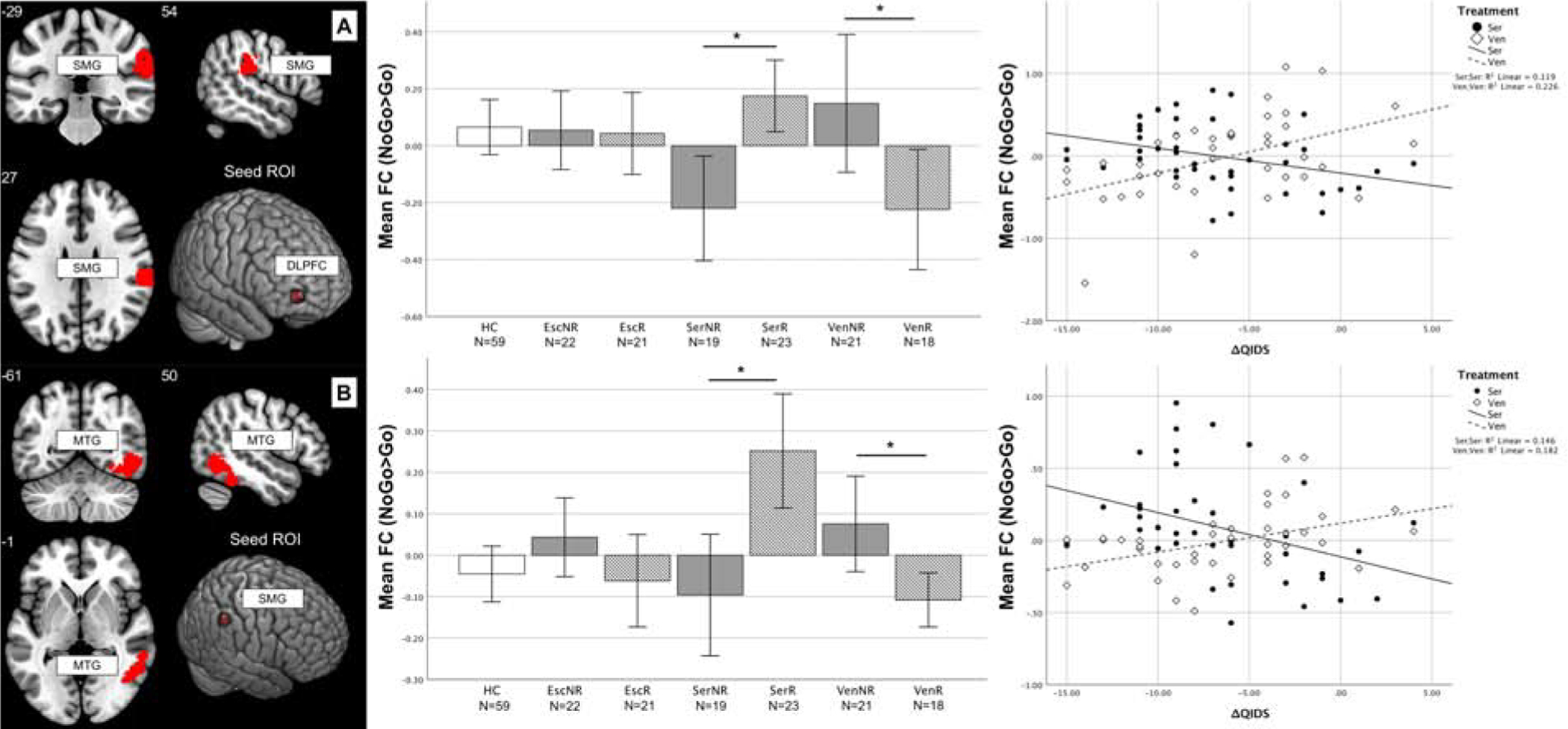
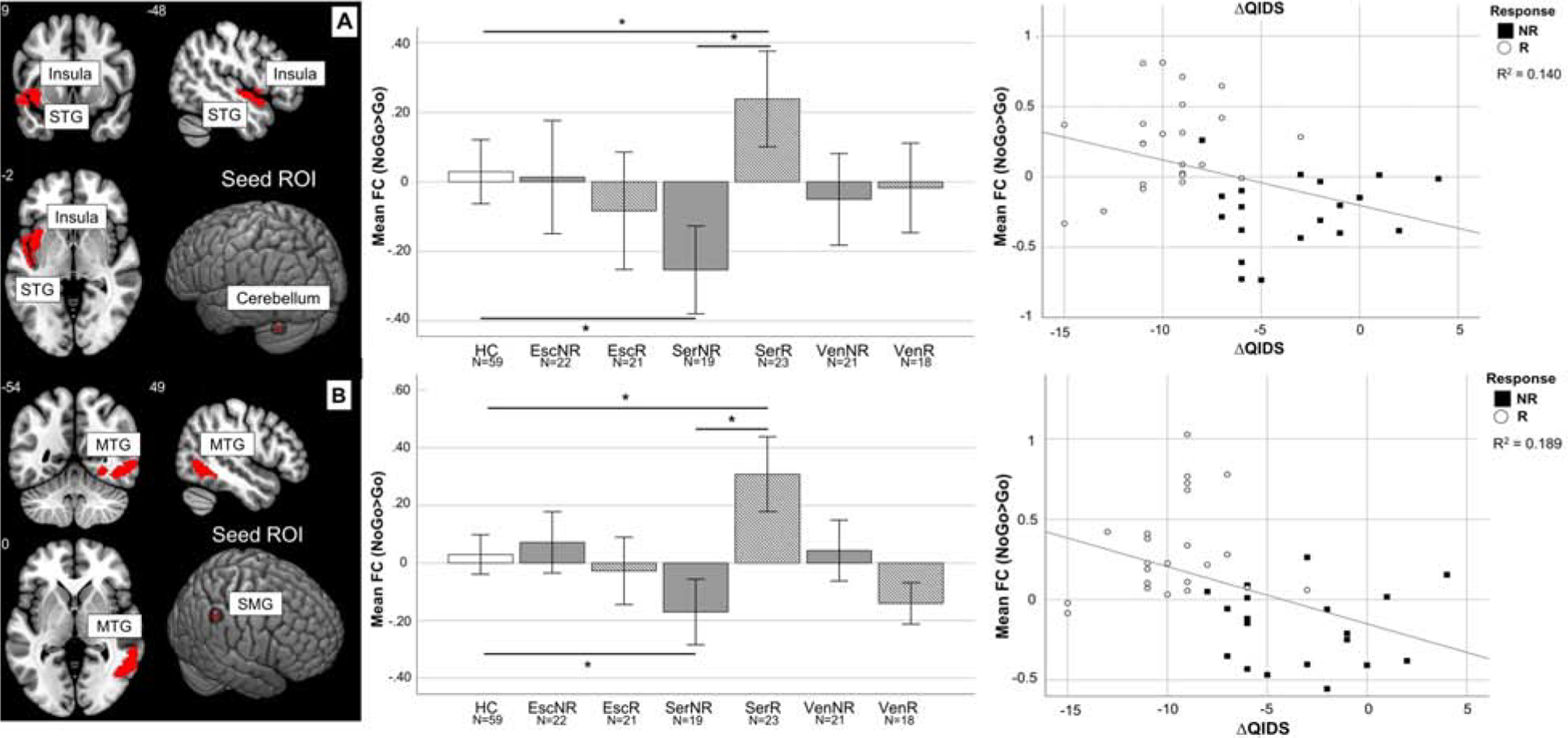
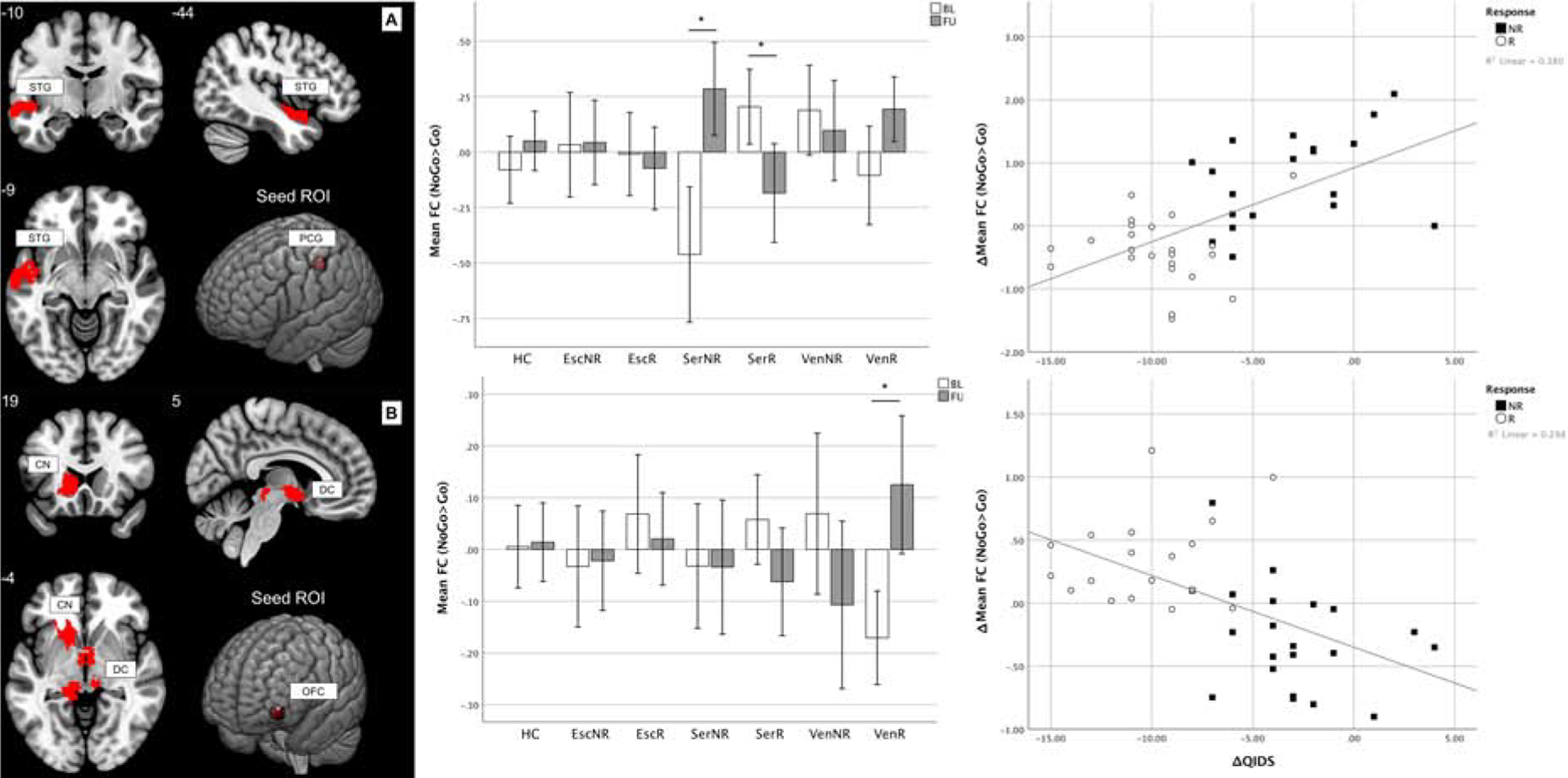
Results: During response inhibition, connectivity between the dorsolateral prefrontal cortex/supramarginal gyrus and supramarginal gyrus/middle temporal gyrus was associated with response to sertraline and venlafaxine, but not escitalopram. Sertraline responders had higher functional connectivity between these regions compared with nonresponders, whereas venlafaxine responders had lower functional connectivity. For sertraline, attenuation of connectivity in the precentral and superior temporal gyri correlated with posttreatment symptom improvement. For venlafaxine, enhancement of connectivity between the orbitofrontal cortex and subcortical regions correlated with symptom improvement.
Conclusions: Connectivity of the cognitive control circuit during response inhibition selectively and differentially predicts antidepressant treatment response and correlates with symptom improvement. These quantitative markers tied to the neurobiology of cognitive features of depression could be used translationally to predict and evaluate treatment response.
Trial registration: ClinicalTrials.gov NCT00693849.
Keywords: Biomarker; Cognitive control; Go-NoGo; Major depressive disorder; Treatment; fMRI.
Copyright © 2019 Society of Biological Psychiatry. Published by Elsevier Inc. All rights reserved.
Conflict of interest statement
Disclosures
LMW received non-salary direct research costs as an iSPOT-D investigator from Brain Resource Pty Ltd.; and fees as a scientific advisor for Psyberguide and as a consultant for BlackThorn Therapeutics. All other authors report no biomedical financial interests or potential conflicts of interest.
Figures
Comment in
-
Developing Predictive Biomarkers Goes Alongside Diagnostic Biotypes in Major Depressive Disorder.Biol Psychiatry. 2020 Mar 1;87(5):386-387. doi: 10.1016/j.biopsych.2019.11.011. Biol Psychiatry. 2020. PMID: 32029074 No abstract available.
References
-
- Friedrich MJ (2017): Depression is the leading cause of disability around the world. JAMA. 317: 1517–1517. - PubMed
-
- Cipriani A, Furukawa TA, Salanti G, Chaimani A, Atkinson LZ, Ogawa Y, et al. (2018): Comparative efficacy and acceptability of 21 antidepressant drugs for the acute treatment of adults with major depressive disorder: a systematic review and network meta-analysis. Lancet Lond Engl. 391: 1357–1366. - PMC - PubMed
Publication types
MeSH terms
Substances
Associated data
Grants and funding
LinkOut - more resources
Full Text Sources
Medical
