


A large data resource of genomic copy number variation across neurodevelopmental disorders
- PMID: 31602316
- PMCID: PMC6779875
- DOI: 10.1038/s41525-019-0098-3
A large data resource of genomic copy number variation across neurodevelopmental disorders
Abstract
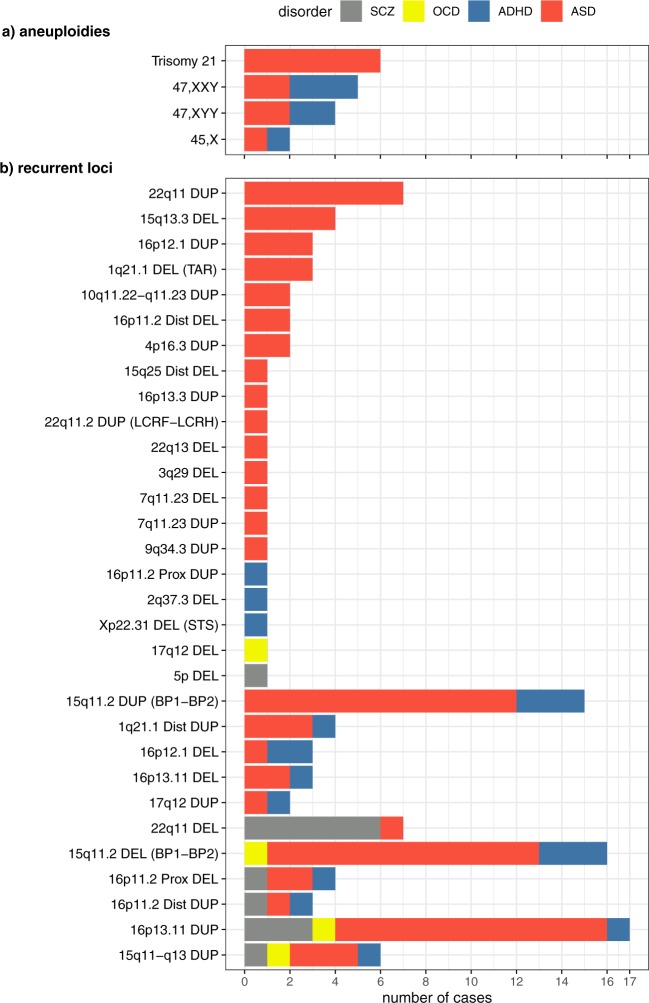
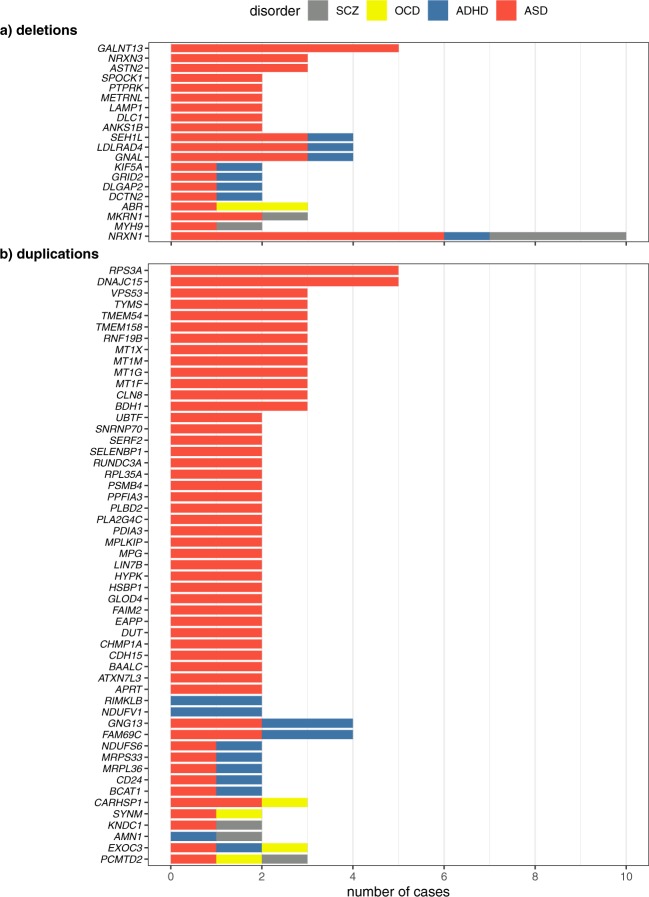
Copy number variations (CNVs) are implicated across many neurodevelopmental disorders (NDDs) and contribute to their shared genetic etiology. Multiple studies have attempted to identify shared etiology among NDDs, but this is the first genome-wide CNV analysis across autism spectrum disorder (ASD), attention deficit hyperactivity disorder (ADHD), schizophrenia (SCZ), and obsessive-compulsive disorder (OCD) at once. Using microarray (Affymetrix CytoScan HD), we genotyped 2,691 subjects diagnosed with an NDD (204 SCZ, 1,838 ASD, 427 ADHD and 222 OCD) and 1,769 family members, mainly parents. We identified rare CNVs, defined as those found in <0.1% of 10,851 population control samples. We found clinically relevant CNVs (broadly defined) in 284 (10.5%) of total subjects, including 22 (10.8%) among subjects with SCZ, 209 (11.4%) with ASD, 40 (9.4%) with ADHD, and 13 (5.6%) with OCD. Among all NDD subjects, we identified 17 (0.63%) with aneuploidies and 115 (4.3%) with known genomic disorder variants. We searched further for genes impacted by different CNVs in multiple disorders. Examples of NDD-associated genes linked across more than one disorder (listed in order of occurrence frequency) are NRXN1, SEH1L, LDLRAD4, GNAL, GNG13, MKRN1, DCTN2, KNDC1, PCMTD2, KIF5A, SYNM, and long non-coding RNAs: AK127244 and PTCHD1-AS. We demonstrated that CNVs impacting the same genes could potentially contribute to the etiology of multiple NDDs. The CNVs identified will serve as a useful resource for both research and diagnostic laboratories for prioritization of variants.
Keywords: Molecular medicine; Neurodevelopmental disorders; Pathogenesis.
© The Author(s) 2019.
Conflict of interest statement
Competing interestsS.W.S. serves on the Scientific Advisory Committees of Population Bio and Deep Genomics; intellectual property originating from his research and held at the Hospital for Sick Children is licensed to Lineagen, and separately Athena Diagnostics. D.M. is a full-time employee of Deep Genomics and is entitled to a stock option. R.J.S., P.D.A., and J.C. consult for Highland Therapeutics. Intellectual property from ADHD research at the Hospital for Sick Children is licensed to Ehave and the National Research Council of Canada. Other authors declare no competing interests for the data and interpretation presented in this study. R.J.S., P.D.A., and J.C. consults for Highland Therapeutics. Intellectual property from their research at the Hospital for Sick Children is licensed to Ehave and the National Research Council. D.M. is a full-time employee of Deep Genomics and is entitled to stock options. S.W.S. is on the Scientific Advisory Committees of Population Bio and Deep Genomics; intellectual property from his research held at the Hospital for Sick Children is licensed to Athena Diagnostics, and separately to Lineagen. These relationships did not influence data interpretation or presentation during this study, but are disclosed for potential future consideration.
Figures
References
Grants and funding
LinkOut - more resources
Full Text Sources
Other Literature Sources
Research Materials
Miscellaneous
