. 2019;6(1):78-89.
doi: 10.1007/s40472-019-0230-4. Epub 2019 Jan 29.

The Evolving Role of Neutrophils in Liver Transplant Ischemia-Reperfusion Injury

Affiliations

The Evolving Role of Neutrophils in Liver Transplant Ischemia-Reperfusion Injury

Kojiro Nakamura et al. Curr Transplant Rep. 2019.

Abstract

Purpose of review: Hepatic ischemia-reperfusion injury (IRI), an inevitable event during liver transplantation, represents a major risk factor for the primary graft dysfunction as well as the development of acute and chronic rejection. Neutrophils, along macrophages are pivotal in the innate immune-driven liver IRI, whereas the effective neutrophil targeting therapies remain to be established. In this review, we summarize progress in our appreciation of the neutrophil biology and discuss neutrophil-based therapeutic perspectives.

Recent findings: New technological advances enable to accurately track neutrophil movements and help to understand molecular mechanisms in neutrophil function, such as selective recruitment to IR-stressed tissue, formation of neutrophil extracellular traps, or reverse migration into circulation. In addition to pro-inflammatory and tissue-destructive functions, immune regulatory and tissue-repairing phenotype associated with distinct neutrophil subsets, have been identified.

Summary: Newly recognized and therapeutically attractive neutrophil characteristics warrant comprehensive preclinical and clinical attention to target IRI in transplant recipients.

Keywords: homeostasis recovery; liver ischemia-reperfusion injury; neutrophil; neutrophil extracellular traps; reverse migration.


Conflict of interest statement

Conflict of Interest Kojiro Nakamura, Shoichi Kageyama, and Jerzy W. Kupiec-Weglinski declare no conflict of interest.

Figures
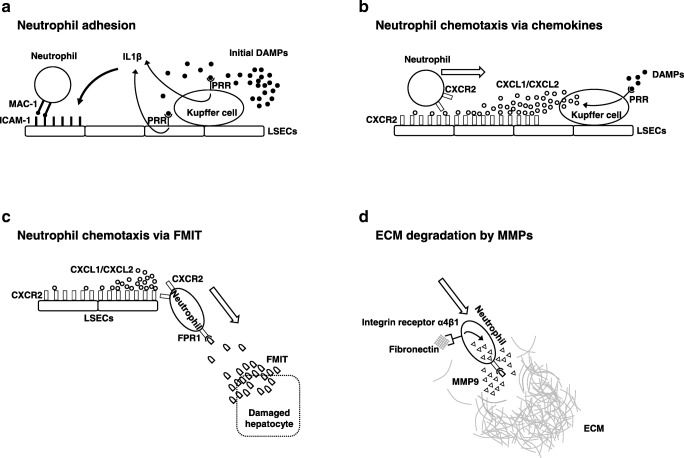
Fig. 1
Fig. 1
Putative mechanisms of neutrophil recruitment in liver ischemia-reperfusion injury. a Liver-resident Kupffer cells and liver sinusoidal endothelial cells (LSECs) sense initial danger-associated molecular patterns (DAMPs) via pattern recognition receptors (PRRs) to trigger intercellular adhesion molecule-1 (ICAM-1) expression on endothelial cells and neutrophil adhesion by integrin αMβ2 (Mac-1) signaling. b Neutrophils move on the LSECs luminal side toward the damaged site, guided by Kupffer cell-derived chemokine (CXCL1/CXCL2) gradient. c Neutrophils detect mitochondrial N-formyl peptides (FMIT) via formyl peptide receptor 1 (FPR1) and migrate underneath LSECs toward the injury site. d Neutrophils express and secret matrix metalloproteinase 9 (MMP9) to degrade extracellular matrix (ECM) during migration

References

    1. Dutkowski P, Linecker M, DeOliveira ML, Mullhaupt B, Clavien PA. Challenges to liver transplantation and strategies to improve outcomes. Gastroenterology. 2015;148(2):307–323. doi: 10.1053/j.gastro.2014.08.045. - DOI - PubMed
    1. Busuttil RW, Tanaka K. The utility of marginal donors in liver transplantation. Liver Transpl. 2003;9(7):651–663. doi: 10.1053/jlts.2003.50105. - DOI - PubMed
    1. Zhai Y, Petrowsky H, Hong JC, Busuttil RW, Kupiec-Weglinski JW. Ischaemia-reperfusion injury in liver transplantation--from bench to bedside. Nat Rev Gastroenterol Hepatol. 2013;10(2):79–89. doi: 10.1038/nrgastro.2012.225. - DOI - PMC - PubMed
    1. Selzner M, Selzner N, Jochum W, Graf R, Clavien PA. Increased ischemic injury in old mouse liver: an ATP-dependent mechanism. Liver Transpl. 2007;13(3):382–390. doi: 10.1002/lt.21100. - DOI - PubMed
    1. Guan LY, Fu PY, Li PD, Li ZN, Liu HY, Xin MG, Li W. Mechanisms of hepatic injury and protective effects of nitric oxide. World J Gastrointest Surg. 2014;6(7):122–128. doi: 10.4240/wjgs.v6.i7.122. - DOI - PMC - PubMed