


Family Leave and Return-to-Work Experiences of Physician Mothers
- PMID: 31603485
- PMCID: PMC6804274
- DOI: 10.1001/jamanetworkopen.2019.13054
Family Leave and Return-to-Work Experiences of Physician Mothers
Abstract
Importance: With the substantial increase in the proportion of women graduating from medical school, factors surrounding family leave require careful attention. Although many circumstances and experiences are unique to the training setting and specialty, a nationwide representation of physician mothers across all disciplines and all levels of training may reveal common themes and experiences among them, enable comparison across training setting and subspecialties, and identify best practices for supporting physician mothers throughout their careers.
Objective: To characterize family leave and return-to-work experiences of physician mothers across subspecialties.
Design, setting, and participants: This cross-sectional US nationwide survey study evaluating the experiences of 844 physician mothers was administered electronically via REDCap from September 2 to December 20, 2018.
Main outcomes and measures: A survey was developed using a modified Delphi process with a panel of experts to characterize physician mothers' family leave and return-to-work experiences. The survey covered both negative and positive experiences of physician mothers for each child they conceived or adopted after medical school to identify areas for change and strategies for successfully supporting physician parents.
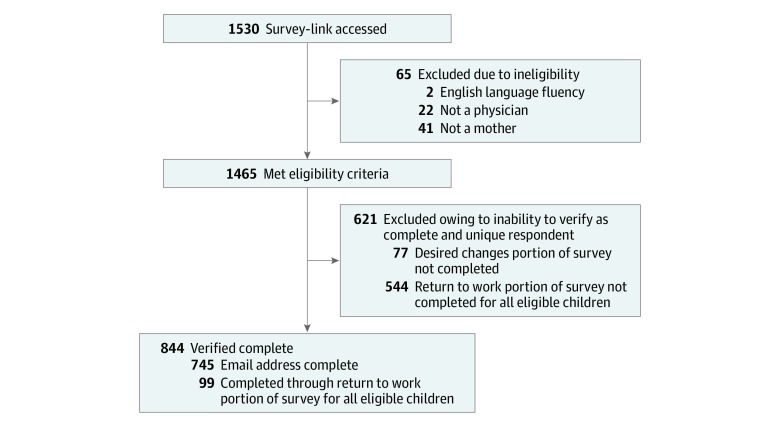
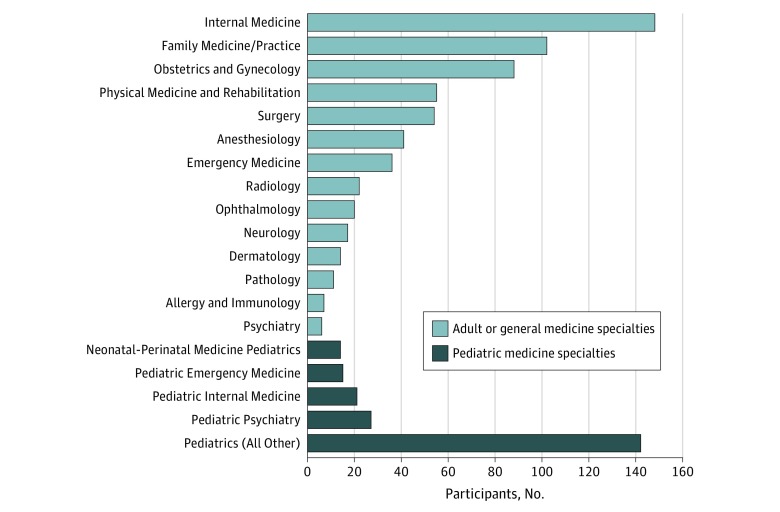
Results: Of 1465 potentially eligible survey respondents, 844 (57.6%) were verified as unique respondents with complete surveys. Their mean (SD) age was 35.8 (5.2) years (range, 27-67 years), with most women (826 [97.9%]) currently practicing and 138 women (16.4%) currently in a residency program. Participants were included from 19 subspecialty groups. Of the women surveyed, 619 (73.3%) felt that leave time was insufficient. The majority (751 [89.0%]) would have preferred 11 weeks to 6 months of leave vs the 5 to 12 weeks (often not paid) most commonly available. The most frequently reported negative experiences when returning to work were associated with lack of facilities for breast pumping (range, 12 of 78 [15.4%] for the third child to 272 of 844 [32.2%] for the first child) and time for breast pumping (range, 27 of 78 [34.6%] for the third child to 407 of 844 [48.2%] for the first child), difficulty obtaining childcare (eg, for the first child, 298 of 844 [35.3%]), and discrimination (eg, for the first child, 152 of 844 [18.0%]). The most common positive experience was emotional support (eg, for the first child, 504 of 844 [59.7%]), primarily from colleagues.
Conclusions and relevance: The present study, capturing one of the largest and most heterogeneous samples of physician mothers, showed that a substantial number of women physicians working in a variety of specialties at all levels of training across the United States needed and wanted more support for maternity leave and return to work. Support at the institutional level, such as paid leave, adequate breast pumping time without penalty, on-site childcare, and schedule flexibility, would likely provide the greatest direct assistance to help physician mothers thrive in their careers.
Conflict of interest statement
Figures
References
-
- Clemen NM, Blacker BC, Floen MJ, Schweinle WE, Huber JN. Work-life balance in women physicians in South Dakota: results of a state-wide assessment survey. S D Med. 2018;71(12):550-558. - PubMed
Publication types
MeSH terms
Grants and funding
LinkOut - more resources
Full Text Sources
