


Antimicrobial resistance genotypes and phenotypes of Campylobacter jejuni isolated in Italy from humans, birds from wild and urban habitats, and poultry
- PMID: 31603950
- PMCID: PMC6788699
- DOI: 10.1371/journal.pone.0223804
Antimicrobial resistance genotypes and phenotypes of Campylobacter jejuni isolated in Italy from humans, birds from wild and urban habitats, and poultry
Erratum in
-
Correction: Antimicrobial resistance genotypes and phenotypes of Campylobacter jejuni isolated in Italy from humans, birds from wild and urban habitats, and poultry.PLoS One. 2019 Nov 7;14(11):e0225231. doi: 10.1371/journal.pone.0225231. eCollection 2019. PLoS One. 2019. PMID: 31697786 Free PMC article.
Abstract
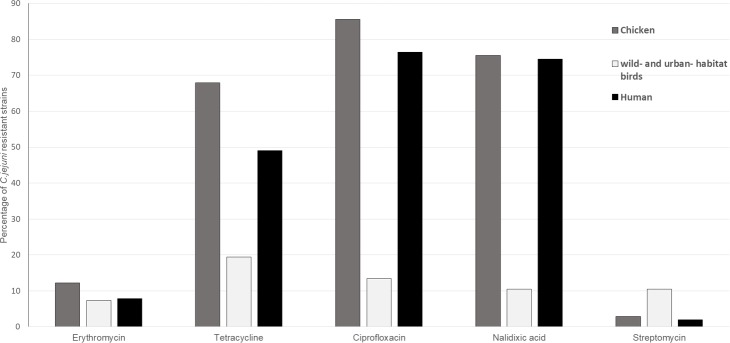
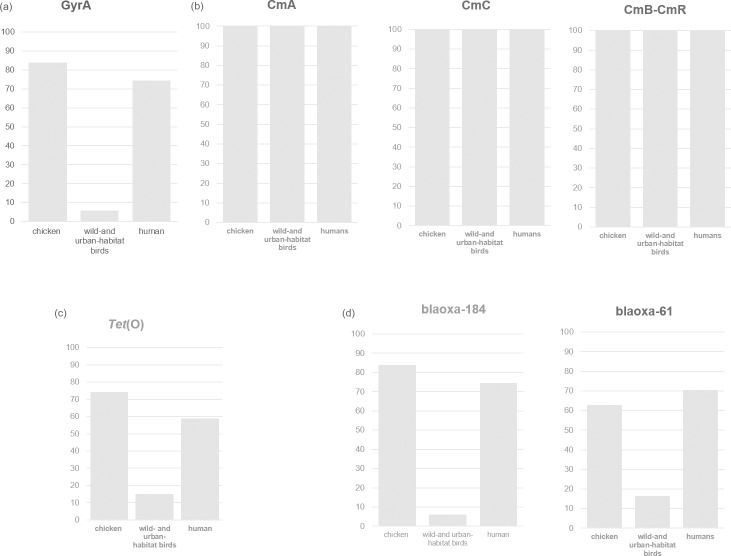
Campylobacter jejuni, a common foodborne zoonotic pathogen, causes gastroenteritis worldwide and is increasingly resistant to antibiotics. We aimed to investigate the antimicrobial resistance (AMR) genotypes of C. jejuni isolated from humans, poultry and birds from wild and urban Italian habitats to identify correlations between phenotypic and genotypic AMR in the isolates. Altogether, 644 C. jejuni isolates from humans (51), poultry (526) and wild- and urban-habitat birds (67) were analysed. The resistance phenotypes of the isolates were determined using the microdilution method with EUCAST breakpoints, and AMR-associated genes and single nucleotide polymorphisms were obtained from a publicly available database. Antimicrobial susceptibility testing showed that C. jejuni isolates from poultry and humans were highly resistant to ciprofloxacin (85.55% and 76.47%, respectively), nalidixic acid (75.48% and 74.51%, respectively) and tetracycline (67.87% and 49.02%, respectively). Fewer isolates from the wild- and urban-habitat birds were resistant to tetracycline (19.40%), fluoroquinolones (13.43%), and quinolone and streptomycin (10.45%). We retrieved seven AMR genes (tet (O), cmeA, cmeB, cmeC, cmeR, blaOXA-61 and blaOXA-184) and gyrA-associated point mutations. Two major B-lactam genes called blaOXA-61 and blaOXA-184 were prevalent at 62.93% and 82.08% in the poultry and the other bird groups, respectively. Strong correlations between genotypic and phenotypic resistance were found for fluoroquinolones and tetracycline. Compared with the farmed chickens, the incidence of AMR in the C. jejuni isolates from the other bird groups was low, confirming that the food-production birds are much more exposed to antimicrobials. The improper and overuse of antibiotics in the human population and in animal husbandry has resulted in an increase in antibiotic-resistant infections, particularly fluoroquinolone resistant ones. Better understanding of the AMR mechanisms in C. jejuni is necessary to develop new strategies for improving AMR programs and provide the most appropriate therapies to human and veterinary populations.
Conflict of interest statement
The authors have declared that no competing interests exist.
Figures
References
-
- Kirk MD, Pires SM, Black RE, Caipo M, Crump JA, Devleesschauwer B, et al. Correction: World Health Organization Estimates of the Global and Regional Disease Burden of 22 Foodborne Bacterial, Protozoal, and Viral Diseases, 2010: A Data Synthesis.PLoSMed. 2015. December 23;12(12):e1001940. - PMC - PubMed
-
- EFSA (European Food Safety Authority) and ECDC (European Centre for Disease Prevention and Control) (2018). The European Union summary report on antimicrobial resistance in zoonotic and indicator bacteria from humans, animals and food in 2017. EFSA J. 16 (12): 5500 10.2903/j.efsa.2018.5500 - DOI - PMC - PubMed
-
- Kaakoush NO, Deshpande NP, Man SM, Burgos-Portugal JA, Khattak FA, Raftery MJ, et al. Transcriptomic and proteomic analyses reveal key innate immune signatures in the host response to the gastrointestinal pathogen Campylobacter concisus. Infect Immun. 2015;83(2):832–845. 10.1128/IAI.03012-14 - DOI - PMC - PubMed
-
- Mughini Gras L, Smid JH, Wagenaar JA, de Boer AG, Havelaar AH, Friesema IH, et al. Risk factors for campylobacteriosis of chicken, ruminant, and environmental origin: a combined case-control and source attribution analysis. PLoS One. 2012;7(8):e42599 Published 2012 Aug 3. 10.1371/journal.pone.0042599 - DOI - PMC - PubMed
Publication types
MeSH terms
Substances
LinkOut - more resources
Full Text Sources
Medical
Molecular Biology Databases
