


Utility of emergency call centre, dispatch and ambulance data for syndromic surveillance of infectious diseases: a scoping review
- PMID: 31605491
- PMCID: PMC7446941
- DOI: 10.1093/eurpub/ckz177
Utility of emergency call centre, dispatch and ambulance data for syndromic surveillance of infectious diseases: a scoping review
Abstract
Background: Syndromic surveillance can supplement conventional health surveillance by analyzing less-specific, near-real-time data for an indication of disease occurrence. Emergency medical call centre dispatch and ambulance data are examples of routinely and efficiently collected syndromic data that might assist in infectious disease surveillance. Scientific literature on the subject is scarce and an overview of results is lacking.
Methods: A scoping review including (i) review of the peer-reviewed literature, (ii) review of grey literature and (iii) interviews with key informants.
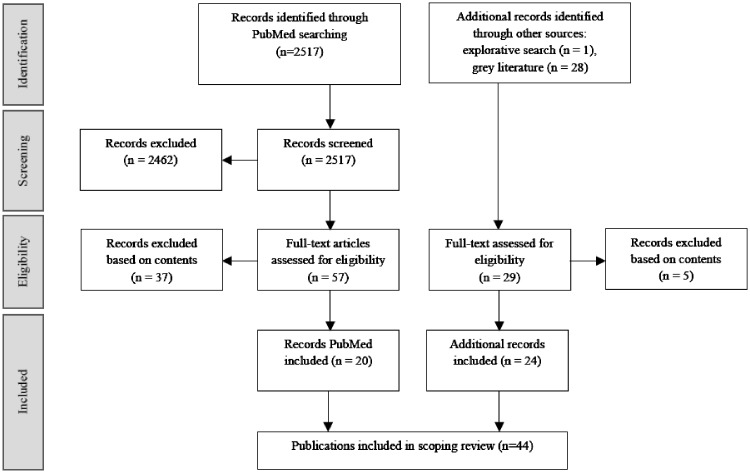
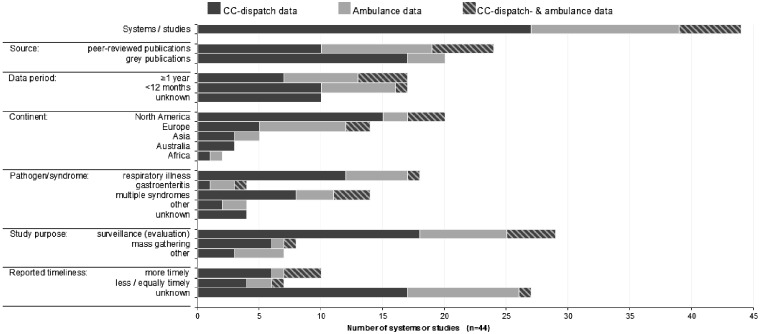
Results: Forty-four records were selected: 20 peer reviewed and 24 grey publications describing 44 studies and systems. Most publications focused on detecting respiratory illnesses or on outbreak detection at mass gatherings. Most used retrospective data; some described outcomes of temporary systems; only two described continuously active dispatch- and ambulance-based syndromic surveillance. Key informants interviewed valued dispatch- and ambulance-based syndromic surveillance as a potentially useful addition to infectious disease surveillance. Perceived benefits were its potential timeliness, standardization of data and clinical value of the data.
Conclusions: Various dispatch- and ambulance-based syndromic surveillance systems for infectious diseases have been reported, although only roughly half are documented in peer-reviewed literature and most concerned retrospective research instead of continuously active surveillance systems. Dispatch- and ambulance-based syndromic data were mostly assessed in relation to respiratory illnesses; reported use for other infectious disease syndromes is limited. They are perceived by experts in the field of emergency surveillance to achieve time gains in detection of infectious disease outbreaks and to provide a useful addition to traditional surveillance efforts.
© The Author(s) 2019. Published by Oxford University Press on behalf of the European Public Health Association.
Figures
References
-
- Sala Soler M, Fouillet A, Viso AC, et al.Assessment of syndromic surveillance in Europe. Lancet 2011;378: 1833–4. - PubMed
-
- Van den Wijngaard C, van Pelt W, Nagelkerke N, et al.Evaluation of syndromic surveillance in the Netherlands: its added value and recommendations for implementation. Epidemiol Infect 2011;16:19806. - PubMed
Publication types
MeSH terms
LinkOut - more resources
Full Text Sources
Medical
Miscellaneous
