


Capturing the patient voice: implementing patient-reported outcomes across the health system
- PMID: 31606809
- PMCID: PMC6995985
- DOI: 10.1007/s11136-019-02320-8
Capturing the patient voice: implementing patient-reported outcomes across the health system
Abstract
Purpose: Supporting the capture and use of patient-reported outcomes (PROs) at the point-of-care enriches information about important clinical and quality of life outcomes. Yet the ability to scale PROs across healthcare systems has been limited by knowledge gaps around how to manage the diversity of PRO uses and leverage health information technology. In this study, we report learnings and practice insights from UW Medicine's practice transformation efforts to incorporate patient voice into multiple areas of care.
Methods: Using a participatory, action research approach, we engaged with UW Medicine clinical and administrative stakeholders experienced with PRO implementation to inventory PRO implementations across the health system, characterize common clinical uses for PROs, and develop recommendations for system-wide governance and implementation of PROs.
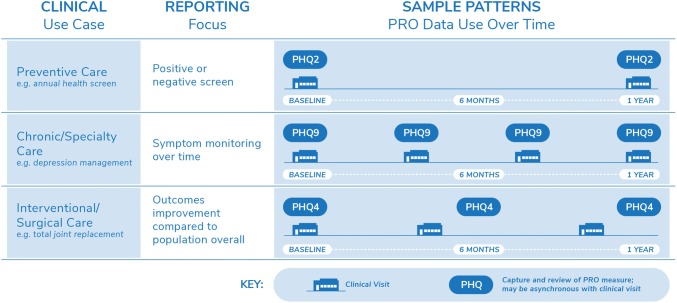
Results: We identified a wide breadth of PRO implementations (n = 14) in practice and found that nearly half (47%) of employed PRO measures captured shared clinical domains (e.g., depression). We developed three vignettes (use cases) that illustrate how users interact with PROs, characterize common ways PRO implementations support clinical care across the health system (1) Preventive care, (2) Chronic/Specialty care, and (3) Surgical/Interventional care), and elucidate opportunities to enhance efficient PRO implementations through system-level standards and governance.
Conclusions: Practice transformation efforts increasingly require integration of the patient voice into clinical care, often through the use of PROs. Learnings from our work highlight the importance of proactively considering how PROs will be used across the layers of healthcare organizations to optimize the design and governance of PROs.
Keywords: Action research; Care transformation; Depression; Implementation; Patient engagement; Patient-reported outcomes.
Conflict of interest statement
The authors do not have any personal, professional, or financial conflicts of interest to disclose for this work. The authors did not work with or were otherwise influenced by any external sponsors for this work.
Figures
References
-
- Centers for Medicare and Medicaid Services. (2019). Person and Family Engagement Strategy, 2018. Retrieved August 20, 2019, from https://www.cms.gov/Medicare/Quality-Initiatives-Patient-Assessment-Inst....
-
- Centers for Medicare and Medicaid Services. (2019). Promoting interoperability.
-
- National Quality Forum. (2018). NQF: Patient-reported outcomes. Retrieved August 20, 2018, from https://www.qualityforum.org/Patient-Reported_Outcomes.aspx.
MeSH terms
Grants and funding
LinkOut - more resources
Full Text Sources
Medical
Miscellaneous
