


Effect of implementing digital breast tomosynthesis (DBT) instead of mammography on population screening outcomes including interval cancer rates: Results of the Trento DBT pilot evaluation
- PMID: 31607526
- PMCID: PMC7375541
- DOI: 10.1016/j.breast.2019.09.012
Effect of implementing digital breast tomosynthesis (DBT) instead of mammography on population screening outcomes including interval cancer rates: Results of the Trento DBT pilot evaluation
Abstract
Background/aim: The Trento screening program transitioned to digital breast tomosynthesis (DBT) screening based on evidence that DBT improves breast cancer (BC) detection compared to mammography; an evaluation of the transition to DBT is reported in this pilot study.
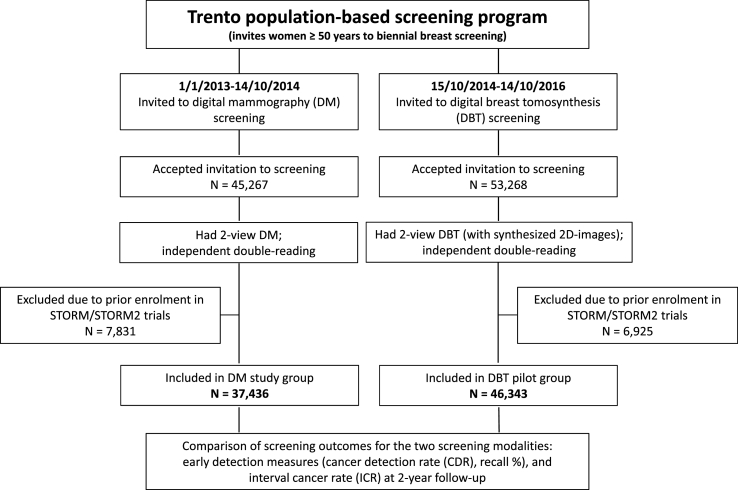
Methods: Prospective implementation of DBT screening included women aged ≥50 years who attended the Trento program for biennial screening. DBT screening included DBT acquisitions with synthesized 2D-images. A historical cohort of women who attended the program (January 2013-October 2014) and received digital mammography (DM) provided a comparison group. Independent double-reading (with a third arbitrating read for discordance) was used for DBT and DM screening. Screening outcomes included cancer detection rate (CDR/1000 screens), percentage of screens recalled to assessment (recall%), interval cancer rate (ICR/1000 screens) at 2-year follow-up, and screening sensitivity. Rate ratios (RR) and 95% confidence interval (95%CI) examined outcomes for DBT versus DM screening.
Results: From women aged 50-69 years who accepted an invitation to screening (October 2014-October 2016) 46,343 comprised the DBT-screened group: amongst these 402 BCs (includes 50 ductal carcinoma in-situ (DCIS)) were detected (CDR 8.67/1000), whereas 205 BCs (includes 33 DCIS) were detected amongst 37,436 DM screens (CDR 5.48/1000) [RR for CDR:1.58 (1.34-1.87)]. Recall% was lower for DBT (2.55%) than DM (3.21%) [RR:0.79 (0.73-0.86)]. Compared to DM, DBT screening increased CDR for stage I-II BC, for all tumour size and grade categories, and for node-negative BC, but did not increase CDR for DCIS. Estimated ICR for DBT was 1.1/1000 whereas ICR for DM was 1.36/1000 [RR:0.81 (0.55-1.19)]. Screening sensitivity was 88.74% for DBT versus 80.08% for DM [RR:1.11 (0.94-1.31)].
Conclusion: DBT significantly improved early-detection measures but did not significantly reduce ICR (relative to DM screening), suggesting that it could add benefit as well as adding over-detection in population BC screening.
Keywords: Breast cancer; Cancer screening; Digital breast tomosynthesis; Interval cancers; Population screening.
Copyright © 2019 Elsevier Ltd. All rights reserved.
Figures
References
-
- Ciatto S., Houssami N., Bernardi D., Caumo F., Pellegrini M., Brunelli S. Integration of 3D digital mammography with tomosynthesis for population breast-cancer screening (STORM): a prospective comparison study. Lancet Oncol. 2013 Jun 6;(14):583–589. - PubMed
-
- Houssami N., Macaskill P., Bernardi D., Caumo F., Pellegrini M., Brunelli S. Breast screening using 2D-mammography or integrating digital breast tomosynthesis (3D-mammography) for single-reading or double-reading--evidence to guide future screening strategies. European Journal of Cancer. 2014 Jul;50(10):1799–1807. - PubMed
-
- Bernardi D., Macaskill P., Pellegrini M., Valentini M., Fanto C., Ostillio L. Breast cancer screening with tomosynthesis (3D mammography) with acquired or synthetic 2D mammography compared with 2D mammography alone (STORM-2): a population-based prospective study. Lancet Oncol. 2016 Aug;17(8):1105–1113. - PubMed
-
- Skaane P., Bandos A.I., Gullien R., Eben E.B., Ekseth U., Haakenaasen U. Prospective trial comparing full-field digital mammography (FFDM) versus combined FFDM and tomosynthesis in a population-based screening programme using independent double reading with arbitration. Eur Radiol. 2013 Aug;23(8):2061–2071. - PMC - PubMed
-
- Zackrisson S., Lång K., Rosso A., Johnson K., Dustler M., Fornvik D. One-view breast tomosynthesis versus two-view mammography in the Malmo Breast Tomosynthesis Screening Trial (MBTST): a prospective, population-based, diagnostic accuracy study. Lancet Oncology. 2018 Nov;19(11):1493–1503. - PubMed
MeSH terms
LinkOut - more resources
Full Text Sources
Medical
