Review
. 2019 Sep 19:10:1079.
doi: 10.3389/fphar.2019.01079. eCollection 2019.

Pathophysiological Mechanisms and Potential Therapeutic Targets in Intracerebral Hemorrhage

Affiliations
Review

Pathophysiological Mechanisms and Potential Therapeutic Targets in Intracerebral Hemorrhage

Zhiwei Shao et al. Front Pharmacol. .

Abstract

Intracerebral hemorrhage (ICH) is a subtype of hemorrhagic stroke with high mortality and morbidity. The resulting hematoma within brain parenchyma induces a series of adverse events causing primary and secondary brain injury. The mechanism of injury after ICH is very complicated and has not yet been illuminated. This review discusses some key pathophysiology mechanisms in ICH such as oxidative stress (OS), inflammation, iron toxicity, and thrombin formation. The corresponding therapeutic targets and therapeutic strategies are also reviewed.

Keywords: Nrf2; inflammation; intracerebral hemorrhage; iron; oxidative stress; thrombin.


Figures

Figure 1
Figure 1
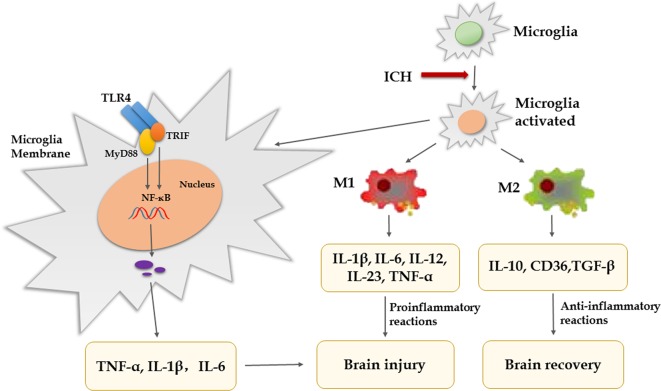
Pro- and anti-inflammatory cytokines in secondary brain injury after ICH.
Figure 2
Figure 2
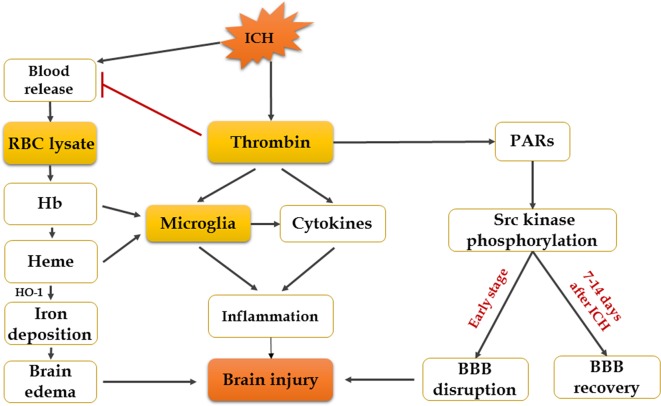
Mechanisms of erythrocyte lysates and thrombin in secondary brain injury after ICH.
Figure 3
Figure 3
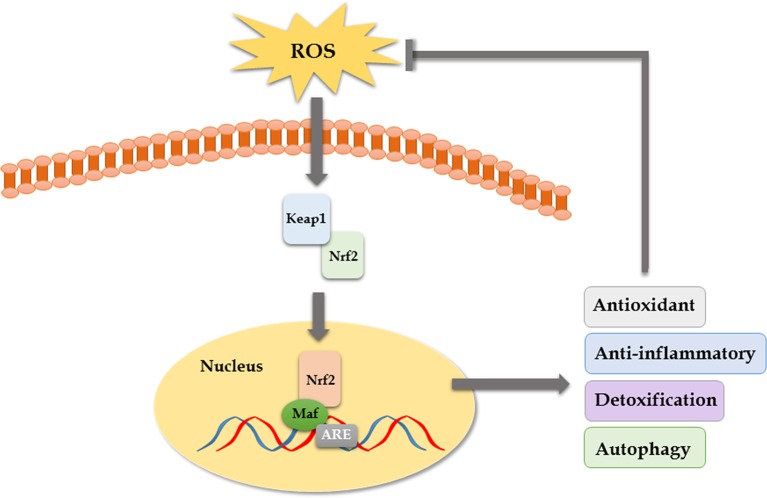
The Keap1–Nrf2–ARE pathway. Keap1 is an OS sensor and negatively regulates Nrf2. Once exposed to ROS, the activated Nrf2 translocates to the nucleus, binds to antioxidant response element (ARE), heterodimerizes with one of the small Maf (musculoaponeurotic fibrosarcoma oncogene homolog) proteins, and enhances the upregulation of cytoprotective, antioxidant, anti-inflammatory, and detoxification genes that mediate cell survival.

References

    1. Aronowski J., Zhao X. (2011). Molecular pathophysiology of cerebral hemorrhage: secondary brain injury. Stroke 42, 1781–1786. 10.1161/STROKEAHA.110.596718 - DOI - PMC - PubMed
    1. Auriat A. M., Silasi G., Wei Z., Paquette R., Paterson P., Nichol H., et al. (2012). Ferric iron chelation lowers brain iron levels after intracerebral hemorrhage in rats but does not improve outcome. Exp. Neurol. 234, 136–143. 10.1016/j.expneurol.2011.12.030 - DOI - PMC - PubMed
    1. Behrouz R. (2016). Re-exploring tumor necrosis factor alpha as a target for therapy in intracerebral hemorrhage. Transl. Stroke Res. 7, 93–96. 10.1007/s12975-016-0446-x - DOI - PubMed
    1. Bhatia H. S., Baron J., Hagl S., Eckert G. P., Fiebich B. L. (2016). Rice bran derivatives alleviate microglia activation: possible involvement of MAPK pathway. J. Neuroinflammation 13, 148. 10.1186/s12974-016-0615-6 - DOI - PMC - PubMed
    1. Bimpis A., Papalois A., Voumvourakis K., Olah O., Tiszlavicz L., Liapi C. (2015). Neuronal tumour necrosis factor-alpha and interleukin-1beta expression in a porcine model of intracerebral haemorrhage: modulation by U-74389G. Brain Res. 1615, 98–105. 10.1016/j.brainres.2015.04.034 - DOI - PubMed

LinkOut - more resources