


Rheumatoid Arthritis Morning Stiffness Is Associated With Synovial Fibrin and Neutrophils
- PMID: 31612614
- PMCID: PMC7113097
- DOI: 10.1002/art.41141
Rheumatoid Arthritis Morning Stiffness Is Associated With Synovial Fibrin and Neutrophils
Abstract
Objective: Morning stiffness is a hallmark symptom of rheumatoid arthritis (RA), but its etiology is poorly understood. This study was undertaken to determine whether any histologic features of synovium are associated with this symptom.
Methods: Data on patient-reported morning stiffness duration and severity, and Disease Activity Score in 28 joints (DAS28) were collected from 176 patients with RA undergoing arthroplasty. Synovium was scored for 10 histopathologic features: synovial lining hyperplasia, lymphocytes, plasma cells, Russell bodies, binucleate plasma cells, fibrin, synovial giant cells, detritus, neutrophils, and mucin. Fibrinolysis of clots seeded with various cell types was measured in turbidimetric lysis assays.
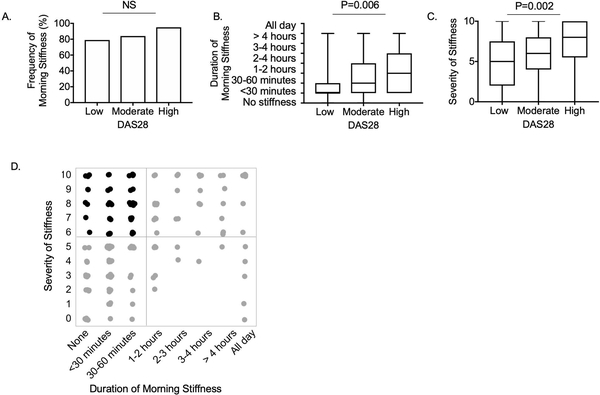
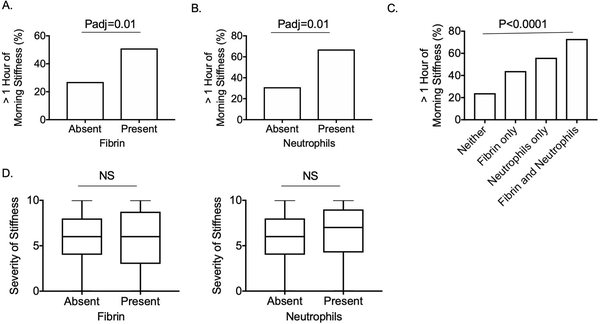
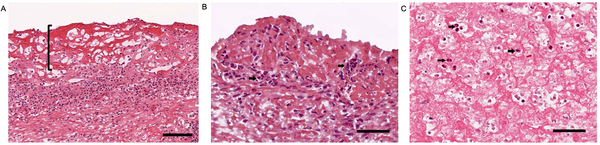
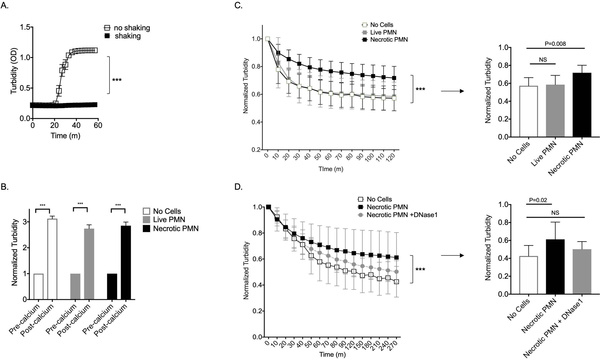
Results: Stiffness severity and morning stiffness duration were both significantly associated with DAS28 (P = 0.0001 and P = 0.001, respectively). None of the synovial features examined were associated with patient-reported stiffness severity. The presence of neutrophils and fibrin in RA synovial tissue were significantly associated (P < 0.0001) with patient-reported morning stiffness of ≥1 hour, such that 73% of patients with both synovial fibrin and neutrophils reported morning stiffness of ≥1 hour. Further, neutrophils and fibrin deposits colocalized along the synovial lining. In in vitro analyses, fibrin clots seeded with necrotic neutrophils were more resistant to fibrinolysis than those seeded with living neutrophils or no cells (P = 0.008). DNase I treatment of necrotic neutrophils abrogated the delay in fibrinolysis.
Conclusion: In RA, prolonged morning stiffness may be related to impaired fibrinolysis of neutrophil-enmeshed fibrin deposits along the synovial membrane. Our findings also suggest that morning stiffness severity and duration may reflect distinct pathophysiologic phenomena.
© 2019, American College of Rheumatology.
Figures
Comment in
-
Reply.Arthritis Rheumatol. 2021 Jan;73(1):175-176. doi: 10.1002/art.41463. Epub 2020 Dec 5. Arthritis Rheumatol. 2021. PMID: 32729675 Free PMC article. No abstract available.
-
Determinants of Morning Stiffness in Rheumatoid Arthritis: Comment on the Article by Orange et al.Arthritis Rheumatol. 2021 Jan;73(1):174-175. doi: 10.1002/art.41459. Epub 2020 Dec 7. Arthritis Rheumatol. 2021. PMID: 32741150 No abstract available.
-
Morning Stiff ness and Neutrophil Circadian Disarming: Comment on the Article by Orange et al.Arthritis Rheumatol. 2021 Feb;73(2):356-357. doi: 10.1002/art.41503. Epub 2020 Dec 24. Arthritis Rheumatol. 2021. PMID: 32892506 Free PMC article. No abstract available.
-
Reply.Arthritis Rheumatol. 2021 Feb;73(2):357-358. doi: 10.1002/art.41505. Epub 2020 Dec 20. Arthritis Rheumatol. 2021. PMID: 32892514 Free PMC article. No abstract available.
References
-
- Aletaha D, et al., 2010 Rheumatoid arthritis classification criteria: an American College of Rheumatology/European League Against Rheumatism collaborative initiative. Arthritis Rheum, 2010. 62(9): p. 2569–81. - PubMed
-
- Mattila K, Buttgereit F, and Tuominen R, Influence of rheumatoid arthritis-related morning stiffness on productivity at work: results from a survey in 11 European countries. Rheumatol Int, 2015. 35(11): p. 1791–7. - PubMed
-
- Arnett FC, et al., The American Rheumatism Association 1987 revised criteria for the classification of rheumatoid arthritis. Arthritis Rheum, 1988. 31(3): p. 315–24. - PubMed
-
- Hazes JM, Hayton R, and Silman AJ, A reevaluation of the symptom of morning stiffness. J Rheumatol, 1993. 20(7): p. 1138–42. - PubMed
Publication types
MeSH terms
Substances
Grants and funding
LinkOut - more resources
Full Text Sources
Medical
