


New Challenges of HIV-1 Infection: How HIV-1 Attacks and Resides in the Central Nervous System
- PMID: 31614895
- PMCID: PMC6829584
- DOI: 10.3390/cells8101245
New Challenges of HIV-1 Infection: How HIV-1 Attacks and Resides in the Central Nervous System
Abstract
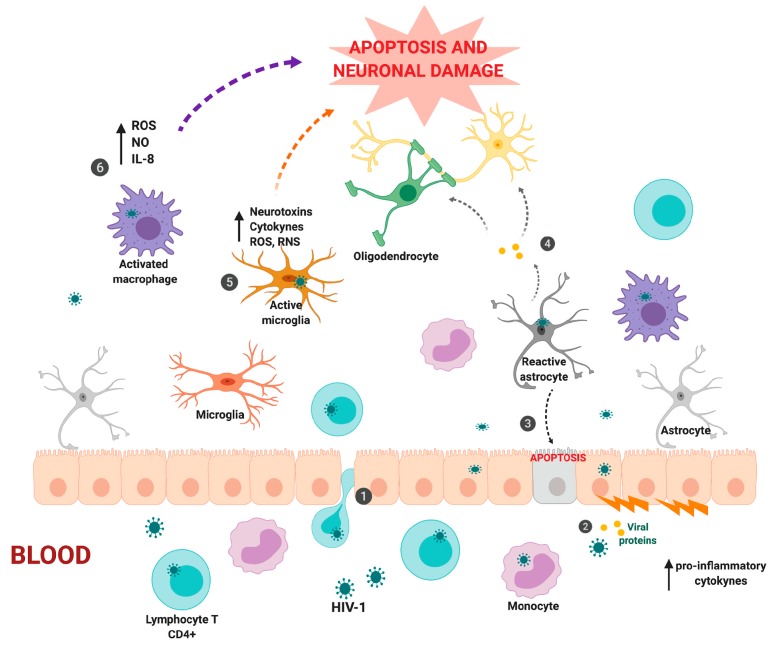
Acquired immunodeficiency syndrome (AIDS) has become one of the most devastating pandemics in recorded history. The main causal agent of AIDS is the human immunodeficiency virus (HIV), which infects various cell types of the immune system that express the CD4 receptor on their surfaces. Today, combined antiretroviral therapy (cART) is the standard treatment for all people with HIV; although it has improved the quality of life of people living with HIV (PLWH), it cannot eliminate the latent reservoir of the virus. Therefore HIV/AIDS has turned from a fatal disease to a chronic disease requiring lifelong treatment. Despite significant viral load suppression, it has been observed that at least half of patients under cART present HIV-associated neurocognitive disorders (HAND), which have been related to HIV-1 infection and replication in the central nervous system (CNS). Several studies have focused on elucidating the mechanism by which HIV-1 can invade the CNS and how it can generate the effects seen in HAND. This review summarizes the research on HIV-1 and its interaction with the CNS with an emphasis on the generation of HAND, how the virus enters the CNS, the relationship between HIV-1 and cells of the CNS, and the effect of cART on these cells.
Keywords: AIDS; CNS; CNS cells; HAND; HIV-1; cART.
Conflict of interest statement
The authors declare no conflicts of interest.
Figures
References
-
- UNAIDS. [(accessed on 20 July 2019)]; Available online: https://www.unaids.org/en/resources/fact-sheet.
-
- Egger M., May M., Chene G., Phillips A.N., Ledergerber B., Dabis F., Costagliola D., D’Arminio Monforte A., de Wolf F., Reiss P., et al. Prognosis of HIV-1-infected patients starting highly active antiretroviral therapy: A collaborative analysis of prospective studies. Lancet. 2002;360:119–129. doi: 10.1016/S0140-6736(02)09411-4. - DOI - PubMed
Publication types
MeSH terms
LinkOut - more resources
Full Text Sources
Medical
Research Materials
