Review
. 2020 Jan 1;44(1):33-53.
doi: 10.1093/femsre/fuz025.

Carbon/nitrogen homeostasis control in cyanobacteria

Affiliations
Review

Carbon/nitrogen homeostasis control in cyanobacteria

Karl Forchhammer et al. FEMS Microbiol Rev. .

Abstract

Carbon/nitrogen (C/N) balance sensing is a key requirement for the maintenance of cellular homeostasis. Therefore, cyanobacteria have evolved a sophisticated signal transduction network targeting the metabolite 2-oxoglutarate (2-OG), the carbon skeleton for nitrogen assimilation. It serves as a status reporter for the cellular C/N balance that is sensed by transcription factors NtcA and NdhR and the versatile PII-signaling protein. The PII protein acts as a multitasking signal-integrating regulator, combining the 2-OG signal with the energy state of the cell through adenyl-nucleotide binding. Depending on these integrated signals, PII orchestrates metabolic activities in response to environmental changes through binding to various targets. In addition to 2-OG, other status reporter metabolites have recently been discovered, mainly indicating the carbon status of the cells. One of them is cAMP, which is sensed by the PII-like protein SbtB. The present review focuses, with a main emphasis on unicellular model strains Synechoccus elongatus and Synechocystis sp. PCC 6803, on the physiological framework of these complex regulatory loops, the tight linkage to metabolism and the molecular mechanisms governing the signaling processes.

Keywords: 2-oxoglutarate; CO2 metabolism; arginine synthesis; energy sensing; nitrogen assimilation; protein-serine-phosphorylation.


Figures

Figure 1.
Figure 1.
Metabolic basis of C/N balance sensing: schematic model of central metabolism at the intersection of CO2 fixation and nitrogen assimilation and the role of PII in controlling key reactions (indicated by red lines). Changes in the level 2-oxoglutarate, which are sensed by the PII signaling protein, report changes in the balance between CO2 fixation and ammonium assimilation: the levels are depleted by ammonium assimilation though the GS-GOGAT cycle and refilled by carbon flux originating from CO2 fixation. According to metabolic flux analysis (Wan et al. 2017), the phosphoenol pyruvate (PEP) carboxylase (PEPC) reaction plays a major role for carbon flux into the oxidative branch of the TCA cycle/2-oxoglutarate. Glutamate is the primary nitrogen donor for anabolic reactions, with arginine synthesis being of particular importance (PII controls reactions for nitrogen storage formation (N-acetyl glutamate kinase, NAGK) and fatty acid synthesis (Acetyl-CoA carboxylase, ACCase) as well as the uptake of the nitrogen sources ammonium, nitrate and urea through their respective uptake systems as indicated. The arrows width is indicative of the carbon flow.
Figure 2.
Figure 2.
PII-structure and general targets of PII proteins among bacteria. (A), Cartoon representation of S. elongatus PII in complex with 2-OG-Mg2+-ATP (PDB entry 2XUL) viewed from top and side. The clefts between the subunits constitute the metabolite binding sites (for details see text). The distal part of the large, solvent exposed T-loop, is disordered and therefore, not resolved. The dotted lines connect the proximal parts of the T-loop. (B), General scheme of signal perception, integration and transduction by PII proteins, resembling the function of a central processor unit (Ninfa and Atkinson 2000). Through competitive binding of ATP or ADP and synergistic binding of 2-OG with Mg2+-ATP, PII responds to changes in the energy state and C/N balance. Moreover, in many cases, PII proteins might be modified at the tip of the T-loop by post-translational covalent modification (PTM). The various binding states and eventually covalent modifications result in differential interactions with a wide variety of receptors of the PII signal, the most prominent being transporters, key metabolic enzymes or transcription factors. Target proteins specific to cyanobacteria are written in green, universal targets in red. In grey, PII targets outside the cyanobacteria are indicated (TnrA and GlnR: Global nitrogen-transcription factors; NtrB-NtrC: Nitrogen regulatory proteins B and C; NagB: Glucosamine 6-phosphate deaminase; ATase: Adenylyl-transferase; DraT: Dinitrogenase reductase ADP-ribosyl-transferase; DraG: Dinitrogenase reductase glycohydrolase; ?: unidentified targets).
Figure 3.
Figure 3.
PII controls the arginine pathway by NAGK interaction. The arginine synthesis pathway is controlled by PII-dependent activation of the rate-limiting step, the N-acetyl glutamate kinase (NAGK) reaction. Under nitrogen sufficient, low 2-OG conditions, two PII trimers (in ATP complex) symmetrically associate with the hexameric NAGK (PDB entry 2V5H) to activate the reaction and to tune down arginine feedback inhibition. This allows increased flux towards arginine, which then may be used also to store excess nitrogen in form of cyanopyhcin (for details see text). Under nitrogen-limiting conditions, the increasing 2-OG levels lead to dissociation of the complex. Free NAGK is highly sensitive towards arginine-feedback inhibition. Subsequent phosphorylation of PII robustly prevents further NAGK interaction, unless PII becomes dephosphorylated again in response to sustained nitrogen excess conditions.
Figure 4.
Figure 4.
Indirect regulation of transcription factor NtcA by PII. Conditions of nitrogen sufficiency (low 2-OG levels) or low energy state (high ADP to ATP ratio) favor formation of the PII-PipX complex (PDB entry 3N5B), where PipX does not associate with NtcA. When 2-OG and ATP levels increase, NtcA successfully competes with PII for PipX. The NtcA-PipX complex (PDB entry 2XKO) has increased affinity to the NtcA-specific DNA binding sites and turns on transcription of NtcA-dependent genes.
Figure 5.
Figure 5.
Schematic representation of cyanobacterial CCM. In Synechocystis PCC 6803, the carbon concentrating mechanism CCM is composed of five Ci uptake systems (among them three HCO3 transporters and two CO2 uptake systems), a Na+/H+ gradient restoring system and the carboxysome, where HCO3 is dehydrated to CO2 by carbonic anhydrase (CA) enzyme and then CO2 is fixed by RubisCO (Burnap et al. ; Long et al. 2016). The cyanobacterial HCO3 uptake systems consist of: a high affinity ATP-dependent ABC-type transporter (BCT1 complex), which consists of CmpA/B/C/D subunits (CmpA PDB entry 2I4B) encoded by the cmpABCD operon and two sodium-dependent bicarbonate single-subunit transporters: A low Ci inducible/high affinity/low flux transporter SbtA and a constitutive medium affinity/high flux transporter BicA. The PII-like SbtB protein (PDB entry 5O3R) is a regulatory component of the CCM. The cyanobacterial CO2 uptake systems are organized into two thylakoid-bound systems: (A), the high-affinity/low-flux/low Ci-inducible redox driven CO2 uptake NDH-I3 complex consisting of NdhB/NdhF3/NdhD3/CupA subunits and (B), the low affinity/high flux/constitutive redox driven CO2 uptake NDH-I4 complex consisting of NdhB/NdhF4/NdhD4/CupB subunits. The CO2-NDH-I3/4 complexes possess CA-like activity using the recently discovered CA (EcaB), which is interacting with CupA and CupB subunits to convert CO2 into HCO3 by hydrating CO2 and creating a proton gradient (Han et al. ; Sun et al. 2019).
Figure 6.
Figure 6.
Regulation of cyanobacterial CCM by transcription by transcription factors (TFs) NdhR and CmpR and their modulation by effector metabolites 2-OG, NADP+, 2-PG and RuBP. Dashed lines indicate regulatory interactions between the TFs to components of CCM, binding of effector metabolites to target proteins is indicated by straight arrows, with the effect on the respective target indicated by (+) for activation and (−) for inactivation.
Figure 7.
Figure 7.
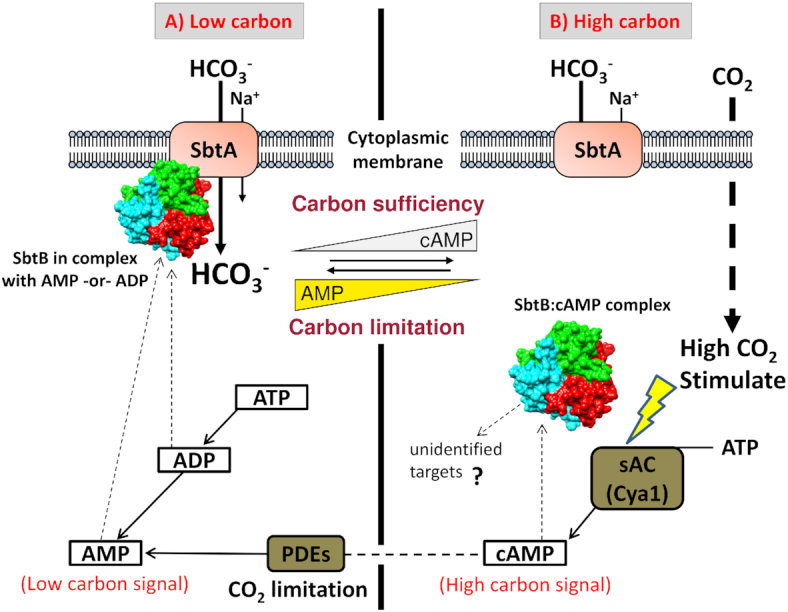
Model for the proposed regulatory mechanism of the PII-like protein SbtB. The interactions of SbtB are modulated by the formation of various SbtB—adenylnucleotide complexes. Under carbon-limiting conditions (part A), SbtA/SbtB proteins are highly expressed and form a membrane-localized complex, favored by the binding of ADP or AMP to SbtB. Under the low carbon conditions, the levels of AMP are high, presumably due to energy consuming CO2 uptake activity. When low carbon-adapted cells are shifted to high carbon conditions (part B), soluble adenylate cyclase (sAC) Cya1 becomes activated by CO2 and produces cAMP. When SbtB interacts with cAMP, it no longer stays bound to the membrane. Instead, soluble, cAMP-complexed SbtB may now be able to interact with additional targets (model according to Selim et al. 2018).

References

    1. Agostoni M, Montgomery BL. Survival strategies in the aquatic and terrestrial world: the impact of second messengers on cyanobacterial processes. Life (Basel). 2014;4:745–69. - PMC - PubMed
    1. Aldehni FM, Sauer J, Spielhaupter Cet al. .. Signal transduction protein P(II) is required for NtcA-regulated gene expression during nitrogen deprivation in the cyanobacterium Synechococcus elongatus strain PCC 7942. J Bacteriol. 2003;185:2582–891. - PMC - PubMed
    1. Allen MM, Smith AJ. Nitrogen chlorosis in blue-green algae. Arch Microbiol. 1969;69:114–20. - PubMed
    1. Allen MM, Weathers PJ. Structure and composition of cyanophycin granules in the cyanobacterium Aphanocapsa 6308. J Bacteriol. 1980;141:959–62. - PMC - PubMed
    1. Arcondeguy T, Jack R, Merrick M. P(II) signal transduction proteins, pivotal players in microbial nitrogen control. Microbiol Mol Biol R: MMBR. 2001;65:80–105. - PMC - PubMed

Publication types