. 2020 Jan 2;153(2):198-209.
doi: 10.1093/ajcp/aqz155.

Systematic Review of the Use of Telepathology During Intraoperative Consultation

Affiliations

Systematic Review of the Use of Telepathology During Intraoperative Consultation

Robin L Dietz et al. Am J Clin Pathol. .

Abstract

Objective: To compare studies that used telepathology systems vs conventional microscopy for intraoperative consultation (frozen-section) diagnosis.

Methods: A total of 56 telepathology studies with 13,996 cases in aggregate were identified through database searches.

Results: The concordance of telepathology with the reference standard was generally excellent, with a weighted mean of 96.9%. In comparison, we identified seven studies using conventional intraoperative consultation that showed a weighted mean concordance of 98.3%. Evaluation of the risk of bias showed that most of these studies were low risk.

Conclusions: Despite limitations such as variation in reporting and publication bias, this systematic review provides strong support for the safety of using telepathology for intraoperative consultations.

Keywords: Frozen section; Intraoperative consultation; Systematic review; Telepathology.


Figures

Figure 1
Figure 1
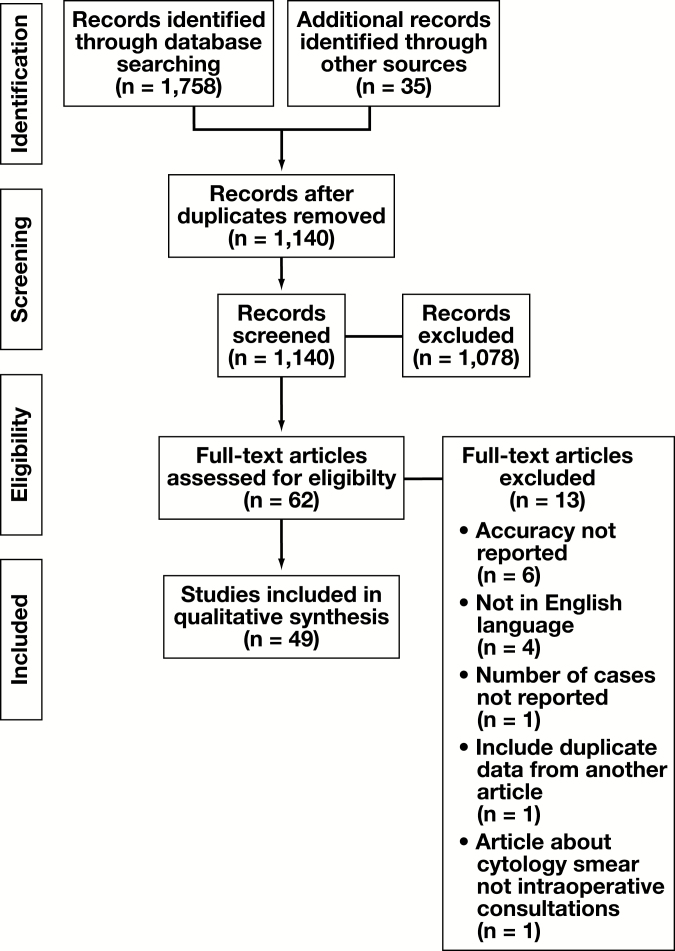
Preferred Reporting Items for Systematic Reviews and Meta-Analysis (PRISMA) flow diagram detailing the study selection process. For the final review, data was extracted from the full texts of 49 articles.
Figure 2
Figure 2
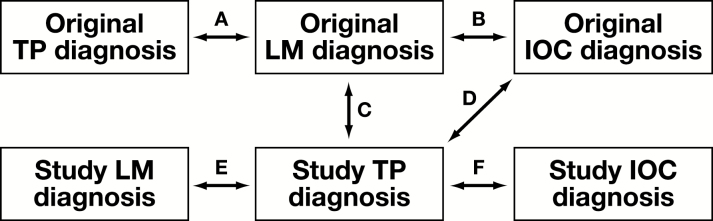
Study design classification in published TP for IOC articles. Prospective studies included study types A and B, and retrospective studies included study types B through F. A, Original LM diagnosis to original TP diagnosis. B, Original LM diagnosis to original IOC diagnosis. C, Original LM diagnosis to study TP diagnosis. D, Original IOC diagnosis to study TP diagnosis. E, Study LM diagnosis to study TP diagnosis. F, Study IOC diagnosis to study TP diagnosis. IOC, intraoperative consultation; LM, light microscopy; TP, telepathology.
Figure 3
Figure 3
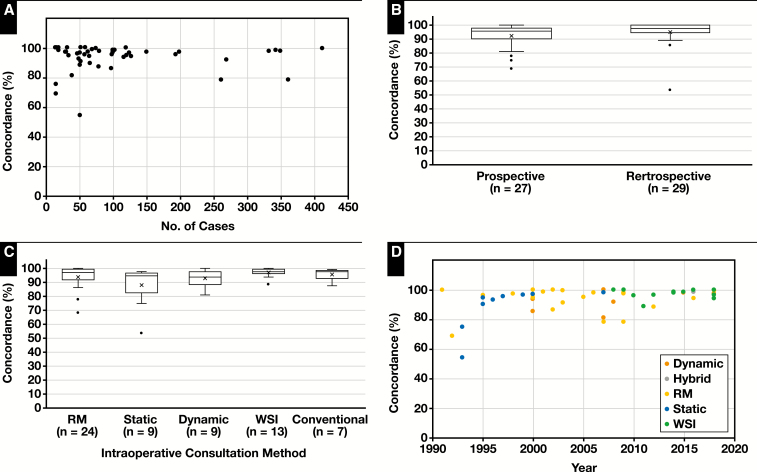
The means calculated in the scatterplots are weighted by the number of cases. RM, robotic microscopy; WSI, whole-slide image. A, Concordance vs the number of cases. Most studies have concordance rates more than 90%. Many studies did not reach the College of American Pathologists’ validation requirement of 80 cases. Three studies with total numbers of cases more than 450 were omitted from the graph with study sizes of 633, 1,204, and 1,329 and concordance rates of 98%, 98.6%, and 98%, respectively. B, Box-and-whisker plot of concordance vs study type. The means of both prospective (92.5%) and retrospective (94.9%) studies are shown as an “X,” and the median is the bar within the box. C, Box-and-whisker plot of concordance vs intraoperative consultation method. The means of RM (93.9%), static (88.3%), dynamic (93.1%), WSI (97.3%), and conventional microscopy (95.9%) are shown. The single study with a hybrid method (concordance = 98.3%) was omitted from this graph. D, Concordance vs year of publication. Points are color coded by method. Eras of popular telepathology methods are more apparent. Static images predominated prior to 2000, RM from 2000 to 2007, and WSI from 2007 to present.
Figure 4
Figure 4
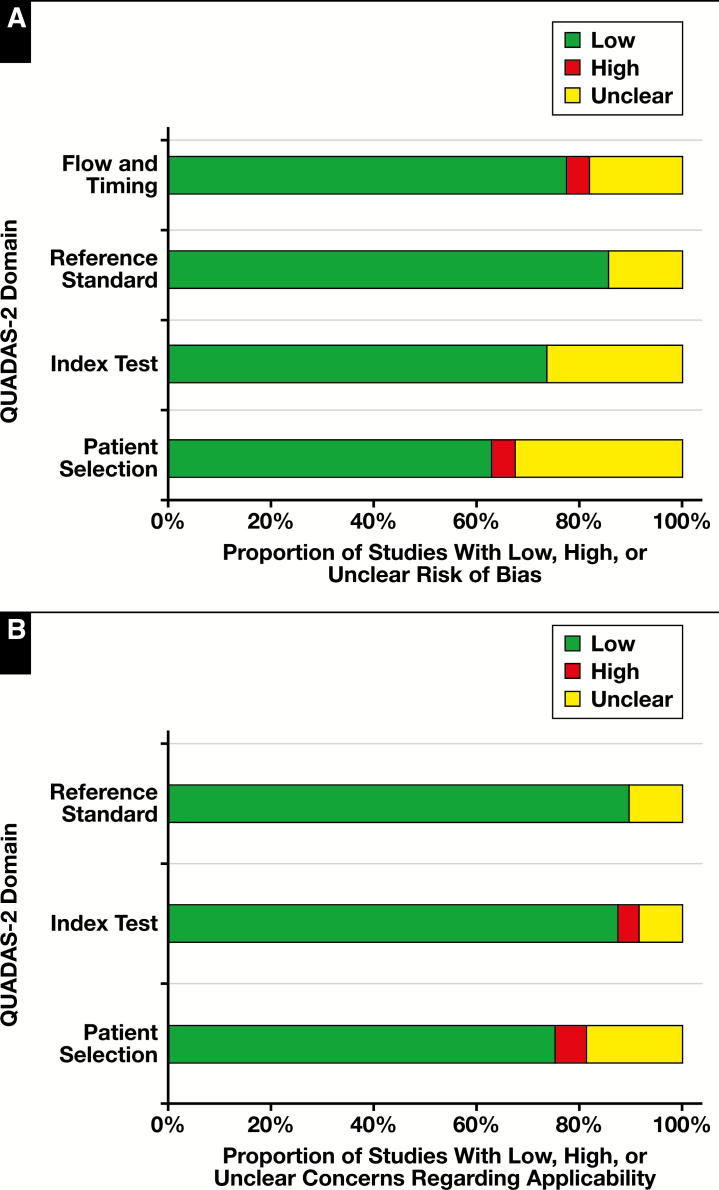
Quality Assessment of Diagnostic Accuracy Studies 2 (QUADAS-2) quality assessment results. A, Proportion of studies reviewed (n = 49) with low, high, or unclear risk of bias. B, Proportion of studies reviewed (n = 49) with low, high, or unclear concerns regarding applicability. Graphs adopted from the template for graphical display from the QUADAS-2 resource page.

References

    1. Weinstein RS. Prospects for telepathology. Hum Pathol. 1986;17:433-434. - PubMed
    1. Dietz RL, Hartman DJ, Zheng L, et al. . Review of the use of telepathology for intraoperative consultation. Expert Rev Med Devices. 2018;15:883-890. - PubMed
    1. Pantanowitz L, Dickinson K, Evans AJ, et al. . American Telemedicine Association clinical guidelines for telepathology. J Pathol Inform. 2014;5:39. - PMC - PubMed
    1. Nordrum I, Engum B, Rinde E, et al. . Remote frozen section service: a telepathology project in northern Norway. Hum Pathol. 1991;22:514-518. - PubMed

    1. Wellnitz U, Binder B, Fritz P, et al. . Reliability of telepathology for frozen section service. Anal Cell Pathol. 2000;21:213-222. - PMC - PubMed

Publication types