


Vocabulary comprehension in adults with fragile X syndrome (FXS)
- PMID: 31619160
- PMCID: PMC6796341
- DOI: 10.1186/s11689-019-9285-x
Vocabulary comprehension in adults with fragile X syndrome (FXS)
Abstract
Background: Receptive and expressive vocabulary in adult and adolescent males with fragile X syndrome (FXS) have been shown as significantly lower than their chronological age; however, receptive vocabulary has been considered a strength relative to mental age. This has not been formally examined, however, and data are needed to compare receptive vocabulary with other language skills and with mental age in individuals with FXS. This is especially important as vocabulary measures are sometimes used as a proxy to estimate language ability.
Methods: This preliminary study examined receptive vocabulary, global language, and cognitive skills in 42 adults (33 males and 9 females) with FXS as a portion of the baseline evaluation prior to randomization in a clinical trial of ampakine CX516. The battery of standardized tests addressed receptive vocabulary with the Peabody Picture Vocabulary Test, Third Edition (PPVT-III), receptive and expressive language (termed henceforth as global language) via the Preschool Language Scale, Fourth Edition or the Clinical Evaluation of Language Fundamentals, Third Edition, and non-verbal cognition via the Stanford-Binet Intelligence Scales, Fourth Edition (SB-IV).
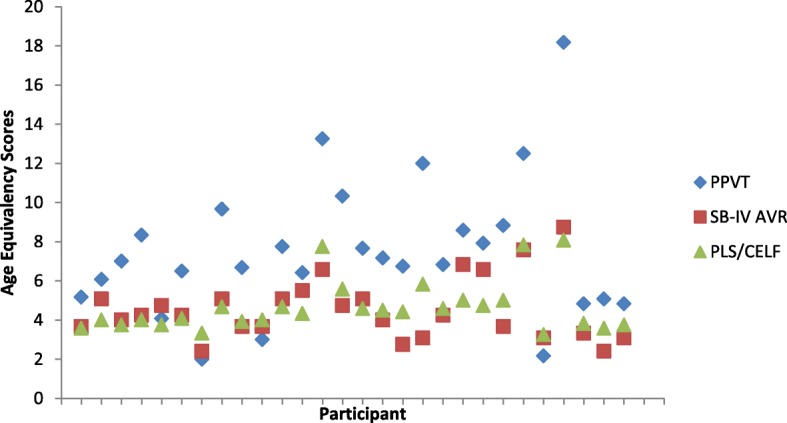
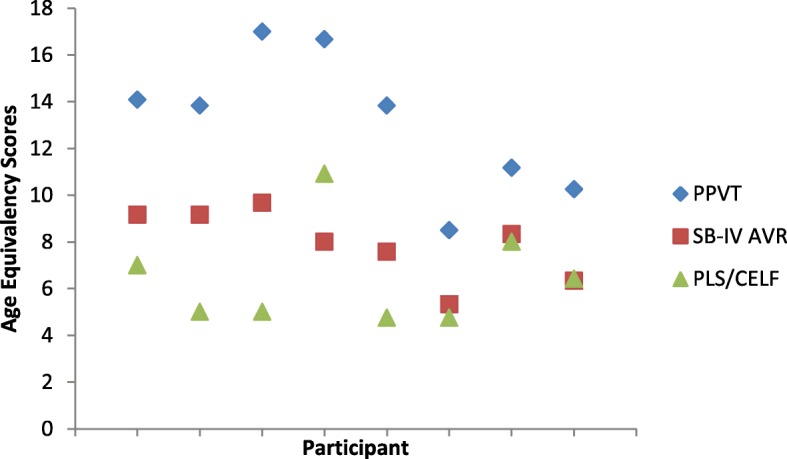
Results: Results showed (1) significantly higher receptive vocabulary than global language, (2) significantly better receptive vocabulary than non-verbal cognition, (3) equivalent non-verbal cognition and global language, and (4) severity of autism symptomatology was not correlated to receptive vocabulary or global language once non-verbal cognition was removed as factor. The scores from the PPVT-III did not represent the global language skills in our sample of adults with FXS.
Conclusions: Findings from this investigation strongly suggest that the PPVT-III should not be used as a screening tool for language levels or cognitive function in clinical studies since the scores from the PPVT-III were not representative of global language or non-verbal cognitive skills in adults with intellectual disabilities. This finding is critical in order to understand how to evaluate, as well as to treat, language in individuals with FXS. Development of efficient and appropriate tools to measure language, cognition, and behavior in individuals with FXS is essential.
Keywords: Adults; Cognition; Comprehension; Fragile X syndrome; Language; Vocabulary.
Conflict of interest statement
EBK has subsequently received funding from Seaside Therapeutics, Novartis, Roche, Alcobra, Neuren, Cydan, Fulcrum, Marinus, Ovid, Zynerba, GW, and Neurotrope Pharmaceuticals to consult on trial design or development strategies and/or conduct clinical trials in FXS, Rett syndrome, or Down syndrome, from Vtesse to conduct clinical trials in NP-C, and from Asuragen Inc. to develop testing standards for FMR1 testing. The other authors declare that they have no competing interests.
Figures
References
-
- Hagerman RJ, Berry-Kravis E, Ono MY, Tartaglia N, Lachiewicz A, Kronk B, Delahunty C, Kauffman W, Hessl DR, Visootsak J, Picker J, Gane L, Tranfaglia M, Hatton D, Rivera S, Farzin F, Lemons-Chitwood K, Greiss-Hess L, Ferguson H. Advances in the treatment of fragile X syndrome. J Pediatr. 2009;123:378–390. doi: 10.1542/peds.2008-0317. - DOI - PMC - PubMed
-
- Van der Molen MJW, Van der Molen MW, Ridderinkhof KR, Hamel BCJ, Curfs LMG, Ramakers GJA. Auditory and visual cortical activity during selective attention in fragile X syndrome: a cascade of processing deficiencies. Clin Neurophysiol. 2012;123(4):720–729. doi: 10.1016/j.clinph.2011.08.023. - DOI - PubMed
Publication types
MeSH terms
LinkOut - more resources
Full Text Sources
Medical
