Review
. 2019 Oct 16;39(42):8239-8249.
doi: 10.1523/JNEUROSCI.1164-19.2019.

Redefining Noradrenergic Neuromodulation of Behavior: Impacts of a Modular Locus Coeruleus Architecture

Affiliations
Review

Redefining Noradrenergic Neuromodulation of Behavior: Impacts of a Modular Locus Coeruleus Architecture

Dan J Chandler et al. J Neurosci. .

Abstract

The locus coeruleus (LC) is a seemingly singular and compact neuromodulatory nucleus that is a prominent component of disparate theories of brain function due to its broad noradrenergic projections throughout the CNS. As a diffuse neuromodulatory system, noradrenaline affects learning and decision making, control of sleep and wakefulness, sensory salience including pain, and the physiology of correlated forebrain activity (ensembles and networks) and brain hemodynamic responses. However, our understanding of the LC is undergoing a dramatic shift due to the application of state-of-the-art methods that reveal a nucleus of many modules that provide targeted neuromodulation. Here, we review the evidence supporting a modular LC based on multiple levels of observation (developmental, genetic, molecular, anatomical, and neurophysiological). We suggest that the concept of the LC as a singular nucleus and, alongside it, the role of the LC in diverse theories of brain function must be reconsidered.

Keywords: anxiety; development; executive function; locus coeruleus; pain; stress.


Figures

Figure 1.
Figure 1.
Drawings of the pons by Vicq-d'Azur (1786); Reil (1809), and Wenzel and Wenzel (1812) and identification of a darkly pigmented area, which was named the Loci caerulei. A, Vicq-d'Azur produced detailed drawings of the gross anatomy of the human brain, noting a pigmented area, the locus niger crurum cerebri, which is consistent with the substantia nigra. B, Reil (1809) reported a “schwarze substanz” (black substance) in two areas consistent with the substantia nigra and the locus coeruleus. C, The Wenzel brothers also reported a pigmented structure on the roof of the pons under the fourth ventricle, naming it the Loci caerulei from which the locus coeruleus takes its name. The label “ff” refers to the Loci caerulei in the drawings (found in Table X in the book). We have highlighted this area with red ovals. The structure name is on page 341 and is presented as Figure 4 (“Figura quarta,” p 340) in Table 10 (“Tabula decima,” p 339). Figure provided by N.K.T. and Stefan Hirschberg.
Figure 2.
Figure 2.
Reconstruction of LC projections suggests a modular architecture. A, Expression of fluorophore in the right LC. A Cre-dependent recombinant adeno-associated virus (AAV) expressing the fluorophore was injected into the mouse LC as an anterograde tracer. The mice were from a Cre-driver line in which Cre recombinase is under control of the promotor for tyrosine hydroxylase (TH), an enzyme expressed by LC neurons as it is required for norepinephrine synthesis (Allen Brain Atlas Connectivity Project Experiment 511971714, TH-Cre_Fl172 mouse). B, After 2-photon serial tomography, the LC axonal projections were reconstructed in 3D. C, The distribution of the LC axons is seen to form an extensive network throughout the brain predominantly ipsilateral to the injection (contralateral hemisphere removed). D, Assignation of projection axons by target region reveals an architecture of distinct fiber trajectories consistent with the proposed modular organization. Figure provided by A.E.P.
Figure 3.
Figure 3.
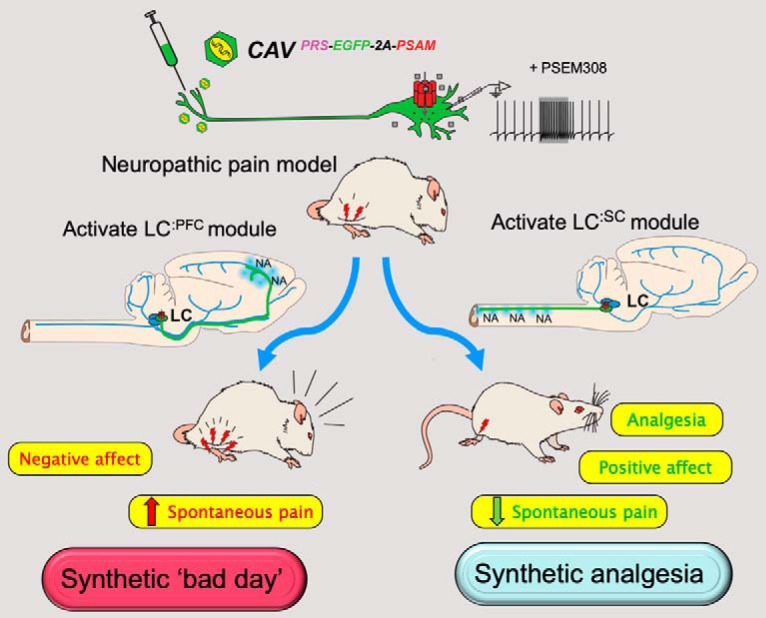
Selective chemogenetic activation of different LC modules bidirectionally modifies the behavioral phenotype in a model of neuropathic pain. A retrograde targeting strategy with a CAV containing the PRS promoter was used by Hirschberg et al. (2017) to selectively express the excitatory chemogenetic actuator (PSAM, modified nicotinic ionophore) in LC modules. This enabled the selective activation (using the agonist PSEM308) of either spinal or PFC-projecting LC neurons during behavioral testing in the tibial nerve transection model of neuropathic pain. Activation of the spinally projecting LC module increased withdrawal thresholds, produced a positive affective bias, and reduced spontaneous pain behavior, consistent with a synthetic analgesic state. In contrast, activation of the PFC projection produced aversion and increased spontaneous pain behavior, which reflects a worsening of the pain phenotype and might be analogous to having a “bad pain day.” This analgesic targeting of the spinal LC modules was equally effective preemptively (before nerve injury) and after the nerve injured and the pain phenotype had manifested. Figure provided by A.E.P.
Figure 4.
Figure 4.
LC projections to PFC and CeA operate in parallel to guide behavior. A, Following normal conditions that do not elicit anxiety-like behavior in male rats, LC cells innervating PFC and CeA show similar levels of spontaneous discharge as assessed by ex vivo whole-cell patch-clamp electrophysiology. The level of spontaneous spiking is illustrated by spiking superimposed on the projection fibers. B, One week after a single stressful episode (simultaneous physical restraint and exposure to the predator odor 2,5-dihydro-2,4,5-trimethylthiazoline), rats show increased anxiety-like behavior in the open field. Whole-cell patch-clamp recordings show that LC cells innervating CeA become hyperactive and hyperexcitable, whereas those projecting to PFC show a suppression of activity and excitability 1 week after stressor exposure. C, Injection of CAV-PRS-Cre into either region, followed by an injection of Cre-inducible AAVs to drive expression of designer receptors exclusively activated by designer drugs, (DREADDs) (Roth, 2016) permits manipulation of discrete LC efferent pathways. Inhibition of the LC-CeA pathway during stressor exposure prevents the development of an anxiety-like behavioral phenotype. D, Conversely, activation of the LC-PFC pathway in the absence of a stressor promotes exploration and loss of avoidance of open arms in the elevated plus maze. Figure provided by D.J.C.

References

    1. Adèr PJ, Room P, Postema F, Korf J (1980) Bilaterally diverging axon collaterals and contralateral projections from rat locus coeruleus neurons, demonstrated by fluorescent retrograde double labeling and norepinephrine metabolism. J Neural Transm 49:207–218. 10.1007/BF01252126 - DOI - PubMed
    1. Aghajanian GK, Kogan JH, Moghaddam B (1994) Opiate withdrawal increases glutamate and aspartate efflux in the locus coeruleus: an in vivo microdialysis study. Brain Res 636:126–130. 10.1016/0006-8993(94)90186-4 - DOI - PubMed
    1. Agster KL, Mejias-Aponte CA, Clark BD, Waterhouse BD (2013) Evidence for a regional specificity in the density and distribution of noradrenergic varicosities in rat cortex. J Comp Neurol 521:2195–2207. 10.1002/cne.23270 - DOI - PMC - PubMed
    1. Anlezark GM, Crow TJ, Greenway AP (1973) Impaired learning and decreased cortical norepinephrine after bilateral locus coeruleus lesions. Science 181:682–684. 10.1126/science.181.4100.682 - DOI - PubMed
    1. Arnsten AF, Goldman-Rakic PS (1984) Selective prefrontal cortical projections to the region of the locus coeruleus and raphe nuclei in the rhesus monkey. Brain Res 306:9–18. 10.1016/0006-8993(84)90351-2 - DOI - PubMed

Publication types