


Cannabis and the Developing Brain: Insights into Its Long-Lasting Effects
- PMID: 31619494
- PMCID: PMC6794936
- DOI: 10.1523/JNEUROSCI.1165-19.2019
Cannabis and the Developing Brain: Insights into Its Long-Lasting Effects
Erratum in
-
Erratum: Hurd et al., "Cannabis and the Developing Brain: Insights into Its Long-Lasting Effects".J Neurosci. 2020 Jan 8;40(2):493. doi: 10.1523/JNEUROSCI.2716-19.2019. J Neurosci. 2020. PMID: 31915198 Free PMC article. No abstract available.
Abstract
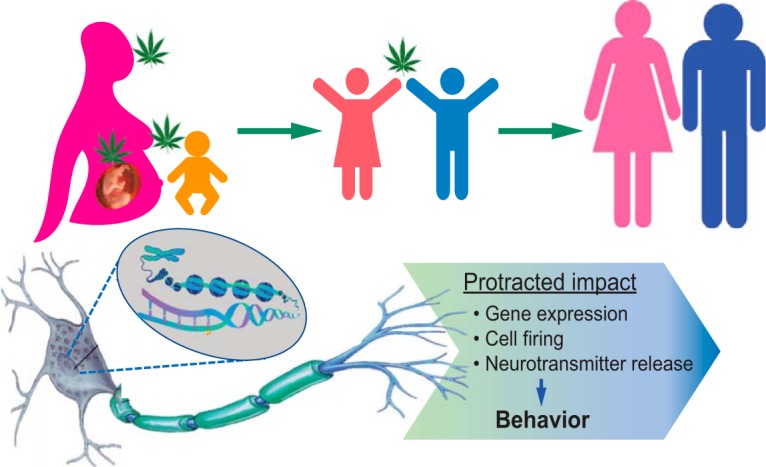
The recent shift in sociopolitical debates and growing liberalization of cannabis use across the globe has raised concern regarding its impact on vulnerable populations, such as pregnant women and adolescents. Epidemiological studies have long demonstrated a relationship between developmental cannabis exposure and later mental health symptoms. This relationship is especially strong in people with particular genetic polymorphisms, suggesting that cannabis use interacts with genotype to increase mental health risk. Seminal animal research directly linked prenatal and adolescent exposure to delta-9-tetrahydrocannabinol, the major psychoactive component of cannabis, with protracted effects on adult neural systems relevant to psychiatric and substance use disorders. In this article, we discuss some recent advances in understanding the long-term molecular, epigenetic, electrophysiological, and behavioral consequences of prenatal, perinatal, and adolescent exposure to cannabis/delta-9-tetrahydrocannabinol. Insights are provided from both animal and human studies, including in vivo neuroimaging strategies.
Keywords: adolescence; cannabis; cognition; perinatal; psychiatric disorders; reward.
Copyright © 2019 the authors.
Figures
References
-
- Antonelli T, Tanganelli S, Tomasini MC, Finetti S, Trabace L, Steardo L, Sabino V, Carratu MR, Cuomo V, Ferraro L (2004) Long-term effects on cortical glutamate release induced by prenatal exposure to the cannabinoid receptor agonist (R)-(+)-[2,3-dihydro-5-methyl-3-(4-morpholinyl-methyl)pyrrolo[1,2,3-de]-1,4-benzo xazin-6-yl]-1-naphthalenylmethanone: an in vivo microdialysis study in the awake rat. Neuroscience 124:367–375. 10.1016/j.neuroscience.2003.10.034 - DOI - PubMed
-
- Antonelli T, Tomasini MC, Tattoli M, Cassano T, Tanganelli S, Finetti S, Mazzoni E, Trabace L, Steardo L, Cuomo V, Ferraro L (2005) Prenatal exposure to the CB1 receptor agonist WIN 55,212–2 causes learning disruption associated with impaired cortical NMDA receptor function and emotional reactivity changes in rat offspring. Cereb Cortex 15:2013–2020. 10.1093/cercor/bhi076 - DOI - PubMed
Publication types
MeSH terms
Grants and funding
LinkOut - more resources
Full Text Sources
Other Literature Sources
Medical
