. 2019 Oct 16;9(1):14831.
doi: 10.1038/s41598-019-51358-8.

Anatomical Pathology of Subtle Lisfranc Injury

Affiliations

Anatomical Pathology of Subtle Lisfranc Injury

Naoki Haraguchi et al. Sci Rep. .

Abstract

The extent and patterns of Lisfranc joint complex disruption in subtle Lisfranc injuries have not been well clarified. We reviewed the direct intraoperative findings for 87 patients, examined computed tomography images that had been obtained preoperatively for 73 of the patients, and classified the injuries according to the Kaar et al. criteria as the transverse type (instability between the first cuneiform [C1] and the second metatarsal [M2] and between the second cuneiform [C2] and M2) or longitudinal type (instability between C1 and M2 and between C1 and C2). Our patients' injuries were classified as follows: longitudinal type (38%), transverse type (30%), transverse type and first tarsometatarsal (TMT) joint injury (20%), longitudinal type plus transverse type (7%), longitudinal type and first TMT joint injury (3%), and longitudinal type, transverse type, and first TMT joint injury (2%). In 11 patients, the longitudinal injury extended into the naviculo-first cuneiform joint. In 41 (56%) of the 73 patients for whom CT images were obtained, 1 or more fractures (not counting small avulsion fragments between C1 and M2) were found. Orthopedic surgeons should be aware of the various injury patterns possible in cases of subtle Lisfranc injury.


Conflict of interest statement

The authors declare no competing interests.

Figures
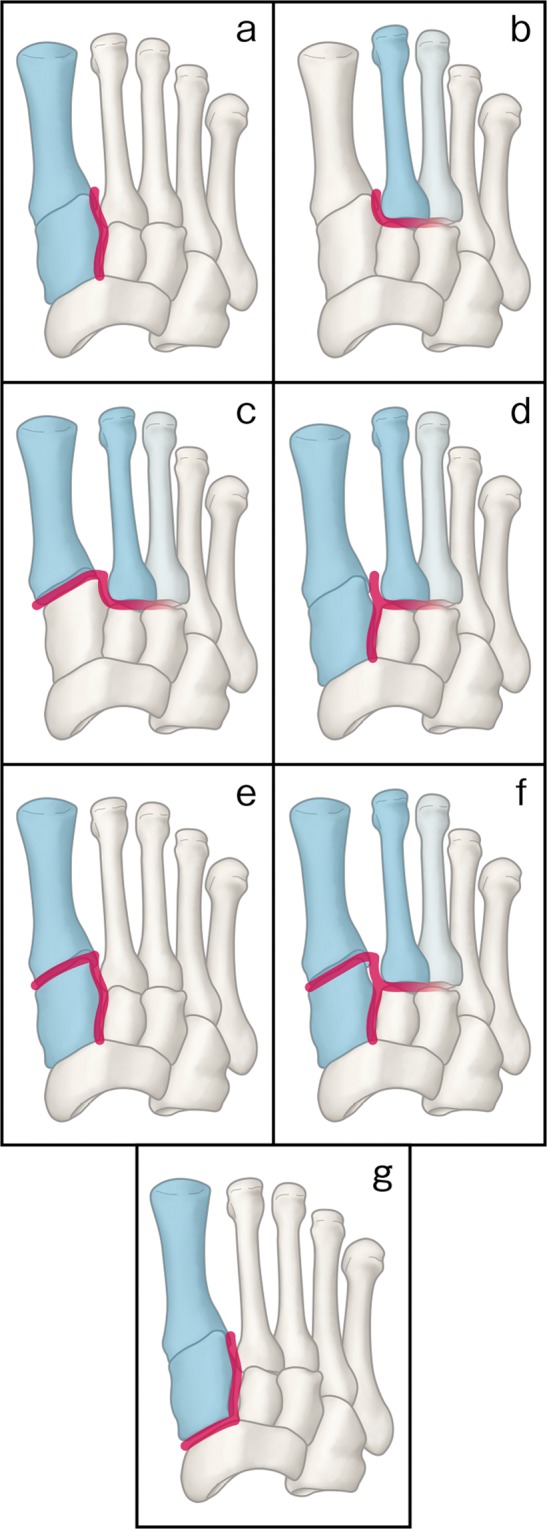
Figure 1
Figure 1
Various patterns of subtle Lisfranc injury. The injured joints are indicated in red. (a) Longitudinal type injury. (b) Transverse type injury. In some patients with this type of injury, the joint between the third cuneiform and third metatarsal may be involved. (c) Transverse type injury combined with first tarsometatarsal joint injury. (d) Longitudinal type injury plus transverse type injury. (e) Longitudinal type injury plus first tarsometatarsal joint injury. (f) Longitudinal type injury, transverse type injury, and first tarsometatarsal joint injury. (g) Longitudinal injury extending into the naviculo-first cuneiform joint.
Figure 2
Figure 2
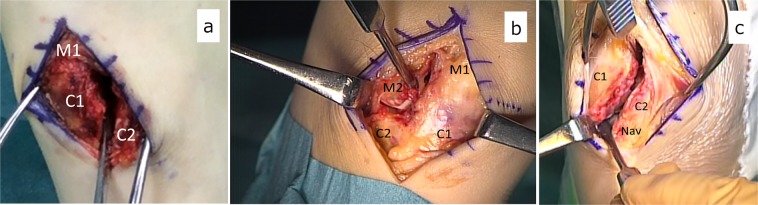
Intraoperative photographs depicting Lisfranc joint instability. The instability is confirmed with the use of a small elevator. (a) Longitudinal instability. (b) Transverse instability. (c) Longitudinal type injury extending into the naviculo-first cuneiform joint. C1: first cuneiform. C2: second cuneiform. M1: first metatarsal. M2: second metatarsal. Nav: navicular.
Figure 3
Figure 3
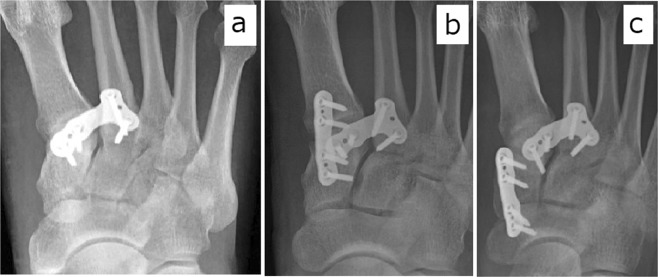
Postoperative radiographs of longitudinal type injury (a), transverse type injury combined with first tarsometatarsal joint injury (b), and Longitudinal injury extending into the naviculo-first cuneiform joint (c).

References

    1. Chilvers M, Donahue M, Nassar L, Manoli A., 2nd Foot and ankle injuries in elite female gymnasts. Foot Ankle Int. 2007;28:214–18. doi: 10.3113/FAI.2007.0214. - DOI - PubMed
    1. Curtis MJ, Myerson M, Szura B. Tarsometarsal joint injuries in the athlete. Am J Sports Med. 1993;21:497–502. doi: 10.1177/036354659302100403. - DOI - PubMed
    1. Komenda GA, Myerson MS, Biddinger KR. Results of arthrodesis of the tarsometatarsal joints after traumatic injury. J Bone Joint Surg Am. 1996;78:1665–76. doi: 10.2106/00004623-199611000-00005. - DOI - PubMed
    1. Ahmed S, Bolt B, McBryde A. Comparison of standard screw fixation versus suture button fixation in Lisfranc ligament injuries. Foot Ankle Int. 2010;31:892–6. doi: 10.3113/FAI.2010.0892. - DOI - PubMed
    1. Alberta FG, et al. Ligamentous Lisfranc joint injuries: a biomechanical comparison of dorsal plate and transarticular screw fixation. Foot Ankle Int. 2005;26:462–73. doi: 10.1177/107110070502600607. - DOI - PubMed