Review
. 2019 Sep 18:10:1091.
doi: 10.3389/fpls.2019.01091. eCollection 2019.

Get the Balance Right: ROS Homeostasis and Redox Signalling in Fruit

Affiliations
Review

Get the Balance Right: ROS Homeostasis and Redox Signalling in Fruit

Guillaume Decros et al. Front Plant Sci. .

Abstract

Plant central metabolism generates reactive oxygen species (ROS), which are key regulators that mediate signalling pathways involved in developmental processes and plant responses to environmental fluctuations. These highly reactive metabolites can lead to cellular damage when the reduction-oxidation (redox) homeostasis becomes unbalanced. Whilst decades of research have studied redox homeostasis in leaves, fundamental knowledge in fruit biology is still fragmentary. This is even more surprising when considering the natural profusion of fruit antioxidants that can process ROS and benefit human health. In this review, we explore redox biology in fruit and provide an overview of fruit antioxidants with recent examples. We further examine the central role of the redox hub in signalling during development and stress, with particular emphasis on ascorbate, also referred to as vitamin C. Progress in understanding the molecular mechanisms involved in the redox regulations that are linked to central metabolism and stress pathways will help to define novel strategies for optimising fruit nutritional quality, fruit production and storage.

Keywords: NAD; ROS; ascorbate; fruit; glutathione; metabolism; redox; tomato.


Figures

Figure 1
Figure 1
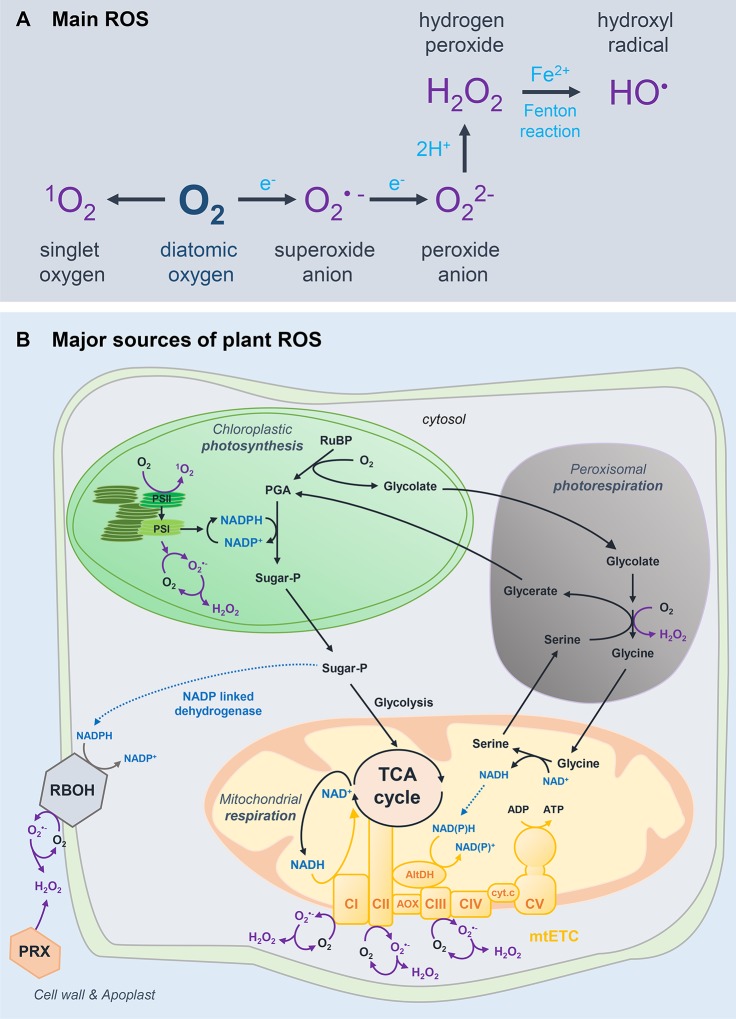
Basics of ROS biology in plants. (A) Main reactive oxygen species (ROS) formed from atmospheric oxygen (O2). (B) Major sources of ROS in plant cells. Excited triplet chlorophylls (Chl) can exacerbate the formation of singlet oxygen, mostly by the photosystem (PS) II reaction centre by photodynamic activation of ground-state oxygen (Fischer et al., 2013). In addition to singlet oxygen, superoxide and hydrogen peroxide can be formed in the chloroplast through the reduction of molecular oxygen, especially by the PSI. The four main complexes (CI–CIV) of the mitochondrial electron transport chain (mtETC) and the ATP synthase (CV) are represented in yellow. Among these complexes, CI (EC 1.6.5.3, NADH: ubiquinone oxidoreductase), CII (EC 1.3.5.1, succinate dehydrogenase) and CIII (EC 1.10.2.2, ubiquinol: cytochrome C oxidoreductase) are ROS-generating systems (Quinlan et al., 2012). mtETC, mitochondrial electron transfer chain; PRX, peroxidase; TCA, tricarboxylic acid; CI-V, complex I-V; AOX, alternative oxidase; AltDH, alternative dehydrogenase; cyt. c, cytochrome c; RuBP, ribulose 1,5-bisphosphate; PGA, phosphoglycerate; Sugar-P, sugar-phosphate; PS, photosystem.
Figure 2
Figure 2
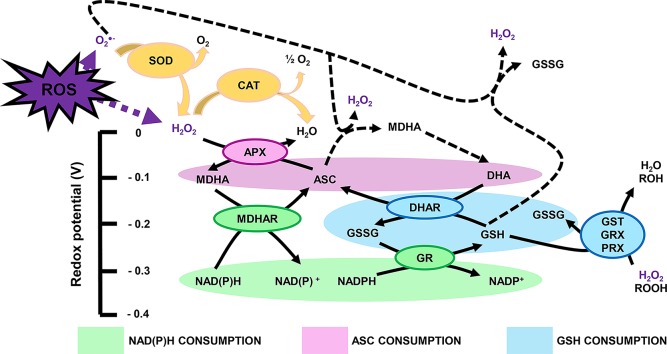
Major cellular redox buffers: a ménage-à-trois to process ROS. Plain and dashed arrows represent enzymatic and nonenzymatic reactions, respectively. ASC, reduced ascorbate; APX, ascorbate peroxidase; CAT, catalase; DHA, dehydroascorbate; DHAR, dehydroascorbate reductase; GSH, reduced glutathione; GSSG, glutathione disulphide; GR, glutathione reductase; GRX, glutaredoxin; GST, glutathione S-transferase; MDHA, monodehydroascorbate; MDHAR, monodehydroascorbate reductase; PRX, GRX-dependent peroxiredoxin; ROH, organic compound with alcohol group; ROOH, organic compound with peroxide group; SOD, superoxide dismutase.
Figure 3
Figure 3
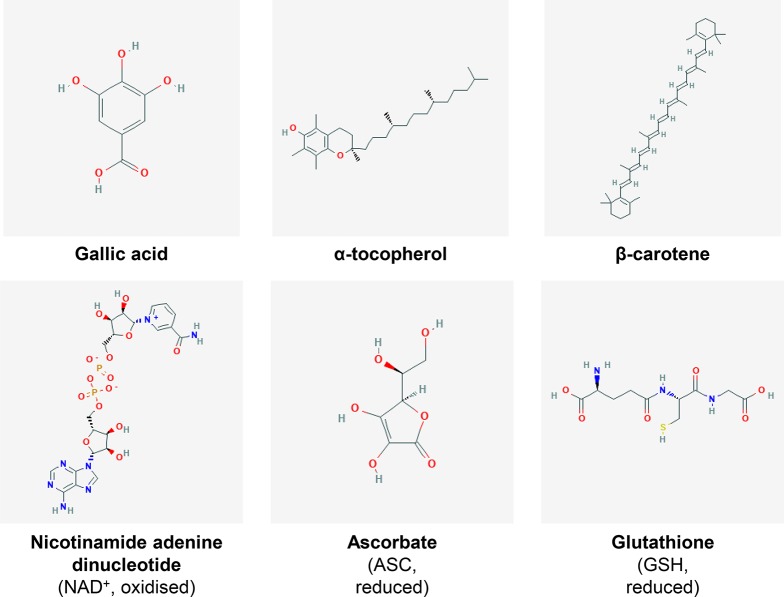
Examples of fruit antioxidants. Chemical structures of several metabolites presenting antioxidant properties. The major redox buffers NAD+, ASC and GSH are also presented. For further detail, refer to Table 1. Individual structures were obtained from PubChem (pubchem.ncbi.nlm.nih.gov/).
Figure 4
Figure 4
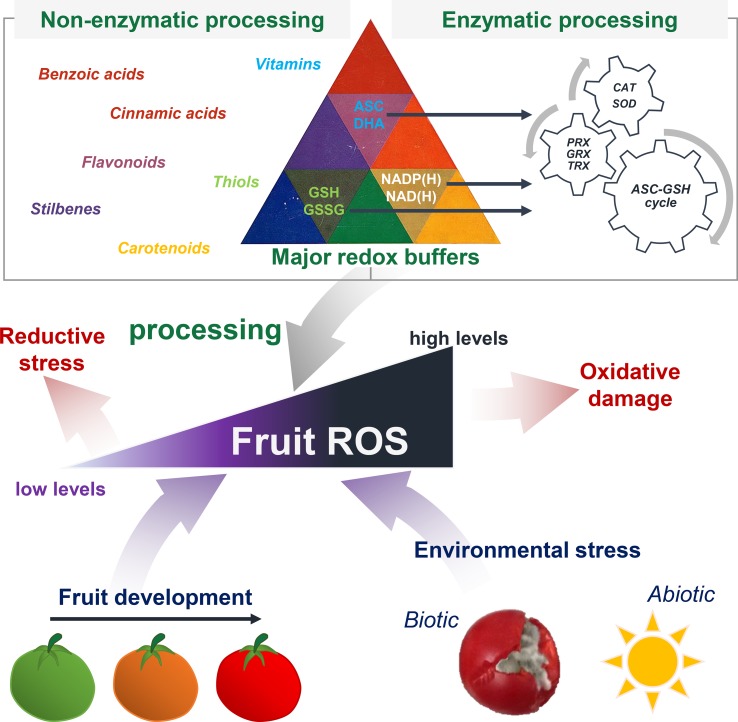
Pivotal role of redox signalling for fruit growth and stress responses. Fruits produce ROS and other redox signals during development and in response to environmental stress. Reactive oxygen species homeostasis is finely tuned between ROS production and processing. This involves several enzymatic and non-enzymatic mechanisms, including antioxidant metabolites and major redox buffers (NAD/P(H), ASC and GSH) that allow antioxidant cycles to process excess of ROS. When ROS levels are too high, the resulting oxidative stress would damage cellular structures.

References

    1. Alferez F. M., Gerberich K. M., Li J.-L., Zhang Y., Graham J. H., Mou Z. (2018). Exogenous nicotinamide adenine dinucleotide induces resistance to citrus canker in citrus. Front. Plant Sci. 9, 1472. 10.3389/fpls.2018.01472 - DOI - PMC - PubMed
    1. Alhagdow M., Mounet F., Gilbert L., Nunes-Nesi A., Garcia V., Just D., et al. (2007). Silencing of the mitochondrial ascorbate synthesizing enzyme l-galactono-1,4-lactone dehydrogenase affects plant and fruit development in tomato. Plant Physiol. 145, 1408–1422. 10.1104/pp.107.106500 - DOI - PMC - PubMed
    1. Alhassan N., Golding J. B., Wills R. B. H., Bowyer M. C., Pristijono P. (2019). Long term exposure to low ethylene and storage temperatures delays calyx senescence and maintains ‘Afourer’ mandarins and navel oranges quality. Foods 8, 19. 10.3390/foods8010019 - DOI - PMC - PubMed
    1. Apel K., Hirt H. (2004). Reactive oxygen species: metabolism, oxidative stress, and signal transduction. Ann. Rev. Plant Biol. 55, 373–399. 10.1146/annurev.arplant.55.031903.141701 - DOI - PubMed
    1. Araújo W. L., Tohge T., Osorio S., Lohse M., Balbo I., Krahnert I., et al. (2012). Antisense inhibition of the 2-oxoglutarate dehydrogenase complex in tomato demonstrates its importance for plant respiration and during leaf senescence and fruit maturation. Plant Cell 24, 2328–2351. 10.1105/tpc.112.099002 - DOI - PMC - PubMed

LinkOut - more resources