Review
. 2019 Oct 16;11(10):1572.
doi: 10.3390/cancers11101572.

Proteomic Biomarkers for the Detection of Endometrial Cancer

Affiliations
Review

Proteomic Biomarkers for the Detection of Endometrial Cancer

Kelechi Njoku et al. Cancers (Basel). .

Abstract

Endometrial cancer is the leading gynaecological malignancy in the western world and its incidence is rising in tandem with the global epidemic of obesity. Early diagnosis is key to improving survival, which at 5 years is less than 20% in advanced disease and over 90% in early-stage disease. As yet, there are no validated biological markers for its early detection. Advances in high-throughput technologies and machine learning techniques now offer unique and promising perspectives for biomarker discovery, especially through the integration of genomic, transcriptomic, proteomic, metabolomic and imaging data. Because the proteome closely mirrors the dynamic state of cells, tissues and organisms, proteomics has great potential to deliver clinically relevant biomarkers for cancer diagnosis. In this review, we present the current progress in endometrial cancer diagnostic biomarker discovery using proteomics. We describe the various mass spectrometry-based approaches and highlight the challenges inherent in biomarker discovery studies. We suggest novel strategies for endometrial cancer detection exploiting biologically important protein biomarkers and set the scene for future directions in endometrial cancer biomarker research.

Keywords: diagnostic biomarkers; endometrial cancer; mass spectrometry; proteomics.


Conflict of interest statement

The authors declare no conflict of interest.

Figures
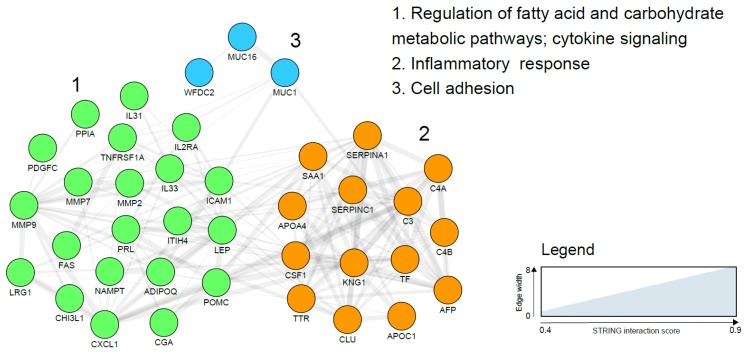
Figure 1
Figure 1
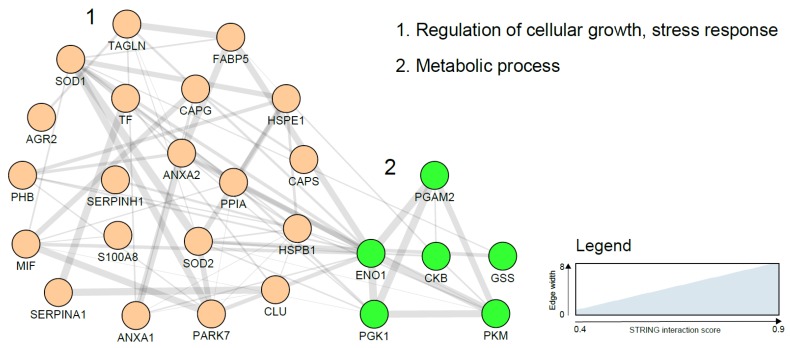
Endometrial cancer blood based biomarker correlation network based on the search tool for the retrieval of interacting genes/proteins (STRING) network analysis using gene names and visualised with the Cytoscape software (https://cytoscape.org/). Line thickness indicates strength of the interactions. Protein biomarkers were clustered using the markov cluster (MCL) algorithm and subjected to functional enrichment. On the right, the biological processes describing the functions of the candidates are indicated. No significant interactions were reported for Dickkopf-related protein 3 precursor (DKK3), Sperm associated antigen-9 (SPAG 9), Alpha-1-beta glycoprotein (AIBG) and Growth differentiation factor 15 (GDF-15) and, therefore, are not included in the final network.
Figure 2
Figure 2
Endometrial cancer tissue based biomarker correlation network based on a STRING network analysis using gene names and visualised with the Cytoscape software (https://cytoscape.org/). Line thickness indicates strength of the interactions. Protein biomarkers were clustered using the MCL algorithm and subjected to functional enrichment. On the right, the biological processes describing the functions of the candidates are indicated. Costars family protein (ABRACL), Desmin (DES), Fibrinogen beta chain (FBG) and polymeric immunoglobulin receptor precursor (PIGR) did not show any previously reported interaction and are not included in the figure above.

References

    1. Bray F., Ferlay J., Soerjomataram I., Siegel R.L., Torre L.A., Jemal A. Global cancer statistics 2018: GLOBOCAN estimates of incidence and mortality worldwide for 36 cancers in 185 countries. CA Cancer J. Clin. 2018;68:394–424. doi: 10.3322/caac.21492. - DOI - PubMed
    1. Lortet-Tieulent J., Ferlay J., Bray F., Jemal A. International patterns and trends in endometrial cancer incidence, 1978-2013. J. Natl. Cancer Inst. 2018;110:354–361. doi: 10.1093/jnci/djx214. - DOI - PubMed
    1. Cancer Research UK Uterine Cancer Statistics. [(accessed on 9 February 2019)]; Available online: http://www.cancerresearchuk.org.
    1. Sundar S., Balega J., Crosbie E., Drake A., Edmondson R., Fotopoulou C., Gallos I., Ganesan R., Gupta J., Johnson N. BGCS uterine cancer guidelines: Recommendations for practice. Eur. J. Obstet. Gynecol. Reprod. Biol. 2017;213:71–97. doi: 10.1016/j.ejogrb.2017.04.015. - DOI - PubMed
    1. Weiderpass E., Antoine J., Bray F.I., Oh J.-K., Arbyn M. Trends in corpus uteri cancer mortality in member states of the European Union. Eur. J. Cancer. 2014;50:1675–1684. doi: 10.1016/j.ejca.2014.02.020. - DOI - PubMed